Story Category: Growing Up In a Stately Home (257 posts)
Hallowe'en Hauntings #100
Viv Wilson | 29th October 2025 |
Life at The Hall
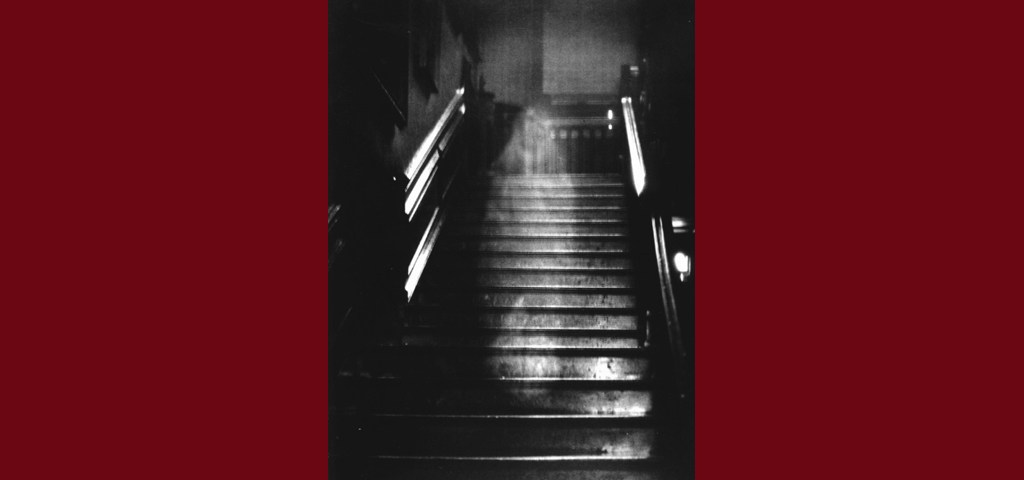
Going to sleep in a big old house is quite scary when you’re young but going to sleep in a big old house that’s haunted is even more scary!! As we approach Hallowe'en my mind has gone back to that first winter at Hoar Cross Hall and all the scary things that happened - and that was without any trick or treaters in those days! We quickly realised that we weren’t the only inhabitants of the house when we moved there in the 1970s. Every time there was a windy night I could hear a window banging in the attic – all night long it kept me awake. The next day I would go upstairs to the attics to close it but there would be no windows open or even loose. They were all tightly shut as they had been for the previous 20 years, when the house had stood empty. I remember standing there in the attic rooms feeling a tingling down my spine and goose bumps all over as I felt the atmosphere closing in on me - and I quickly legged it back downstairs!
On other nights we would hear people walking along the attic corridor (the attic, by the way, was the floor right above our bedroom floor) and then at other times we could hear heavy furniture being dragged about – yet there was nothing up there as the rooms were all empty! How strange! Other members of the family heard it too and also people that stayed overnight, so it wasn’t the imaginings of a frightened child. There was also nobody else in the house at that point, apart from our family and they definitely weren’t walking about the house at 3am. And why is it that these things always happen in the middle of the night? When it’s dark. When we feel most scared? I often woke up at 3am whether there were noises or not – or perhaps there had been a noise and that’s what had woken me up – who knows? I also loved reading books about old houses, mysteries and ghosts but when you actually live in one in real life, it’s a bit different!
The spooky attic
The first few years at Hoar Cross Hall w...
Hoar Cross Hall meets Downton Abbey #99
Viv Wilson | 24th September 2025 |
Life at The Hall
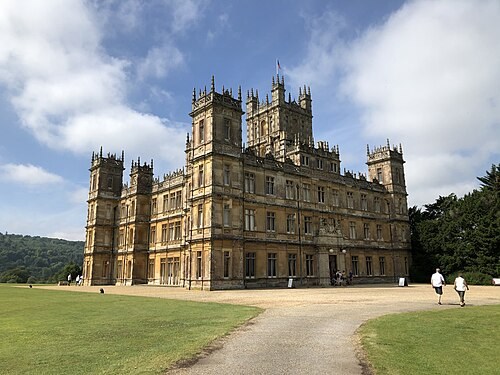
With the new Downton Abbey film out this month I thought I would do a comparison of the two family homes, Downton and Hoar Cross Hall, the latter being my old family home for those of you who are new to these blogs. Although Downton Abbey is fictional, the house on which it is based is not, it being Highclere Castle in Hampshire which was built in 1679 and is owned by the Earl of Carnarvon. Hoar Cross Hall was the original home of the Meynell Ingram family who first came from Leicestershire and was built in 1863. Hugo Meynell of Quorndon was the High Sheriff of Staffordshire and Member of Parliament for Lichfield and the family owned considerable property in Staffordshire, Shropshire and Derbyshire. He bought the Hoar Cross estate in 1793 and built a hunting lodge there known as Old Hall and founded the Meynell Hunt. It seemed the family lived here for many years until Hugo’s grandson, also Hugo, got married in 1863 and decided to build the present Hall for him and his wife, Emily Charlotte.
The house took nine years to build and was eventually finished in 1871. Hugo and Emily had already moved in, but their new life together was soon to be cut short by a tragic accident. Fourteen months earlier at Birch Wood on their estate Hugo had a horse riding accident and had been bed-ridden ever since – he died in May of that year. They had no children and Emily built The Church of the Holy Angels in the grounds of the hall in memory of her husband. This is the church that I got married in over a hundred years later. On Hugo’s death Emily inherited the family's many large estates and they say she was a double millionairess – which in those days was a huge amount of money!
Emily Charlotte
The original site of Highclere Castle was recorded in the Doomsday Book of 1086 when an Anglo-Saxon king granted the estate to the Bishops of Winchester and in the 14th century a palace was built there by the Bishop. However, it was confiscated during the Reformation by ...
Skools out for Summer #98
Viv Wilson | 19th August 2025 |
Life at The Hall
When Hugo and Emily Meynell built Hoar Cross Hall it included a whole estate with it, namely kitchen gardens, greenhouses, stables, a farm and cottages. This was quite common in those days as the estate supported the house with food etc and also gave employment to local people. Old Hall (their original home) was also on the estate and was accessed via a private road, which ran from the main road. By the time the 1970s came along the stable block and Old Hall were private houses and another part of Old Hall had been made into a children’s home. Emily Meynell had started this home in the Victorian days, calling it ‘The Home of the Good Shepherd’ but it was for boys only at that time. When we were there it was a mixed home and run by a husband and wife couple. They used to have fetes there in the summer and we would sometimes go round to play with the children, as they had lots of climbing frames and slides.
The private road also joined up to our woods near the driveway and this is the road I walked along every day, up to the main road, to catch the bus to school in nearby Uttoxeter. It was about half a mile but I hated walking through the woods, especially in the winter when the mornings were darker. One day, whilst walking round Uttoxeter at lunchtime, I saw a newspaper board telling everyone about a streaker that had run through the town the day before – what was this? A man running naked for the fun of it? On further investigation I found that this was the latest craze from America – but why anyone would want to do it in our cold country was beyond me!
Streaking comes to Britain!
I was not an academic by any means and hated my schooldays. I was constantly being teased for being too thin, too quiet or for living in a stately home. (This was from the teachers too!) so when it was time for 'skools out for summer' I was more than ready to leave!
By now the Mediaeval Banquets, which my parents ran in the house, were proving a huge succe...
Anyone for Tennis? #96
Viv Wilson | 25th June 2025 |
Life at The Hall

With the summer season well and truly upon us and Wimbledon almost here, I thought a blog about tennis might be in order! The game of tennis first started in the Mediaeval days and involved hitting a ball with a bare hand and later with a glove. By the 16th century the glove had become a racquet and the game had moved to an enclosed playing area and the rules had stabilized. This was known as ‘real tennis’. The word tennis came into use in English in the mid-14th century from French, via the Anglo-Norman term Tenez, which can be translated as 'hold', 'receive' or 'take', a call from the server to his opponent indicating that he is about to serve.
It seems that royalty and the upper classes played tennis a lot, with Henry VIII making the biggest impact as a young monarch, playing the game with gusto at Hampton Court! However, the game was actually invented in Birmingham (England) and is the direct descendant of what is now denoted ‘real tennis’ or ‘royal tennis’ and continues to be played today with more complex rules. Many original courts still remain at Oxford, Cambridge, Falkland Palace in Fife, Scotland and Hampton Court Palace. Wimbledon itself is the oldest tennis tournament in the world and arguably the most famous. Since the first tournament 148 years ago in 1877, The Championships have been hosted by the All England Lawn Tennis and Croquet Club in Wimbledon, London and take place over two weeks in late June – early July. Tennis became popular because of the waning interest in croquet and the Club decided to organise a tennis tournament to pay for the repair of its pony roller, used to maintain the lawns. It must have been popular as its still going strong! Although you may enjoy the tennis I think people love the strawberries and cream too that are famously served there! Or you may like a tour around the museum - check it out here
Wimbledon
Many stately homes would have had tennis courts including Hoar Cross Hall. Howev...
Summer Balls and Garden Parties #97
Viv Wilson | 25th June 2025 |
Life at The Hall

Balls and functions held at Hoar Cross Hall were lavish affairs, especially before the First World War, with the catering and other services invariably being provided by premier London companies. In 1907, Gunter & Co of Berkeley Square, London, could supply a Ball supper and refreshments for ten shillings (50p) a head, plus 'extra services'.
For a Ball Supper in January 1913, Mayfair Catering, Grosvenor Square, assured Lady Mary Meynell that they had engaged 'a superior staff of tall waiters' to attend her guests and, “.....if waiters are desired to be in Full Dress (silk stockings) the additional cost will be five shillings (25p) per man.” They also provided services for the Servants Dance Supper for 200 persons including silver plate and dishes, glass, china and linen, and the services of three pantrymen!
Footmen and waiters dressed in their finery!
The liquid refreshment for this January 1913 event was provided by Thomas Mallorie & Co in Leeds. They invoiced 4 dozen bottles of fine claret, 3 bottles of port, one bottle of sherry, 6 bottles of scotch whiskey and 2 bottles of gin. The grand total 'less 10% discount' came to £13.13 shillings (£13.65). Delivery was made to Burton-on-Trent by Midland Railway and no doubt the chauffeur from the Hall would have collected it in the car in time for the supper. No nipping out to Sainsbury's in those days!
Emily Meynell's sister-in-law, Lady Mary wanted to organize an eighteenth birthday and 'coming out' Ball in 1912 for her daughter, Daisy. A Ball at the Ritz in London would have cost at least £600 so Lady Mary (now a widow) decided to hold a little dance for eight or more people at home. This was in a house in Surrey as they had moved out of the Hall by this time and had been living a more simple life. With the help of “a good cook and kind friends” the function cost exactly £50 and was enjoyed by all who attended. It just goes to show that great expense doesn't necessarily mean m...
Victorian Fashions #95
Viv Wilson | 29th May 2025 |
Life at The Hall

The Victorian era was roughly from 1830 – 1900 and saw many changes in fashion styles. This was the era of technological advancement and the mass production of sewing machines in the 1850s and the advent of synthetic dyes introduced major changes in fashion. This, coupled with the printing of fashion magazines, allowed the masses to become more fashion conscious – the middle classes were rising up thanks to the Industrial Revolution!
Clothes were an expression of your place in society, therefore upper-class women, who didn’t need to work, could wear more elaborate dresses over layers of petticoats with tightly laced corsets. Men would wear long frock coats over waistcoats and shirts with scarves tied at the neck. As the century progressed women’s dresses went from full skirts and low necklines to crinolines and bodices which extended to the hips. The Victorians seemed to be obsessed with the ‘hourglass’ figure thus creating the need for a crinoline ‘cage’ under the skirt to make it look fuller and corsets which were laced ever more tightly to train the waist to go in – some ladies’ waists could be as small as 18”! However, they could hardly breathe nor eat large meals, which is probably why they were always fainting!
Emily Meynell c.1870
The crinoline didn’t last long though due to its being cumbersome and dangerous for working women so dresses became flatter at the front and voluminous behind with a train gathered together to form soft folds. Necklines rose higher and had collars for the day dresses – however, they still liked to show off those tiny waistlines!
Many Balls were held at Hoar Cross Hall during this era and ladies would wear the latest fashions as they danced in the Ballroom. When we lived there in the 1970s and 1980s we often had dances and Balls, especially on Midsummer’s Eve and New Year’s Eve. People would hire the Hall for charity events such as the Red Cross Ball or weddings so the Ballroom got ple...
Celebrating VE Day #94
Viv Wilson | 08th May 2025 |
Life at The Hall
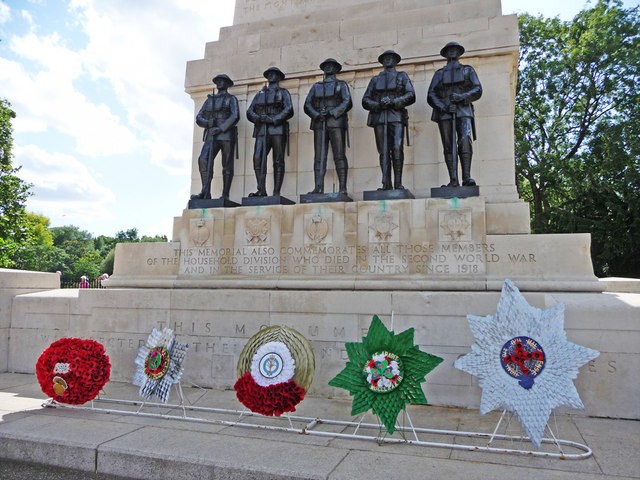
As a way of commemorating V. E. Day I have re-posted my blog from November's Remembrance Day which tells of the sacrifice that the men of the Meynell family made during both world wars as well as the many thousands of others who took part. During the two World Wars the Meynell family of Hoar Cross Hall served their country alongside many others from all walks of life. After each war there was huge social upheaval, especially for women, who had been doing what was traditionally 'men's work' during the war and weren't prepared to go back to domestic roles. At the time of the First World War Frederick Meynell and Lady Mary Meynell were living at the Hall with their five children. Their four sons all served in the war and their daughter Margaret served in the Red Cross as a volunteer.
Their eldest son Francis was a Major but was wounded in action in 1917 with severe wounds to his back. He was moved from the Duchess of Westminster Hospital to the Meynell Hospital in Lennox Gardens, London, the home of his mother, Lady Mary. She had offered her house to the War Office and the Red Cross, and it had become a Military Hospital for officers.
When the Second World War started in 1939 the next generation of Meynells stepped up to help out. Francis had married Lady Dorothy and their eldest son Hugo also served as an officer and was awardedthe Military Cross, although he was seriously injured at Al Alamein leading to his early death in 1960. Their daughter, also Dorothy, moved back to Hoar Cross at the outbreak of war and joined the Joint War Organisation of the Red Cross and St John, which meant travelling overseas to Africa, Sicily and Italy.
One of the Meynells' photos of military men
My own father, William Bickerton-Jones, served in the Royal Army Service Corps (RASC) as a despatch rider because he owned a motor bike and had been racing it at Donington Park during the 1930s. He served in North Africa and Al Alamein as did Hugo Meynell. Who knows - they cou...
Victorian Society #93
Viv Wilson | 24th April 2025 |
Life at The Hall

Victorian society was built around Queen Victoria’s reign, loosely between 1820-1914. It was characterised by a class-based society and Britain being the most powerful empire in the world.
Hoar Cross Hall was built in 1870, at the height of the Victorian era, and boasted up to seventy rooms, twenty-five of them for the servants, approximately fifteen for the kitchens and utility areas, leaving around thirty rooms for the family and their guests. During this time a lot of people, particularly women, went into domestic service and the Housekeeper at the Hall earned about £50 a year, while a housemaid earned £15 a year – quite the difference! By all accounts the Hoar Cross servants were treated well and many stayed for years but their days were long, often starting at 5am to clean and light the fires and finishing late in the evening – at least they had bed and board thrown in, unlike lots of people who lived in poverty in the inner cities.
Hoar Cross Hall servants c.1910
Class was a big issue and encompassed income, occupation, education, family structure and leisure. Men were primarily in charge and independent. They took part in politics and paid work while the dependent women stayed at home and ran the household and looked after the children. The Victorians were also very moral people generally, particularly in the upper classes, although there were a lot of ‘double standards’. There was a prudish refusal to admit the existence of sex, for instance, even though educated men constantly discussed it or wrote books about it, and even had affairs or liaisons with prostitutes. Men seemed to think this was acceptable behaviour yet if a woman had an affair she was ostracised from society!
Back in the Victorian era the Anglican church dominated the religious landscape and many wealthy aristocrats helped to start schools to educate children who otherwise would never have learned to read or write. These schools belonged to the church and we...
Victorian Courtship - gloves #92
Viv Wilson | 26th March 2025 |
Life at The Hall
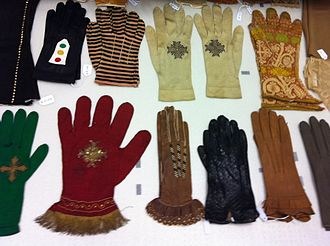
This is the second blog in the series on Victorian courtship and is all about the use of gloves.
During the Victorian era, gloves were deeply connected to the notion of the “perfect hand” which were to be “shapely, finely made, white with blue vein, taper fingers, rosy nails and slightly arched”. They were seen as social markers and accordingly, ladies wore gloves which were too small for them in order to shrink their hands.
Following an old French practice, glove length was traditionally measured in buttons based on the distance between the base of the thumb and the top edge of the glove. Until Queen Victoria’s reign gloves were quite short. Fashion changed however after 1835, and gloves got longer and longer up the arm until the longest ones were well past the elbow and had 16 buttons to fasten them up! No wonder they needed the help of maids to get dressed – it must have taken an eternity to button up gloves, dresses and boots!
A lady in her long white gloves
It was common not to wear gloves within the domestic sphere – for example, when having a meal at home. However, it was considered inappropriate for a woman to go outside without her gloves on, as ungloved hands were sometimes associated with nudity. Gloves, of course, were mainly for the wealthy and were made of kid leather. Wealthy women also wore silk and cotton gloves for informal or country wear.
But how did they use gloves in courtship? In 1890, Henry Wehman presented his interpretation and analysis of the glove language, as presented in his book, “The mystery of love, courtship and marriage explained”. Here are a few samples:-
Holding with tips downward ………………….........I wish to be acquainted
Using them as a fan ………………………… ...............Introduce me to your company
Striking them over the hand ………………............I am displeased
Tossing them up gently …………………...
A New Year Calamity! #90
Viv Wilson | 02nd January 2025 |
Life at The Hall
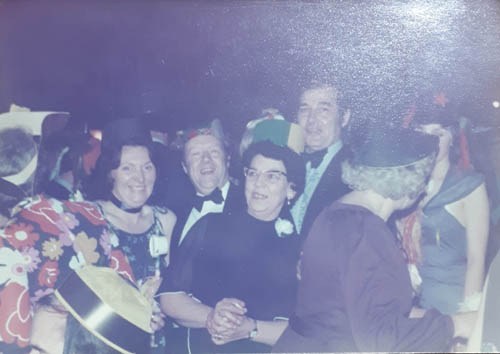
The New Year’s Eve Balls at Hoar Cross Hall were usually the highlight of the year during the 1970s. After twelve months of hard work, especially running the Mediaeval Banquets twice a week through the winter, we were always ready to see out the year in style with a big new year party. In those days it was always black tie for the men and long dresses for the ladies – usually around 500 people bought tickets for an evening of entertainment with a dance band, disco and a meal. At midnight a man dressed in traditional Scottish regalia, including a kilt and sporran, would pipe in the new year with his bagpipes. Down the Long Gallery he would slowly walk and into the Ballroom with his pipes droning on. When midnight arrived a net full of balloons was dropped onto all the guests from the ceiling, out came the party poppers and hats and everyone joined hands to sing ‘Auld Lang Syne’. Once all the traditional stuff was done the band started up again and we all did the Hokey Cokey, the Conga and other silly dances that only happen on New Year’s Eve! It was always great fun and I loved to dress up and be a part of it.
Black tie and party hats!
My parents were having a trial separation around this time so my dad had to run the New Year’s Eve Ball on his own. I helped, as I had before, with the administration; posting out tickets and doing a bit of book-keeping. The week prior to the Ball was spent moving furniture about and cleaning the house up after all the banquet tables and benches were removed. We usually used some of the banquet tables for people to sit at but this particular year my mum had stored them all away in the basement and put a lock on the door – these were her property now! This left my dad in a bit of a quandary about what to do for tables and after a lot of ranting he decided that he would have to hire some. As my dad was well known for being ‘careful’ with his money, he didn’t want to spend too much and hired the ...
A Christmas Celebration #89
Viv Wilson | 20th December 2024 |
Life at The Hall

The final Christmas blog this year is a story of how the servants celebrated Christmas at Hoar Cross Hall, based around true events. The Meynells always gave a party for their servants and local tradesmen in the Long Gallery, and I imagine it went a bit like this!
“Come on, look sharp!” shouted Cook to her assistants in the kitchen. “We’ve got a load of cooking to do for the Christmas party at the weekend and if you don’t get a move on there’ll be nothing to eat!”
The kitchen maids looked at each other, stopped their gossiping and started to move a bit quicker. Cook could be quite intimidating when she was in one of her moods. The table was laden with pastries, jellies and fruit and the girls were just putting the finishing touches to the gingerbread biscuits before starting on the blancmange.
“I love Christmas,” said Molly, a young kitchen maid who’d only just started working for the Meynell family a few months before. “And I can’t wait to go to the party.”
“You’ll be going nowhere if you don’t get all this food prepared on time,” scowled Cook, who didn’t really enjoy mixing with the family ‘upstairs’.
“Don’t worry!” said Jenny airily. “We’ll get it all done.” She looked across at Molly and winked. Jenny had been working at the Hall for a few years now and was used to Cook’s temper. It was only because there was a lot to do and she got easily stressed; also, she was getting on in years and her feet hurt a lot from long hours of standing so it was no wonder she got irritable!
The party was the highlight of the year for most members of staff. The Meynell family treated their servants and workers quite well compared to some families and always hosted a party just before Christmas for the indoor and outdoor staff as well as the estate workers who lived in the cottages nearby. The party was held in the Long Gallery where there were roaring log fires in the two fireplaces and a small band playing...
Ghosts of Christmas Past #88
Viv Wilson | 13th December 2024 |
Life at The Hall
Welcome to another story based on true facts and things that went bump in the night at Hoar Cross Hall, to get you in the mood for all those Christmas ghost stories you'll be watching this season! Hope you don't get too scared!
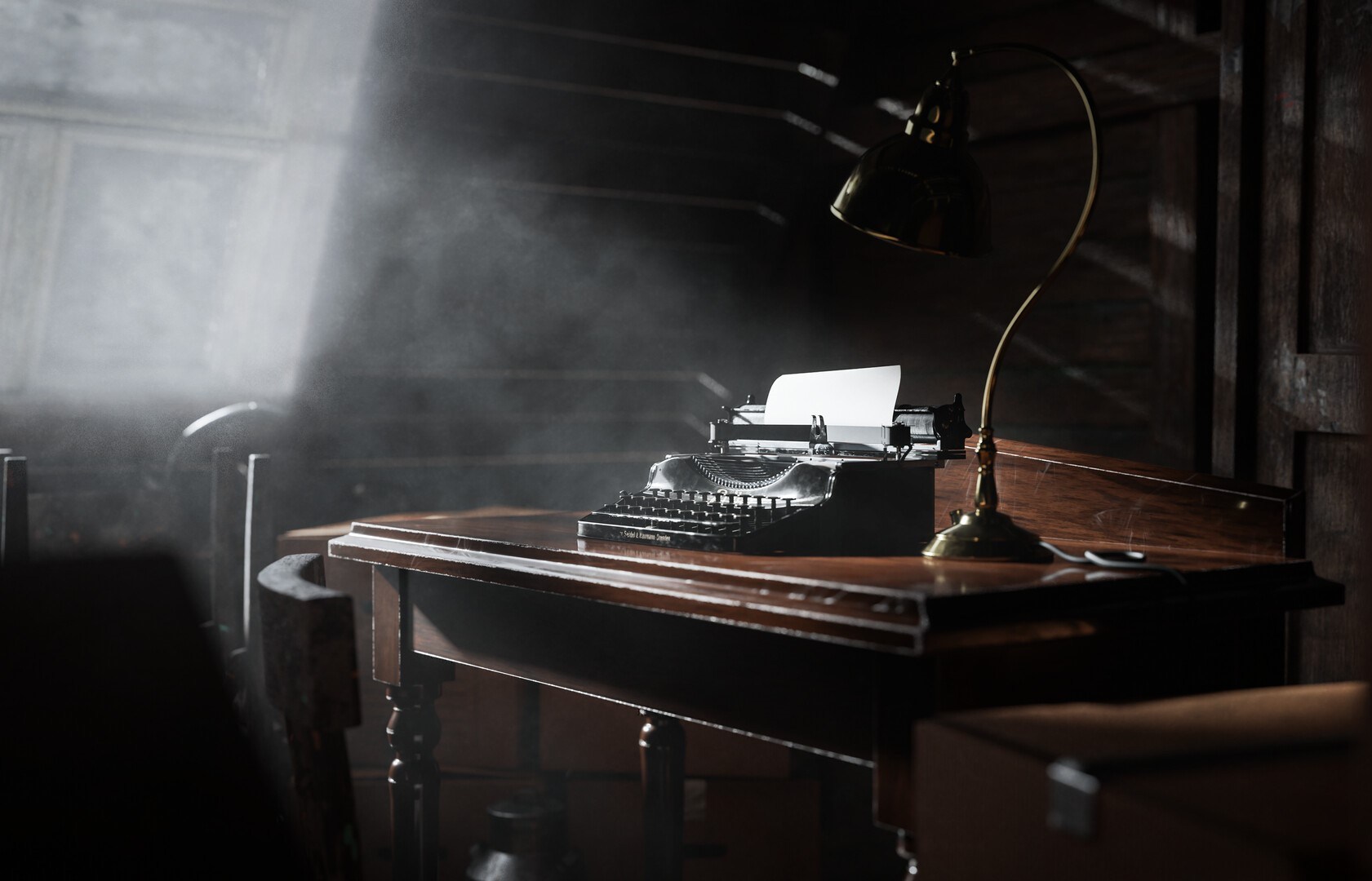
The typewriter keys clattered away as Viv wrote her story. It was coming along nicely and she was feeling pleased with herself. The attic room that she and her brothers had made into their ‘den’ was ideal for getting away from everybody and having some peace and quiet and she quite forgot about the time as she lost herself in the plot. Suddenly she looked up and realized how dark it was getting; the December nights were pulling in and it was already quite dusky by 3.30pm. Quickly she packed her books and folders away and prepared to go downstairs. How she hated being up in the attics when it was getting dark as it was so spooky! The wind was starting to howl outside and the familiar sound of a banging window started. Viv sighed and stood in the doorway of the room – should she go and investigate or leave it? Against her better judgement she walked up the corridor towards the noise and checked all the rooms but as usual all the windows were shut tight. The banging continued along with the familiar prickle down her spine. She needed to get out of here and quick! As she turned to go back along the corridor towards the other end she could hear people talking but not clearly, just a general babble of voices. Viv was in a complete panic now as she knew there was no-one up there and she started to run along the corridor willing the noises to stop, feeling the knot in her stomach and sensing the sheer terror in her mind as she ran to get away from the voices, the people, the footsteps.
The spooky attics
The green baize door banged behind her and Viv breathed a sigh of relief. She’d made it out alive! At least that’s what it felt like; she vowed never to go up to the attics again on her own or in the afternoon. She ...
Christmas High Jinks #87
Viv Wilson | 06th December 2024 |
Life at The Hall

Here's a true story to get you in the mood for Christmas! My brother and I were definitely not good children and we were always amazed that Santa still left us gifts on Christmas Eve! We were like 'elves behaving badly'! Hope you enjoy it!
The sounds of "La Golondrina" floated through the air as Viv sat at the grand piano. How pleased she was that someone had asked them to look after this fine musical instrument for a few months. Having learned to play when she was younger, this gave Viv the opportunity to brush up on her skills as a pianist and she was thoroughly enjoying it. The piano was in the Library and suited the room perfectly. She could hear her father and an antique dealer talking in the Long Gallery as they haggled over the price of a painting that he was selling. Viv gazed out of the window as she played and thought back to the Midsummer’s Eve Ball that they’d had a few months ago. It had been a huge success and so many people were there – more than she’d ever seen in one place. She had worn her long dress and her best friend had stayed the night so that she had someone of her own age there. She and her friend had sold raffle tickets to the guests, which had been fun and a good way to mix with everyone. Now her thoughts headed towards Christmas and the New Year’s Eve Ball that they were planning. It was so exciting having all these Balls and dances; it made Viv feel very grown up when she wore her long evening gown. However, Christmas was first and she began to wonder what gifts she would get.
“Let’s go out for a bit, I’m bored!” Gavin’s voice ran ahead of him into the Library and made Viv jump.
“OK, I suppose we could. I’ve been playing for ages now, I could do with a break,” answered Viv. “Where’s Pap?” Viv used their little brother’s nickname.
“He’s gone to his friends’ house to play – that’s why I’m bored!”
They wandered out of the Library and grabbed their coats; the weather was t...
Lest we forget #86
Viv Wilson | 08th November 2024 |
Life at The Hall
During the two World Wars the Meynell family of Hoar Cross Hall served their country alongside many others from all walks of life. After each war there was huge social upheaval, especially for women, who had been doing what was traditionally 'men's work' during the war and weren't prepared to go back to domestic roles. At the time of the First World War Frederick Meynell and Lady Mary Meynell were living at the Hall with their five children. Their four sons all served in the war and their daughter Margaret served in the Red Cross as a volunteer.
Their eldest son Francis was a Major but was wounded in action in 1917 with severe wounds to his back. He was moved from the Duchess of Westminster Hospital to the Meynell Hospital in Lennox Gardens, London, the home of his mother, Lady Mary. She had offered her house to the War Office and the Red Cross, and it had become a Military Hospital for officers.When the Second World War started in 1939 the next generation of Meynells stepped up to help out. Francis had married Lady Dorothy and their eldest son Hugo also served as an officer and was awardedthe Military Cross, although he was seriously injured at Al Alamein leading to his early death in 1960. Their daughter, also Dorothy, moved back to Hoar Cross at the outbreak of war and joined the Joint War Organisation of the Red Cross and St John, which meant travelling overseas to Africa, Sicily and Italy.
An overseas military group (from the Meynells' photos)
My own father served in the Royal Army Service Corps (RASC) as a despatch rider because he owned a motor bike and had been racing it at Donington Park during the 1930s. He served in North Africa and Al Alamein as did Hugo Meynell. Who knows - they could have crossed paths during the war, my dad never dreaming for a moment that he would one day own Hugo's house! After North Africa he moved to Italy and spent a lot of time in Bari and Naples eventually moving up towards Belgium. He kept diaries of his tim...
Ghouls Galore! #85
Viv Wilson | 17th October 2024 |
Life at The Hall
Going to sleep in a big old house is quite scary when you’re young but going to sleep in a big old house that’s haunted is even more scary!! As we approach Hallowe'en my mind has gone back to that first winter at Hoar Cross Hall and all the scary things that happened - and that was without any trick or treaters in those days! We quickly realised that we weren’t the only inhabitants of the house. Every time there was a windy night I could hear a window banging in the attic – all night long it kept me awake. The next day I would go upstairs to the attics to close it but there would be no windows open or even loose. They were all tightly shut as they had been for 20 years. I remember standing there in the attic rooms feeling a tingling down my spine and goose bumps all over as I felt the atmosphere closing in on me - and I quickly legged it back downstairs!
On other nights we would hear people walking along the attic corridor (the attic, by the way, was the floor right above our bedroom floor) and then at other times we could hear heavy furniture being dragged about – yet there was nothing up there as the rooms were all empty! How strange! Other members of the family heard it too and also people that stayed overnight, so it wasn’t the imaginings of a frightened child. There was also nobody else in the house at that point, apart from our family and they definitely weren’t walking about the house at 3am. And why is it that these things always happen in the middle of the night? When it’s dark. When we feel more scared? I often woke up at 3am whether there were noises or not – or perhaps there had been a noise and that’s what had woken me up – who knows? I loved reading books about old houses, mysteries and ghosts but when you actually live in one in real life, it’s a bit different!
The spooky attic corridor
My parents also heard noises when they were in their bedroom too. It sounded like a room full of people talking, ...
Mediaeval Weaponry #84
Viv Wilson | 27th September 2024 |
Life at The Hall
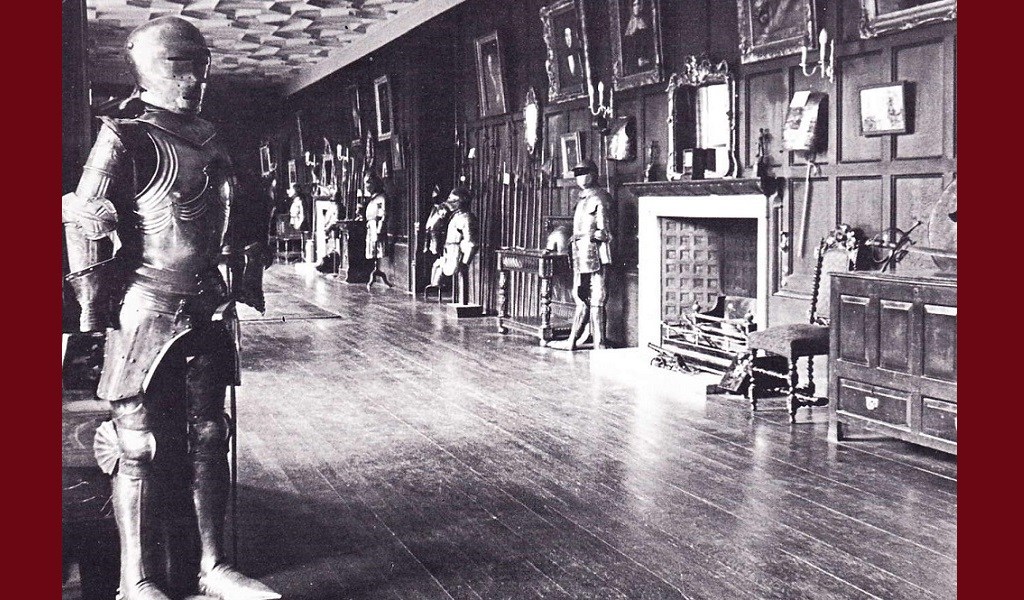
When we moved to Hoar Cross Hall in the 1970s, my father owned the largest private collection of arms and armour in the UK at that time! He owned about 20 suits of armour and numerous items of ‘arms’, which is another word for weapons. The word ‘arms’ comes from the Latin ‘arma’ which means ‘tools of war’; this word passed into the English language from the French in 1200.
Mediaeval weapons consisted of halberds, double-edged swords, daggers, battle axes, crossbows and longbows to name but a few, these being the most common. Knives were also used but mainly for eating and repairing, although I’m sure they got to be used as weapons too in an emergency!
Me standing next to some of the halberds
Mounted warriors or knights would use something called a mace which was a blunt, metal ball on the end of a pole. They would also use a lance too, which was a long wooden pole with a knife on the end, similar to a halberd. Some of these weapons could do some serious damage on the battle field which is why a lot of men wore armour to protect themselves. I can imagine some of them having a few dents in their suits after a particularly gruesome fight and they would be asking the local blacksmith to knock them out ready for the next battle!
When our house was open to the public we had lots of mediaeval weapons on display along with the armour. Later, we ran Mediaeval Banquets and the halberds were used by the Halberdier (a man dressed as a knight) as he stood on guard at the banquet doors before letting the guests enter the Banqueting Hall. He would bang the halberd on the floor very loudly to attract their attention before announcing that the banquet was about to commence!
The Halberdier announces the King
The principal missile weapon of the Middle Ages was the bow. It took two main forms: the simple bow and the crossbow. The simple bow was about five feet long and fired arrows with heads of steel. Later these heads were designed t...
Meet the Neighbours - Trentham Gardens #83
Viv Wilson | 29th August 2024 |
Life at The Hall
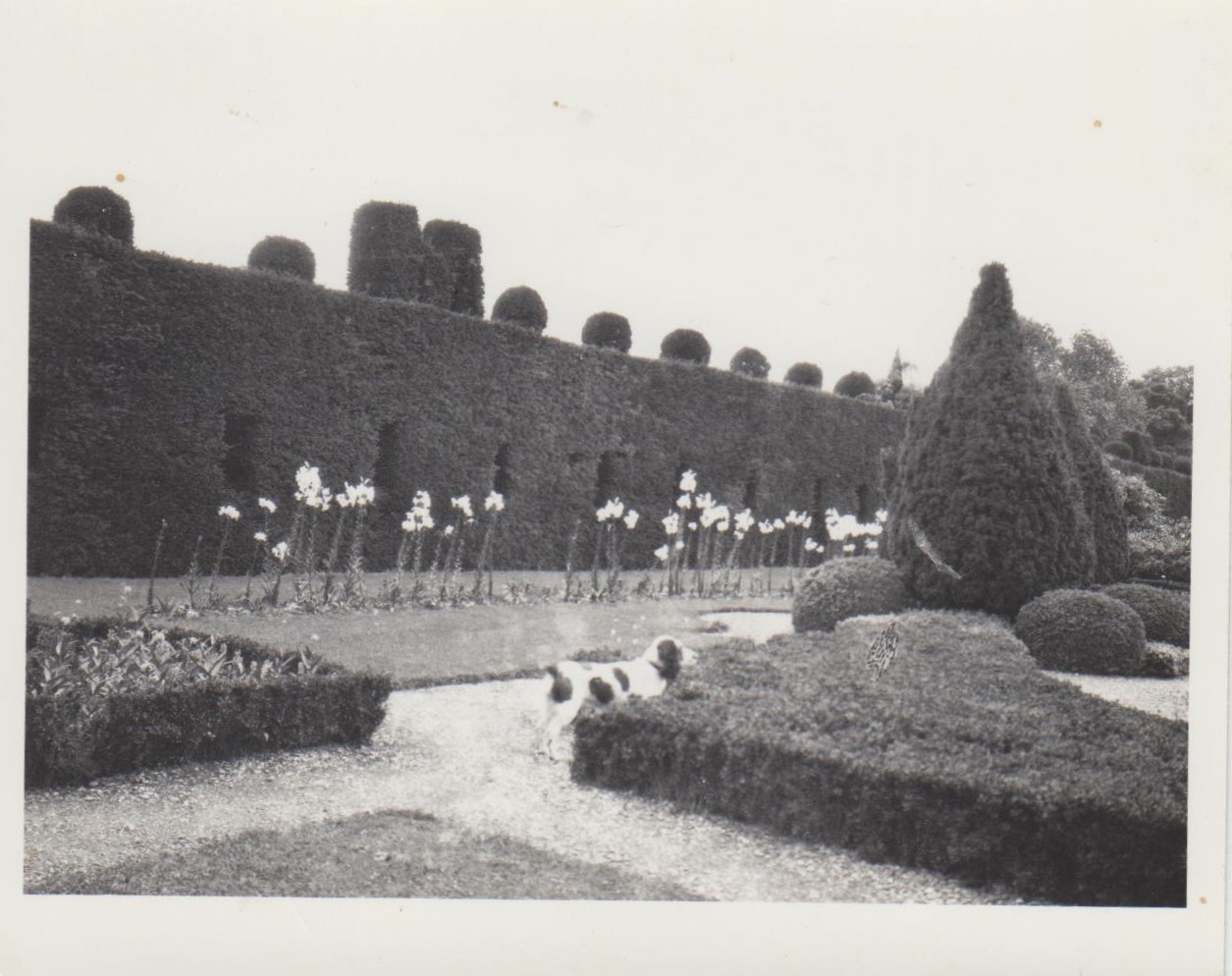
This neighbour was a little further afield to Hoar Cross Hall than the other houses, as it was in Stoke-on-Trent. However, we often visited the gardens and I went to a few concerts there which were held in the Ballroom of the house. It was very similar to Alton Towers in that it had formal gardens with a large house and in later years was made into pleasure grounds, although not as grand as the rides at Alton towers!
Originally the Trentham site was a priory but had been demolished during the dissolution of the monasteries in Henry XIII’s reign. In 1599 the first hall on this estate was built on the priory ruins but later in 1633 a Richard Leveson replaced the hall with an Elizabethan-style mansion. Inspired by French trends, the landscape architect Charles Bridgeman influenced the layout of Trentham by including wide avenues, a boating lake, a deer park, a causeway and canal which created beautiful gardens for the family to walk around and plenty to do on the water!
By 1759, Granville, 2nd Lord Gower was the owner of the park and he engaged the famous landscape designer, ‘Capability’ Brown to redesign the grounds. The formal gardens, walks and walls were replaced by a mile long serpentine lake with a single island, lawns, sweeping gravelled walks, a bowling green and woodland walks. All very typical of his style! A sweeping drive extended up the west side of the lake and across a deer lawn flanked by a series of Ha Ha walls – very similar to the one at Hoar Cross Hall. It seems that deer parks, lakes and walks were a ‘standard’ in most stately homes of that era.
Moving on to 1833 and George Granville, 2nd Duke of Sutherland decided to redesign the hall and gardens but this time the Italian Renaissance was all the rage so Brown’s sweeping lawns were transformed back into formal terraced garden rooms. Fountains, balustrading, clipped topiary and sculptures were the new look now – all this change must have kept the gardeners busy! The lakes...
Meet the Neighbours - Alton Towers #82
Viv Wilson | 17th July 2024 |
Life at The Hall

When you say the name ‘Alton Towers’ most people in the UK will think of the theme park with spectacular rollercoaster rides. It really has changed beyond all recognition to the days when I used to go there back in the 1970s. In those days it was a lovely house set in beautiful grounds with a few fairground rides to one side of the car park! Well, it still is a lovely place to visit but the rides have taken over now so that people only think of it as a theme park with fantastically themed hotels and an enchanted village!
However, this estate started life as an Iron Age Fort built on Bunbury Hill. Then later on in the 11th century, Alton Castle was built following the Norman conquest, in the village of Alton, Staffordshire, about a mile from the present-day Alton Towers. Over the centuries the manorial estate was given to knights who fought in the Crusades as a reward for their hard work. In 1406, Sir John Talbot acquired the estate when he married Maud, the eldest daughter of the 3rd Baron Furnivall. Talbot then became the second created Earl of Shrewsbury in 1442. Sadly, the castle was destroyed during the English Civil War.
A painting of Alton Towers in 1880
Moving on a few centuries to the 17th century, the former castle was redeveloped and turned into a hunting lodge. The house was three stories high and incorporated one of the castle’s towers, which remains part of the present-day building. The Talbots split the house into two properties and used their half as a summer residence. By 1801, the 15th Earl of Shrewsbury decided that the hunting lodge was beyond repair and commissioned a gothic-style country house to be built on his estate. This doubled the size of the property and took 10 years to build! (A bit like Hoar Cross Hall – but I suppose they are big places!). It also had similar rooms to the Hall, including a Chapel, Library, Long Gallery and Drawing Room and was renamed Alton Abbey, despite there being no religious connect...
Meet the Neighbours - Coombe Abbey # 81
Viv Wilson | 13th June 2024 |
Life at The Hall

Although this house isn’t quite so neighbourly to Hoar Cross Hall as the others in this series, it is loosely linked to the hall as it was the inspiration for the Mediaeval Banquets that my parents ran in the 1970s. They went along one night, to one of their banquets, to see what the format was and saw immediately how popular they were and so decided to start their own brand of banquets. The Coombe Abbey banquets were very traditional and had minstrels playing lutes etc while people ate their meal. The entertainment too was typical of mediaeval amusement of the times and I remember my parents saying it was an enjoyable night out but not terribly lively! This may have changed now of course!
The Abbey itself was built in the 12th century, being one of the largest monasteries in Warwickshire. The land was given to a group of Cistercian monks by Richard de Camville and they lived in temporary wooden buildings while they built the monastery; it was dedicated to the Blessed Virgin. Numerous gifts of land were made to the monks during their four hundred years of occupation and they did a lot of work helping the poor in the area. In 1470 King Edward IV actually visited the abbey while chasing his enemy, the Earl of Warwick, during the Wars of the Roses. Of course, it had to shut down in the 1500s when Henry VIII came along!
In 1603 King James I sent his daughter, Princess Elizabeth, to live there and be educated, when it was bought by a John Harington but by 1622 the Craven family had acquired the Abbey, and it stayed with them for another 300 years. Sounds like there’s been a few royal connections to this Grade I listed building! John Harington converted the abbey into one of the most substantial houses in the county and it seems that he and his wife looked after the Princess Elizabeth for about four years, keeping her safe from the plague in 1604 and then the famous Gunpowder Plot later that year. Apparently, King James and his two sons were to be kille...
Meet the Neighbours - Shugborough Hall #80
Viv Wilson | 22nd May 2024 |
Life at The Hall
The next house in this series is a mere half hour from Hoar Cross Hall and we often visited it during the summer months and later, when my children were born, we’d take them for a visit too! Seated on the edge of Cannock Chase this elegant house was once a manor house owned by the Bishops of Lichfield, until the dissolution of the monasteries around 1540. Later it came into the hands of the Anson family, who were ancestors of the Earls of Lichfield, and stayed there for three centuries. William Anson’s grandson, also called William, demolished the manor house in 1693 and built a three storey building in the Neo-Classical style which forms the central part of the hall today. In the 1740s William’s elder son, Thomas, would further extend the house and added two pavilions on either side of the central block. The state rooms contain some of the most opulent and highly decorated interiors in the hall and include the State Dining Room, The Red Drawing Room, The Library, The Saloon and the Veranda Room among others.
The land around Shugborough is mainly flat and Thomas Anson took a keen interest in landscaping the parkland so that trees, water and follies were on view to the family. If you’re wondering what a folly is, it’s an ornamental building of no practical use which the aristocracy would build in their large gardens to make for an interesting view. James Stuart, the classical architect, designed a number of these and the Greek influence is obvious, as he had visited Athens some years before. Therefore, two of the follies are copies of a building and an archway in Athens. Other follies in the grounds are The Chinese House and two Chinese-style bridges, in honour of Admiral George Anson, Thomas’ younger brother, who had visited Canton and left a huge amount of money to his older brother when he died. This was used to further expand the house and estate.
The Admiral was created Lord Anson in 1747 and First Lord of the Admiralty in 1751 and it seem...
Meet the Neighbours - Sudbury Hall #79
Viv Wilson | 24th April 2024 |
Life at The Hall

Continuing the series on neighbouring houses to Hoar Cross Hall, let me introduce you to Sudbury Hall, which is about 7 miles away and on the border of Staffordshire and Derbyshire. The manor of Sudbury was listed in the Doomsday Book following the Norman Conquest in 1086, so a lot older than the Hall, and is a Grade I listed building. The Vernon family came to Sudbury after a 16th century marriage between Sir John Vernon, from Haddon Hall in Derbyshire, and the Sudbury heiress, Ellen Montgomery. It seems the Vernon family have stayed in the Hall for generations right up until the 20th century when the 10th Baron Vernon transferred the Hall and its principal contents, and part of the parkland and gardens to the National Trust in part payment of death duties which had continued to burden the family. However, the remainder of the Sudbury estate is still held by Vernon descendants.
Sudbury Hall
In 1660 George Vernon inherited the house at the age of 25; he also got married that year to a Northamptonshire heiress, Margaret Onley. With the extra wealth that came with the marriage he built a grand new mansion on the same site which he designed himself – a Jacobean house but with the traditional Tudor structure. He also moved the village closer to the Hall so that his servants and the tradesmen could live near at hand. These buildings still survive today!
It seems George Vernon was a very ambitious man who wanted to further his political career and having a large, impressive house helped him to move in higher social circles. Together he and his wife had nine children so those extra rooms would have come in useful! After his wife died in 1675, George married again. Dorothea Shirley was the daughter of Lady Catherine and Sir Robert Shirley and these titles helped George and his family move in even higher social circles. They had two daughters but sadly his wife died in childbirth in 1680. However, it wasn’t long before 44 year-old George was married...
Meet the Neighbours - Blithfield Hall #78
Viv Wilson | 26th March 2024 |
Life at The Hall

This month I start a brand new series on stately homes local to Hoar Cross Hall and the first one is Blithfield Hall, which was probably the nearest stately home neighbour to Hoar Cross Hall and had been privately owned by the Bagot family since the 14th century. The house, which is Grade I listed, is situated between Rugeley and Abbots Bromley and is about 6 miles from the Hall. I remember calling round with my parents once to see Nancy, Lady Bagot, and admiring the goats they had roaming around the nearby fields. Blithfield Hall is known as the home of a breed of goat, the Bagot goat, which for several hundred years have lived semi-wild on the estate.
The Bagot family has a long lineage, holding land in Staffordshire since at least the 11th century. The first Baron, Hervey Bagot, was created a baronet of Blithfield Hall in 1627 for his part in the Civil War – he was also High Sheriff of Staffordshire. His son, grandson and great grandson also represented Staffordshire in the House of Commons.
The Hall, with its embattled towers and walls is mainly Elizabethan and was originally a fortress complete with moat but in the 1820s a Gothic façade was added by the designer John Buckler, it is thought. The interior decoration was carried out by Gothic-style plasterer, Francis Bernasconi, a man of Italian descent who became one of the most successful ornamental carvers and plasterers in Georgian Britain.
The Dining Room
Sadly, in 1945, the Hall was sold by the 5th Baron Bagot to the South Staffordshire Waterworks Company, as they planned to build a reservoir which was completed in 1953 and opened by the Queen Mother. The reservoir is 14 metres deep and approx. 4km long and took 500 men six years to build. It was made in a shallow valley through which the River Blithe ran and has a causeway across it. It is now classed as a Site of Special Scientific Interest due to the over-wintering wildfowl that reside there.
A year later, in 1946, the Baron died hav...
To the Manor Born #77
Viv Wilson | 22nd February 2024 |
Life at The Hall
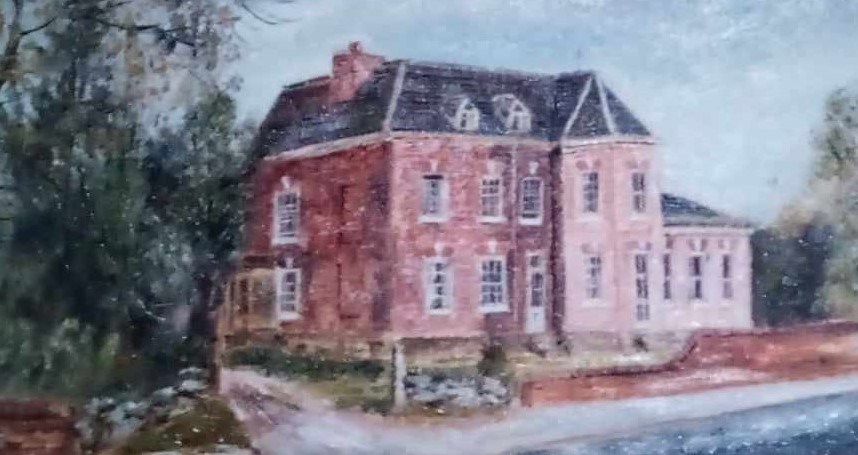
Before we moved to Hoar Cross Hall my father had bought an old manor house in the village of Shardlow, near Derby, which had previously been a vicarage among other things. I think my parents must have had a love of historic buildings and indeed were members of the Society for the Preservation of Ancient Buildings and Monuments. My dad had a business in Derby at the time making alabaster items such as table lamps and candlestick holders and when he bought the manor house he moved his business there, as it had lots of outbuildings for all the alabaster equipment.
Some of my father's alabaster pieces
The house itself had about 17 rooms and was built in 1746 for a Mr Alpheus Burgin for the grand total of £43, after an older property was demolished. The Burgin family owned large portions of Shardlow including the Dog and Duck Public House and part of the land on which the church was built as well as acres of fields and meadows around Shardlow. Alpheus’ father already lived in the old house and when Alpheus got married to a Mary Wells, part of the marriage settlement deeds included the rebuilding of the manor house. The house stayed in the Burgin family for many decades and in 1882 a Reverend William Burgin came into possession of the property and had it extended, adding a large room to the side of the house which we called the Billiard Room, and bay windows to the front – this is when the house officially became a rectory. The header picture is a painting of the house, which somebody gave to us.
My brother Piers' Christening - the Billiard Room
The manor stood on the London Road and nearby were other large properties of a similar age, namely The Dower House, Shardlow House and Shardlow Hall. The village itself is mainly 18th and 19th century; however, there are a few older properties from the 1400s and I think there is evidence of a Roman settlement nearby. The River Trent ran near to the village and in 1770 a canal was built and it seems t...
Panto Pranks! #76
Viv Wilson | 23rd January 2024 |
Life at The Hall
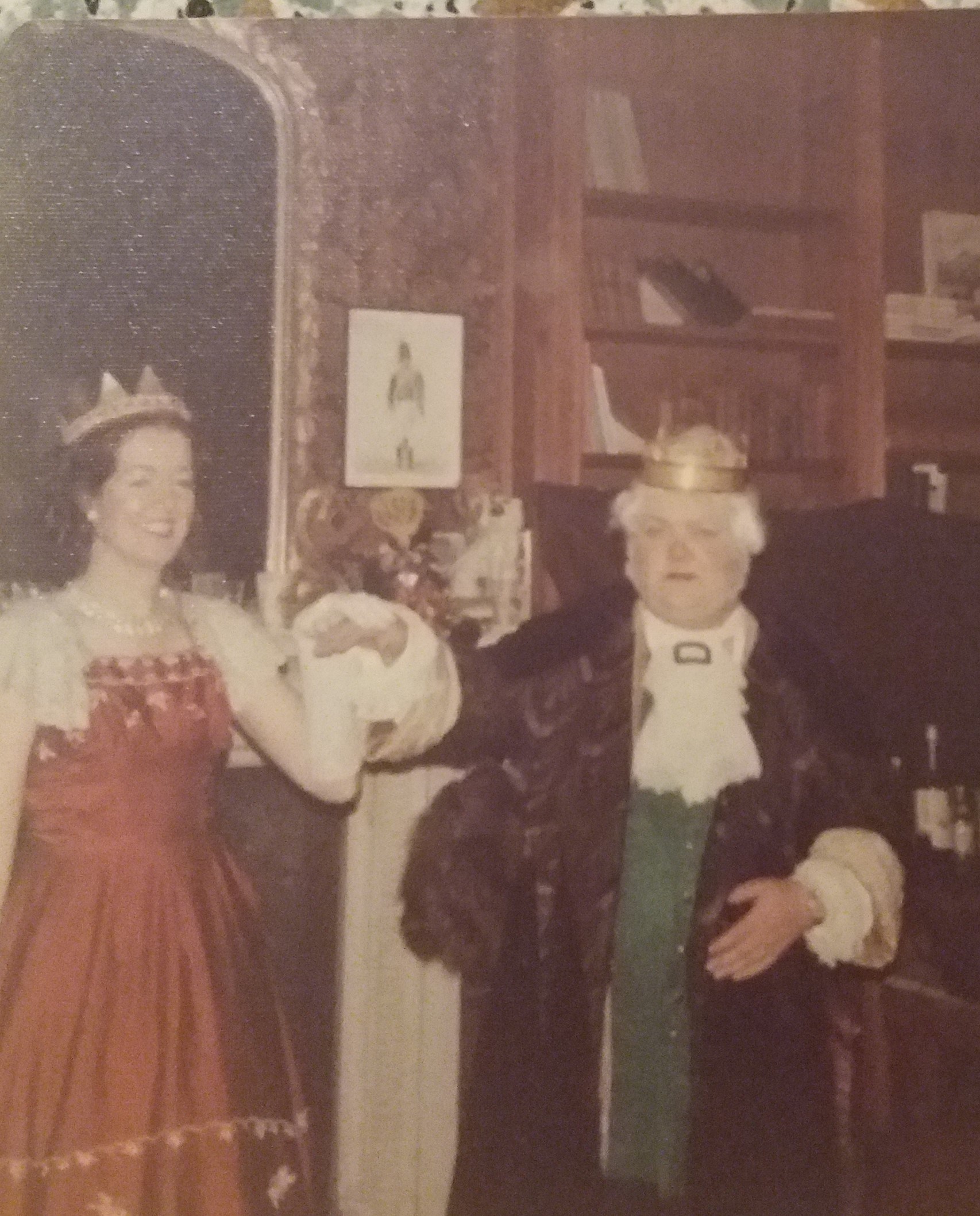
During the 1970s Hoar Cross Hall was used from time to time for local community activities and one such event was the production in 1978 of a traditional pantomime, ‘Midnight and a Journey back to Happiness’. It was written by local people, Robert Leighton from Yoxall and the Hon. Alexandra Meynell, daughter-in-law of Mrs Jean Meynell whom we had purchased the Hall from. The words and music were written by local songwriter, David Matthews, who had written songs for quite a few pop artists during the 1960s, his most famous being Matt Munro’s ‘We’re gonna change the world’. So off to a good start there!
For those of you who don’t reside in the UK and have no idea what a pantomime is, it is a musical play with slapstick comedy based on a children’s nursery story or fairy tale, usually produced at Christmas. It’s mainly for children but adults tend to love them too as there is always a lot of audience participation, especially when the villain walks on and everyone boos and hisses or shouts “He’s behind you!”.
The aim was to involve as many people as possible, particularly the youngsters, and adults and children from around the area of Hoar Cross were invited to participate in the event, forming a group known as ‘The Overdraft Players’! About 80 people took part altogether including three ‘retired’ semi-professionals. A huge, three-tiered, sectional wooden stage was built for the venture and sited in the Ballroom. Local people got involved with set design and costumes; another lady arranged and produced the ballet routines.
Some of the children in costume
My brothers, Gavin and Piers were involved of course but Gavin broke his arm a couple of weeks before the show started so ended up with the minor but important role of working the hands of the large clock that stood to one side of the stage! I felt really sorry for him as he had to stand behind the clock and no-one could see him – however, the clock was a major par...
A New Year Calamity! #75
Viv Wilson | 29th December 2023 |
Life at The Hall
The New Year’s Eve Ball at Hoar Cross Hall was usually the highlight of the year. After twelve months of hard work, especially running the Mediaeval Banquets twice a week through the winter, we were always ready to see out the year in style with a big new year party. In those days it was always black tie for the men and long dresses for the ladies – usually around 500 people bought tickets for an evening of entertainment with a dance band, disco and a meal. At midnight a man dressed in traditional Scottish regalia, including a kilt and sporran, would pipe in the new year with his bagpipes. Down the Long Gallery he would slowly walk and into the Ballroom with his pipes droning on. When midnight arrived a net full of balloons was dropped onto all the guests from the ceiling, out came the party poppers and hats and everyone joined hands to sing ‘Auld Lang Syne’. Once all the traditional stuff was done the band started up again and we all did the Hokey Cokey, the Conga and other silly dances that only happen on New Year’s Eve! It was always great fun and I loved to dress up and mix with he adults.
My parents were having a trial separation around this time so my dad had to run the New Year’s Eve Ball on his own. I helped, as I had before, with the administration; posting out tickets and doing a bit of book-keeping. The week prior to the Ball was spent moving furniture about and cleaning the house up after all the banquet tables and benches were removed. We usually used some of the banquet tables for people to sit at but this particular year my mum had stored them all away in the basement and put a lock on the door – these were her property now! This left my dad in a bit of a quandary about what to do for tables and after a lot of ranting he decided that he would have to hire some. As my dad was well known for being ‘careful’ with his money, he didn’t want to spend too much and hired the cheapest tables and chairs he could. They arrived...
A Christmas Celebration #74
Viv Wilson | 20th December 2023 |
Life at The Hall
The final festive story is here based on true events and people that lived at Hoar Cross Hall.
“Come on, look sharp!” shouted Cook to her assistants in the kitchen. “We’ve got a load of cooking to do for the Christmas party at the weekend and if you don’t get a move on there’ll be nothing to eat!”
The kitchen maids looked at each other, stopped their gossiping and started to move a bit quicker. Cook could be quite intimidating when she was in one of her moods. The table was laden with pastries, jellies and fruit and the girls were just putting the finishing touches to the gingerbread biscuits before starting on the blancmange.
“I love Christmas,” said Molly, a young kitchen maid who’d only just started working for the Meynell family a few months before. “And I can’t wait to go to the party.”
“You’ll be going nowhere if you don’t get all this food prepared on time,” scowled Cook, who didn’t really enjoy mixing with the family ‘upstairs’.
“Don’t worry!” said Jenny airily. “We’ll get it all done.” She looked across at Molly and winked. Jenny had been working at the Hall for a few years now and was used to Cook’s temper. It was only because there was a lot to do and she got easily stressed; also, she was getting on in years and her feet hurt a lot from long hours of standing so it was no wonder she got irritable!
The party was the highlight of the year for most members of staff. The Meynell family treated their servants and workers quite well compared to some families and always hosted a party just before Christmas for the indoor and outdoor staff as well as the estate workers who lived in the cottages nearby. The party was held in the Long Gallery where there were roaring log fires in the two fireplaces and a small band playing music. A table was laden with food and drinks including mulled wine and ginger beer. The staff dressed up in their ‘Sunday best’ and for one night of the year they cou...
The ghost of Christmas past #73
Viv Wilson | 15th December 2023 |
Life at The Hall
Another Christmas story in the run up to the festive season - it may send a shiver down your spine! (Based on true stories)
The typewriter keys clattered away as Viv wrote her story. It was coming along nicely and she was feeling pleased with herself. The attic room that she and her brothers had made into their ‘den’ was ideal for getting away from everybody and having some peace and quiet and she quite forgot about the time as she lost herself in the plot. Suddenly she looked up and realized how dark it was getting; the December nights were pulling in and it was already quite dusky by 3.30pm. Quickly she packed her books and folders away and prepared to go downstairs. How she hated being up in the attics when it was getting dark as it was so spooky! The wind was starting to howl outside and the familiar sound of a banging window started.
Viv sighed and stood in the doorway of the room – should she go and investigate or leave it? Against her better judgement she walked up the corridor towards the noise and checked all the rooms but as usual all the windows were shut tight. The banging continued along with the familiar prickle down her spine. She needed to get out of here and quick! As she turned to go back along the corridor towards the other end she could hear people talking but not clearly, just a general babble of voices. Viv was in a complete panic now as she knew there was no-one up there and she started to run along the corridor willing the noises to stop, feeling the knot in her stomach and sensing the sheer terror in her mind as she ran to get away from the voices, the people, the footsteps.
The green baize door banged behind her and Viv breathed a sigh of relief. She’d made it out alive! At least that’s what it felt like; she vowed never to go up to the attics again on her own or in the afternoon. She gradually stopped shaking and went to find her mother who was putting up Christmas decorations in the Library. This was where t...
Christmas High Jinks #72
Viv Wilson | 06th December 2023 |
Life at The Hall

The sounds of 'La Golondrina' floated through the air as Viv sat at the grand piano. How pleased she was that someone had asked them to look after this fine musical instrument for a few months. Having learned to play when she was younger, this gave Viv the opportunity to brush up on her skills as a pianist and she was thoroughly enjoying it. The piano was in the Library and suited the room perfectly. She could hear her father and an antique dealer talking in the Long Gallery as they haggled over the price of a painting that he was selling.
Viv gazed out of the window as she played and thought back to the Midsummer’s Eve Ball that they’d had a few months ago. It had been a huge success and so many people were there – more than she’d ever seen in one place. She had worn her long dress and her best friend had stayed the night so that she had someone of her own age there. She and her friend had sold raffle tickets to the guests, which had been fun and a good way to mix with everyone. Now her thoughts headed towards Christmas and the New Year’s Eve Ball that they were planning. It was so exciting having all these Balls and dances; it made Viv feel very grown up when she wore her long evening gown. However, Christmas was first and she began to wonder what gifts she would get.
“Let’s go out for a bit, I’m bored!” Gavin’s voice ran ahead of him into the Library and made Viv jump.
“OK, I suppose we could. I’ve been playing for ages now, I could do with a break,” answered Viv. “Where’s Pap?” Viv used their little brother’s nickname.
“He’s gone to his friends’ house to play – that’s why I’m bored!”
They wandered out of the Library and grabbed their coats; the weather was turning quite cold now and the nights were drawing in. As they headed out of the back door, stopping to check the guinea pigs first, their feet followed the path down towards the church, which stood on the edge of the grounds. A low stone wal...
The Chinese Room #71
Viv Wilson | 01st December 2023 |
Life at The Hall

The Chinese Room is the last in the series of the rooms that were open to the public at Hoar Cross Hall during the 1970s. It had three doorways and was entered from the Ballroom, the Long Gallery and the Entrance Hall and was originally the Dining Room of the house when the Meynell family lived there. The centrepiece of the room is the 18th century carved wood mantelpiece, incorporating classical figures and floral decorations, with a carved and painted armorial overmantel.
As you can probably guess from the name of the room, the main theme was oriental armour, tapestries and furniture, including a Burmese Palace Chair. The oriental armour was a lot different to the western armour seen in the Long Gallery and nowhere near as heavy. It consisted of ‘lamellar’ construction, namely pieces sewn together. Chain mail, being light and well ventilated, was also used. Along with the armour was an executioner’s sword and apparently Japanese swordsmiths were the greatest that the world has ever known. The method of making them goes back over 1000 years and was introduced by a blacksmith called Hoki Yasutsuna. He was the first person to make the single-edged curved sword and the method used by him is still used today. However, the way they tested the swords on criminals back in the day was very gory and I won’t go into it here!
Japanese armour with sword
As I said, this room was originally the Dining Room for the family and overlooked the terrace and gardens. In the corner of the room was a large bay window which gave views to the west side of the grounds including the tennis courts and woods. In the wall was a small lift which was used to bring the food up from the kitchens below. Apparently, a pantry boy fell down the lift shaft one day and broke his leg quite badly and after that they sealed it up and the food was brought up a different way – up the spiral staircase and across the Entrance Hall. More extra work for the poor servants!
...
The Ballroom #70
Viv Wilson | 24th November 2023 |
Life at The Hall
Continuing my series on the rooms that were open to the public at Hoar Cross Hall, we move from the Library, through the secret door, to the Ballroom. Overlooking the gardens and the former deer-park, this beautifully proportioned room is elegant and grand.
The lower halves of the walls are covered in carved white and gold wood panelling which is complemented by the original hand printed blue wallpaper, again over 150 years old (see photo below). Incredibly the original wooden printing blocks for the wallpaper were in the house when we moved in and were on show to the public in this room. The fireplaces are made of marble with carved wood overmantels which contained portraits from my father’s collection of paintings. Most of the furniture on display was contemporary to the period of the house although there were two fine Florentine pieces, a limed oak cabinet and a limed oak chest, which my father had bought from Osmaston Manor in Derbyshire before it was demolished in the 1960s.
The first banquet in the Ballroom
On the panelling we displayed the silver armour, which was actually silver on copper armour. These pieces were formally hung in a French Chateau and were a good example of early 19th century “display” armour, never intended for wear, but merely to look decorative. During the mediaeval banquets which we held there, the guests would remove the armour and try it on so we ended up having to remove it permanently when the banquets were running during the winter months!
This room also displayed my mother’s collection of Victorian costumes and dresses to which she was always adding new items. These included uniforms from the East India Company and the Staffordshire Yeomanry through to wedding gowns, afternoon dresses and Ball gowns.
A Ballgown on display near the Chapel
Originally this room was called the Drawing Room, the name deriving from the word ‘withdrawing’ as in a room you ‘withdrew’ to after dinner. This term r...
The Library #69
Viv Wilson | 17th November 2023 |
Life at The Hall
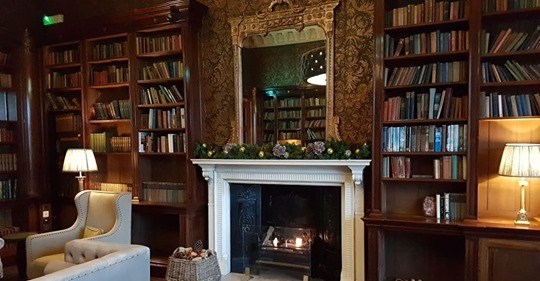
The Library at Hoar Cross Hall is a delightful room, not huge like the other rooms, but not too small either – a room fitted with mahogany bookshelves on three sides and a bay window overlooking the terrace and the gardens. From this window, on a clear day, it is possible to see the “Three ladies of the vale” – the spires of Lichfield Cathedral.
Libraries have been around for centuries with evidence pointing to the Romano-British world when documents and manuscripts were stored in chests in special rooms where people could study them sitting at a table, not unlike today's libraries. In the 15th century classical works were collected by men such as the Earl of Worcester who is said to have “despoiled the libraries of Italy so that he may adorn England with monuments of books”. It seems that people started to collect large amounts of books, known as bibliomania, just to fill up their library shelves, often duplicating books to fill the space!
The Library in the 1930s
Architectural libraries made their appearance around 1720 when the finest Palladian houses also had libraries placed alongside private rooms. Robert Adam designed elegant neo-classical libraries in the later part of the century, although some of these were later converted to dining rooms due to lack of books – no bibliomania there then! It is said that libraries were a good place for courting couples to meet up under the guise of ‘looking for a book to read’ and even couples who were married to other people would use the library as a place of assignation!
When our house was open to the public the shelves were filled with books and ornaments and also some of my father’s alabaster carvings and portrait busts. I also had my doll collection on display which consisted of traditionally dressed dolls from around the world which my father had brought back from his travels abroad. In the early seventies we looked after a grand piano for a friend and this sat in the Library too...
The Chapel #68
Viv Wilson | 03rd November 2023 |
Life at The Hall

Continuing our series on the rooms that were open to the public during the 1970s at Hoar Cross Hall, we find the Garden Hall and Chapel leading off the Long Gallery at the east end of the house. This private chapel was a later addition to the Hall and was designed by G F Bodley, the gothic revival architect, and completed in 1897 at a cost of just under £1000. The walls have a fine linenfold panelling and the ceiling is richly decorated. Many houses in days gone by had their own private chapel and it seems that before the chapel was built, services had been held in another room of the house. I would imagine that Emily Meynell wanted a proper consecrated place of worship in the house as she was a very religious lady and had already built the Church of the Holy Angels in memory of her late husband in the grounds of the Hall.
The church of the Holy Angels
The four stained glass windows contain the Meynell family’s Coats of Arms since the 13th century and the altar originally had altar frontals finely embroidered in gold thread. To the left of the door was the organ with the Bodley organ casing. The organ console was mid-eighteenth century but not working when we moved there. However, various organ enthusiasts tried to fix it but it was a big job and continued to be a work in progress whilst we were there.
The organ
After the chapel was built, in the early part of the 20th century services were held each morning at 9am sharp. Colonel Meynell himself would take the service which involved the reading of prayers and possibly some scripture from the Bible. His daughter Dorothy Meynell would play the organ. The servants were all expected to attend as well as the family and on Sundays they would go across to the church which was situated nearby. However, the family would walk from the back door of the house leading off the Garden Hall and follow the path down to the church while the servants were expected to walk around the boundary of the grou...
The Long Gallery #67
Viv Wilson | 27th October 2023 |
Life at The Hall

I thought that a little series on the different rooms in Hoar Cross Hall might be quite interesting, taking a deeper look at what these rooms were used for and a bit of history surrounding them. The main ground floor rooms were open to the public during the 1970s when people wandered around our home admiring the fine paintings and furniture followed by a walk in the grounds trying to imagine how it looked in days gone by. The house was entered through two huge oak doors which led into an Entrance Hall - this was our cafe area and the Butlers Pantry just off there was what we used as a kitchen to bake scones and sell snacks and ice creams. Leading off the Entrance Hall is the Long Gallery which is 114 feet in length and is entered through two 10 feet high solid oak doors. It contains two white marble fireplaces and a richly decorated ceiling; at the far end is the fine panelled oak staircase which led to our private apartments. My father’s collection of arms and armour, dating from the 14th to the 17th century, was displayed in this room against the oak panelling and was one of the largest private collections in the country at that time (see header picture). However, all those metal suits lining the walls staring back at me through the slits in their visors used to terrify me as a child and I would avoid looking at them when I went up the stairs to bed!
The Long Gallery in the 1970s
So why did country houses have such long rooms? Long Galleries were popular in Elizabethan and Jacobean houses and normally placed on the highest reception floor running along one side of the house, with large windows giving views over the gardens. The family would meet when the weather was inclement and as the rain pattered down outside they would walk and talk together. It was a way of taking exercise in the winter months but also for entertaining and displaying art collections, particularly family portraits. In the 16th century, the corridor had not been introduce...
"He's behind you!" #66
Viv Wilson | 15th September 2023 |
Life at The Hall
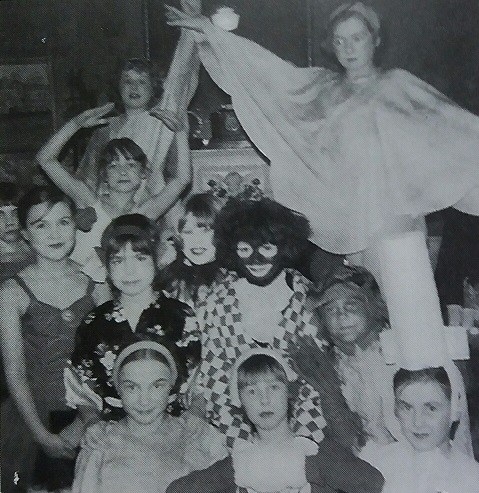
During the 1970s Hoar Cross Hall was used from time to time for local community activities and one such event was the production in 1978 of a traditional pantomime, ‘Midnight and a Journey back to Happiness’. It was written by local people, Robert Leighton from Yoxall and the Hon. Alexandra Meynell, daughter-in-law of Mrs Jean Meynell whom we had purchased the Hall from. The words and music were written by local songwriter, David Matthews, who had written songs for quite a few pop artists during the 1960s, his most famous being Matt Munro’s ‘We’re gonna change the world’. So off to a good start there!
For those of you who don’t reside in the UK and have no idea what a pantomime is, it is a musical play with slapstick comedy based on a children’s nursery story or fairy tale, usually produced at Christmas. It’s mainly for children but adults tend to love them too as there is always a lot of audience participation, especially when the villain walks on and everyone boos and hisses or shouts “He’s behind you!”.
The aim was to involve as many people as possible, particularly the youngsters, and adults and children from around the area of Hoar Cross were invited to participate in the event, forming a group known as ‘The Overdraft Players’! About 80 people took part altogether including three ‘retired’ semi-professionals. A huge, three-tiered, sectional wooden stage was built for the venture and sited in the Ballroom. Local people got involved with set design and costumes; another lady arranged and produced the ballet routines.
This wasn't the first time theatricals were performed here though - back in the 1920s the Meynells and their friends often dressed up and performed shows for fun!
The Meynells dressing up for their shows
My brothers, Gavin and Piers were involved of course but Gavin broke his arm a couple of weeks before the show started so ended up with the minor but important role of working the hands of the large...
Hoar Cross History #65
Viv Wilson | 07th September 2023 |
Life at The Hall
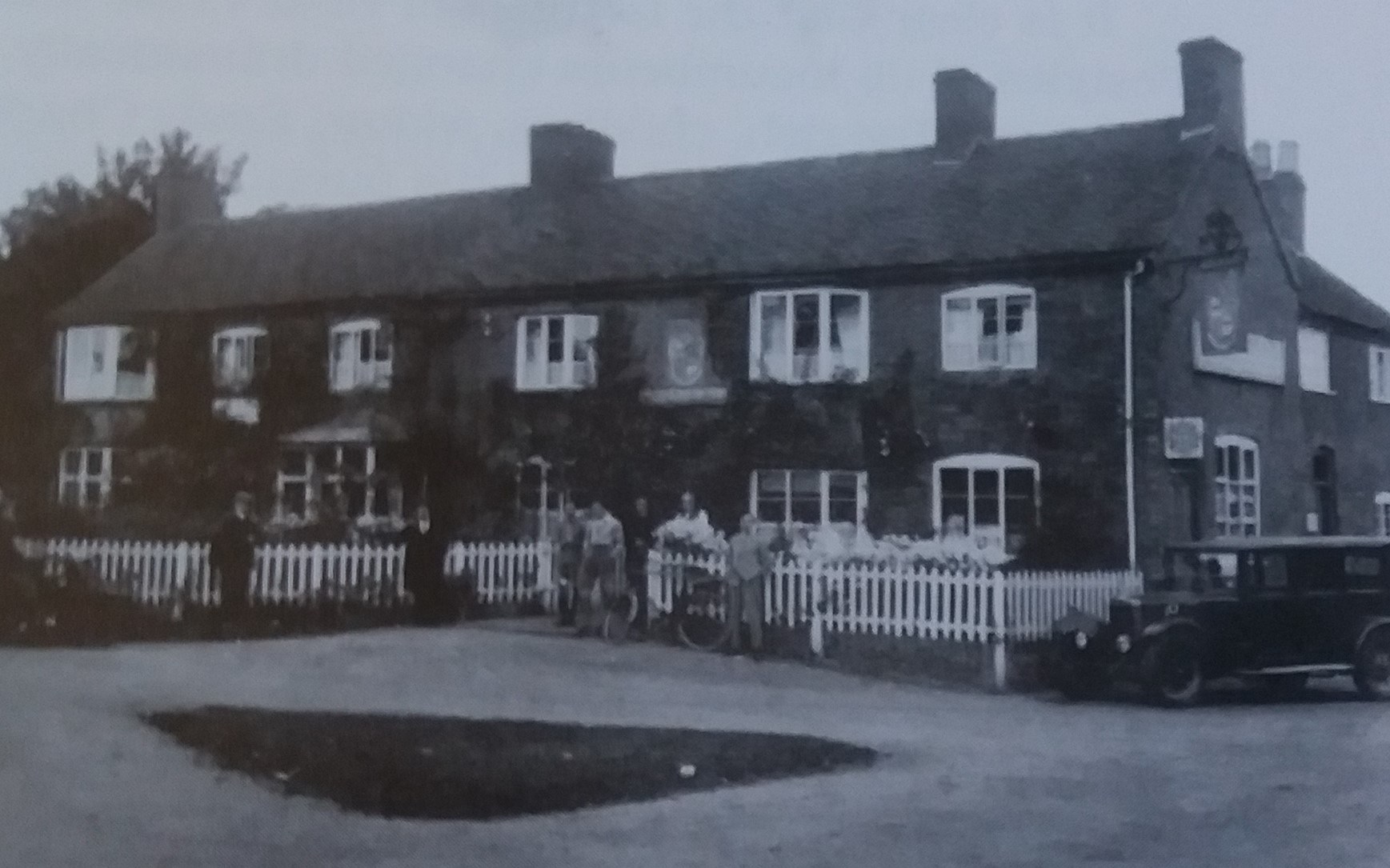
Hoar Cross Hall, where I grew up, is in the village of Hoar Cross, so small that it is almost a hamlet. The only thing that defines it as a village is the fact that it has a place of worship which is The Church of the Holy Angels, built by Emily Meynell in the 1870s in memory of her husband, Hugo. The name of the village was first recorded in 1230 and called ‘Horcros’ and may refer to a grey boundary cross which stood as a marker but is now long gone. No-one is entirely sure if this cross is the point where the four wards of Needwood Forest once met, or whether it indicated the extent of the land owned by Burton Abbey. Whatever the reason we shall never know now!
Emily Meynell-Ingram
The village was made up of a few cottages and farms and the Meynell Ingram Arms pub was actually a farmhouse dating back to the seventeenth century. Before it was known as the Meynell Arms it was a coaching inn called the Shoulder of Mutton. The name was changed in the 1860s when Emily and Hugo Meynell-Ingram were married and built the Hall and it has been thus ever since. Nowadays it is a high quality bar and restaurant - a far cry from its farmyard origins! (see header picture)
Next to the Meynell pub was a blacksmith’s Forge. Here in the 1860s worked blacksmith William Tooth who lived in the village with his wife Mary; he had worked on the ironwork of the Hall during its construction and was the village ‘smithy’ for many years afterwards. He and his wife became grandparents to a young girl called Inez Large who became the schoolroom maid at Hoar Cross Hall in the 1920s. Mary Tooth’s sister, Constance Madeley, was the wife of the landlord at the Buffalo Inn in the nearby village of Newborough and it was through her that Inez secured the job at the Hall.
The Buffalo Inn
After the Hall was built many of the cottages in the village were bought by the Hoar Cross Estate so they had somewhere to house their employees.
In the 1870s the school was b...
Motor Racing Days #64
Viv Wilson | 25th July 2023 |
Life at The Hall
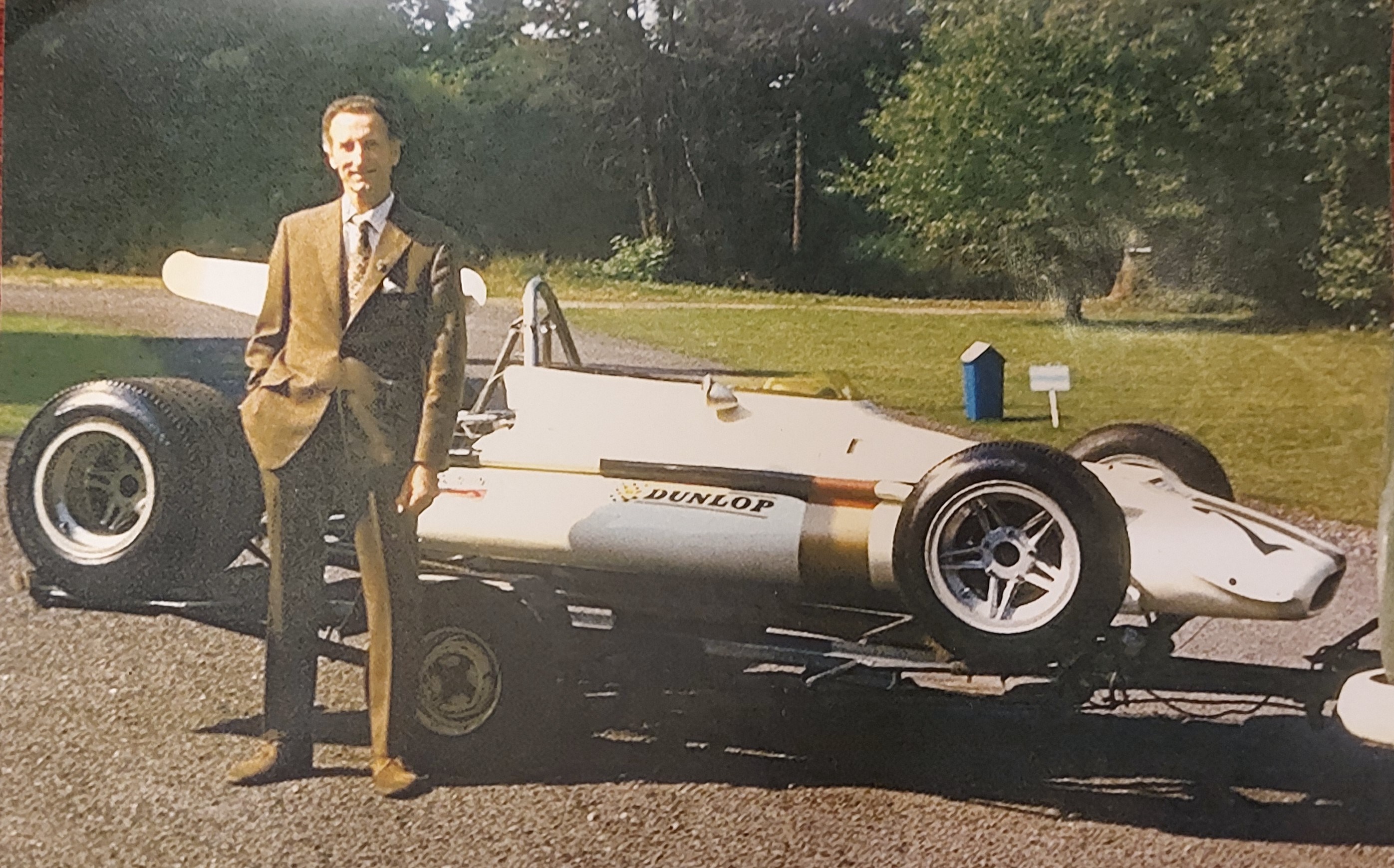
Although my blogs are about living at Hoar Cross Hall, I would just like to give a bit of background about my dad’s motor racing career in the years leading up to moving to the Hall as this will set the scene for later instalments of my story. With the Silverstone Grand Prix recently in the news, I thought this would be quite topical!
As mentioned my dad used to be a motor racing driver but he actually started off racing motor cycles in the 1930s. Because of this he became a despatch rider during the Second World War and spent a lot of time in North Africa. After the war he started racing motor bikes at nearby Donington Park and he raced there up to the beginning of the 1950s. After that he moved onto cars and drove a Cooper 500cc (which is the equivalent to Formula 3) along with the likes of Graham Hill and Sterling Moss. At the end of the 1950s he moved into Formula 2. Of course in those days it was completely different and much more ‘fun’, unlike more recent times where it has become a big money business. My dad didn’t have a rich family to support him or financial backers and probably did it all on a shoestring knowing him! He told me that he would always ‘take it easy’ and wasn’t too bothered about winning; drivers always got their ‘start’ money (a sum of money for entering the race) and he was satisfied with that. Accidents meant expensive repairs!
My dad as a despatch rider in WW2
During the 1960s he raced Lotus Elites and I have never forgotten the time, aged just 5 years old, when he took me for a spin around Mallory Park. I remember it all very clearly, even now. He strapped me into the car, watched by the mechanics in the pits. My poor mother was worried to death and kept asking if I’d be alright! My dad was his usual self, flouting the rules, and continued to do a few laps around the circuit with me clinging petrified to the side of the seat - I have been terrified of speed ever since – can you imagine that ha...
Rags to Riches #63
Viv Wilson | 18th July 2023 |
Life at The Hall

My family originated from Derby and my parents were married there in July 1952. Mum was 19 and dad was 36 so quite a bit older. They both lived in Derby and were very arty; my dad went to the Derby Sketching Club in his free time and my mum attended art college. I’m not sure where they met but it was either at something art related or at a dance, as was usual in those days. My dad was a sculptor by trade; I think his interest was sparked by seeing all the beautiful alabaster in Italian churches during the war.
My parents on their wedding day - 1952
After the Second World War he set up his own business making alabaster lamps, bowls and candlesticks among other things (see header picture). He would go to the alabaster mines at Chellaston near Derby and bring back huge slabs which were then cut down to smaller sizes at his works in Crosby Street. He also owned a car as well as his own business so was quite the catch for my mum! After they married he built a little bungalow next to the works for them to live in, which is still there after all these years although the works have now been demolished.
For someone from his background, owning a business was something of an achievement, being born the illegitimate son of a servant girl during the First World War. Even his birth is a story in itself as his mother worked at a nearby stately home as a servant and fell for the son of the house. My mum told me all about it years later – how they had fallen in love and were ‘walking out’ together even though it was frowned upon in those days for the upper classes to mix with the servants. However, the son caught tuberculosis during the First World War and sadly died so my grandmother had to bring my dad up alone with help from her own parents, and without getting married (this is where my dad gets his double-barrel surname from). When my dad was about 4 years old my grandmother married a sailor and they had a little girl, my Aunty Dorothy. He told me h...
Anyone for tennis? #62
Viv Wilson | 12th July 2023 |
Life at The Hall
With the summer season well and truly upon us and Wimbledon in full swing, I thought a blog about tennis might be in order! The game of tennis first started in the Mediaeval days and involved hitting a ball with a bare hand and later with a glove. By the 16th century the glove had become a racquet and the game had moved to an enclosed playing area and the rules had stabilized. This was known as ‘real tennis’. The word tennis came into use in English in the mid-14th century from French, via the Anglo-Norman term Tenez, which can be translated as 'hold', 'receive' or 'take', a call from the server to his opponent indicating that he is about to serve.
It seems that royalty and the upper classes played tennis a lot, with Henry VIII making the biggest impact as a young monarch, playing the game with gusto at Hampton Court!
However, the game was actually invented in Birmingham (England) and is the direct descendant of what is now denoted ‘real tennis’ or ‘royal tennis’ and continues to be played today with more complex rules. Many original courts still remain at Oxford, Cambridge, Falkland Palace in Fife, Scotland and Hampton Court Palace.
Wimbledon
Wimbledon itself is the oldest tennis tournament in the world and arguably the most famous. Since the first tournament 125 years ago in 1877, The Championships have been hosted by the All England Lawn Tennis and Croquet Club in Wimbledon, London and take place over two weeks in late June – early July. Tennis became popular because of the waning interest in croquet and the Club decided to organise a tennis tournament to pay for the repair of its pony roller, used to maintain the lawns. It must have been popular as its still going strong! Although you may enjoy the tennis I think people love the strawberries and cream too that are famously served there! Or you may like a tour around the museum - check it out here
Many stately homes would have had tennis courts including Hoar Cross Hall. Howev...
Change and the Country House #61
Viv Wilson | 07th July 2023 |
Life at The Hall

Hoar Cross Hall was clearly a very different house in the Victorian era compared to today. Like other country houses it has not been immune from the social and economic changes affecting all walks of life over the last hundred years.
At the beginning of Queen Victoria’s reign in 1837 the local landowner with his country house and estate was the focal point of the community, often dispensing law, charity and education. The estate would also provide employment for the local people and over fifty locals were employed on the Hoar Cross estate in the house and grounds plus many more on Home Farm along with carpenters, electricians and plumbers to keep the estate and cottages maintained. So not really any different to the hotel that is there today run by lots of staff and using local produce, except that the Hall was being run for just one family! Despite the vast wealth of some of these landowners many did good works and used their money to create charities to help the poor and uneducated as did Emily Meynell when she created a childrens' home called 'The Home of the Good Shepherd' from nearby Old Hall, her former home before she and her husband built the Hall.
The Home of the Good Shepherd at Hoar Cross
So what changed as the 19th century moved on? The Industrial Revolution caused a lot of change – the growth of industry spawned cities and a new class of people, self-sufficient and educated, not dependent on the old landlords. This shift in power had greatly accelerated by 1890. The mid-1870s had seen the agricultural depression take its toll and landed estates lost their attraction. Also there were reforming Acts of Parliament and the ballot box which were creating a lot of change. By the end of the 19th century, the traditional community responsibilities of the country gentleman had been eroded and institutionalized due to the creation of county councils in 1888. Up until then the justices of the peace (JPs) represented generally by the gentry ...
Midnight Pool Parties # 59
Viv Wilson | 16th June 2023 |
Life at The Hall

Following on with the summer theme my mind drifted back to those halcyon days of summer when we were all young and lively and hanging out with a large group of friends. By now Kev and I had left college and were both working but weekends were for fun and parties!
Kev and the band were also getting a few gigs around the area and after singing with them for a little while I gave it up and let a more professional singer take over – I needed to work on my confidence first! We still went to the local '76 Club' though to see live music – it was the start of the punk era and we saw the Sex Pistols there when they were just starting out – I have to say they didn’t get a very good reception as they couldn’t even start the first song properly and were actually booed off stage which was a ‘first’ for that club. Their ‘punk’ behaviour almost started a riot in what was normally a peaceful hippy venue!
Poster for the Sex Pistols
My mum still wasn’t convinced that Kev was the right person for me and was becoming quite determined to split us up. She tried to talk me into giving Kev up for six months - but we didn’t want to be parted. When he walked 7 miles from Burton to see me my mum asked him to dig a border (our borders were about 30 feet long!) as a way of proving himself. He did it too, bless him! We were very determined to stay together but my mum started to plan ways to prevent this – one of her schemes (we discovered) was to suggest to the local Police that Kev’s band were all taking drugs which led to the drug squad regularly following us. It was quite comical as we would be walking down the street and notice a car kerb crawling behind us; we would purposely stop at every shop and stare in the window for a few minutes so that they had to keep stopping too!
On another occasion Kev gave me a lift home on his motorbike late at night and we noticed a car driving behind us. As we got near to Hoar Cross the car was still a little wa...
Skools out for Summer! #58
Viv Wilson | 09th June 2023 |
Life at The Hall
When Hugo and Emily Meynell built Hoar Cross Hall they also included on their estate kitchen gardens, greenhouses, stables, a farm and cottages. Old Hall (their original home) was also on the estate and was accessed via a private road, which ran from the main road.
By the time the seventies came along the stable block and Old Hall were private houses and another part of Old Hall had been made into a children’s home. Emily Meynell had started this home in the Victorian days, calling it ‘The Home of the Good Shepherd’ but it was for boys only at that time. When we were there it was a mixed home and run by a husband and wife couple. They used to have fetes there in the summer and we would sometimes play there as they had lots of climbing frames and slides. At one of the fetes I was standing next to a crockery smashing stall and a piece of crockery cut my head open causing a huge gash. I ran all the way home screaming and crying with blood pouring down my face – no-one could stop me – and was taken to the nearby hospital to have it stitched up. I still have a huge scar from that cut but luckily no-one can see it!
Old Hall - the childrens home is on the right
The private road also joined up to our woods near the driveway and this is the road I walked along every day, up to the main road, to catch the bus to school. It was about half a mile but I hated walking through the woods, especially in the winter when the mornings were darker. I was growing up now and keeping different secrets from my parents than the previous escapades with my brothers, Gavin and Piers; I had started smoking! Going into Uttoxeter every day meant I could buy cigarettes for 30p a pack and smoke them on the way home. I often went up to our attic room to do my homework and write stories but also to have a crafty cigarette! One day, whilst walking round Uttoxeter at lunchtime, I saw a newspaper board telling everyone about a streaker that had run through the town the day before – ...
Summer Balls and Garden Parties #57
Viv Wilson | 02nd June 2023 |
Life at The Hall

Balls and functions held at Hoar Cross Hall were lavish affairs, especially before the First World War, with the catering and other services invariably being provided by premier London companies. Tea dances became popular in the 1880s but Balls with a supper included were also very popular amongst the aristocracy, especially if it was a 'coming out' Ball.
In 1907, Gunter & Co of Berkeley Square, London, could supply a Ball supper and refreshments for ten shillings (50p) a head, plus 'extra services'.
For a Ball Supper in January 1913, Mayfair Catering, Grosvenor Square, assured Lady Mary Meynell that they had engaged 'a superior staff of tall waiters' to attend her guests and, “.....if waiters are desired to be in Full Dress (silk stockings) the additional cost will be five shillings (25p) per man.” They also provided services for the Servants Dance Supper for 200 persons including silver plate and dishes, glass, china and linen, and the services of three pantrymen!
The liquid refreshment for this January 1913 event was provided by Thomas Mallorie & Co in Leeds. They invoiced 4 dozen bottles of fine claret, 3 bottles of port, one bottle of sherry, 6 bottles of scotch whiskey and 2 bottles of gin. The grand total 'less 10% discount' came to £13.13 shillings (£13.65). Delivery was made to Burton-on-Trent by Midland Railway and no doubt the chauffeur from the Hall would have collected it in the car in time for the supper. No nipping out to Sainsbury's in those days!
Emily Meynell's sister-in-law, Lady Mary wanted to organize an eighteenth birthday and 'coming out' Ball in 1912 for her daughter, Daisy. A Ball at the Ritz in London would have cost at least £600 so Lady Mary (now a widow) decided to hold a little dance for eight or more people at home. This was in a house in Surrey as they had moved out of the Hall by this time and had been living a more simple life. With the help of “a good cook and kind friends” the function cost exactly £50 a...
Bacon's 'Essay on Gardens' # 56
Viv Wilson | 25th May 2023 |
Life at The Hall

Francis Bacon was born in 1561 and was 1st Viscount St Alban. He wrote his Essay on Gardens in 1625, a year before his death of pneumonia. He was also Lord Chancellor of England under King James I and led the advancement of both natural philosophy and scientific method and his works remained influential even in the late stages of the Scientific Revolution. The essays he wrote between, mainly, 1612 and 1625 were about anything from love and marriage to superstitions to gardens and any subject in between! Bacon's genius as a phrase-maker appears to great advantage in the later essays and the 'Oxford Dictionary of Quotations' includes no fewer than 91 quotations from them.
In keeping with the Elizabethan style of the house, the gardens of Hoar Cross Hall were planned by Emily Meynell Ingram according to Bacon's 'Essay on Gardens'. Bacon's plan was one of magnificence and based on the Elizabethan garden with new ideas imported from France, Italy and Holland.
“The garden is best to be square, encompassed on all four sides with a stately arched hedge”.
Yews were used extensively for hedges, but more for walks and shelter within the gardens, than to form the outer enclosure. In larger gardens, there were two or three gates in the walls with handsome stone pillars surmounted with balls. The gardens at Hoar Cross have some of these features, in particular the wrought-iron gates at the bottom of the garden set in the middle of the Ha-Ha wall; these once led out onto the Deer Park.
The gates during renovation
The terrace was contrived to get a more extended view over the park beyond and the garden within. Terraces were generally wide with stone steps at the ends or in the centre – or both as at Hoar Cross – and were raised above the garden with a brick or stone wall. Everything in the Elizabethan garden was well-proportioned and walks formed the main lines of the garden design. Bacon describes the width of the path as “wide enough for four to walk abre...
The Church of the Holy Angels #55
Viv Wilson | 19th May 2023 |
Life at The Hall
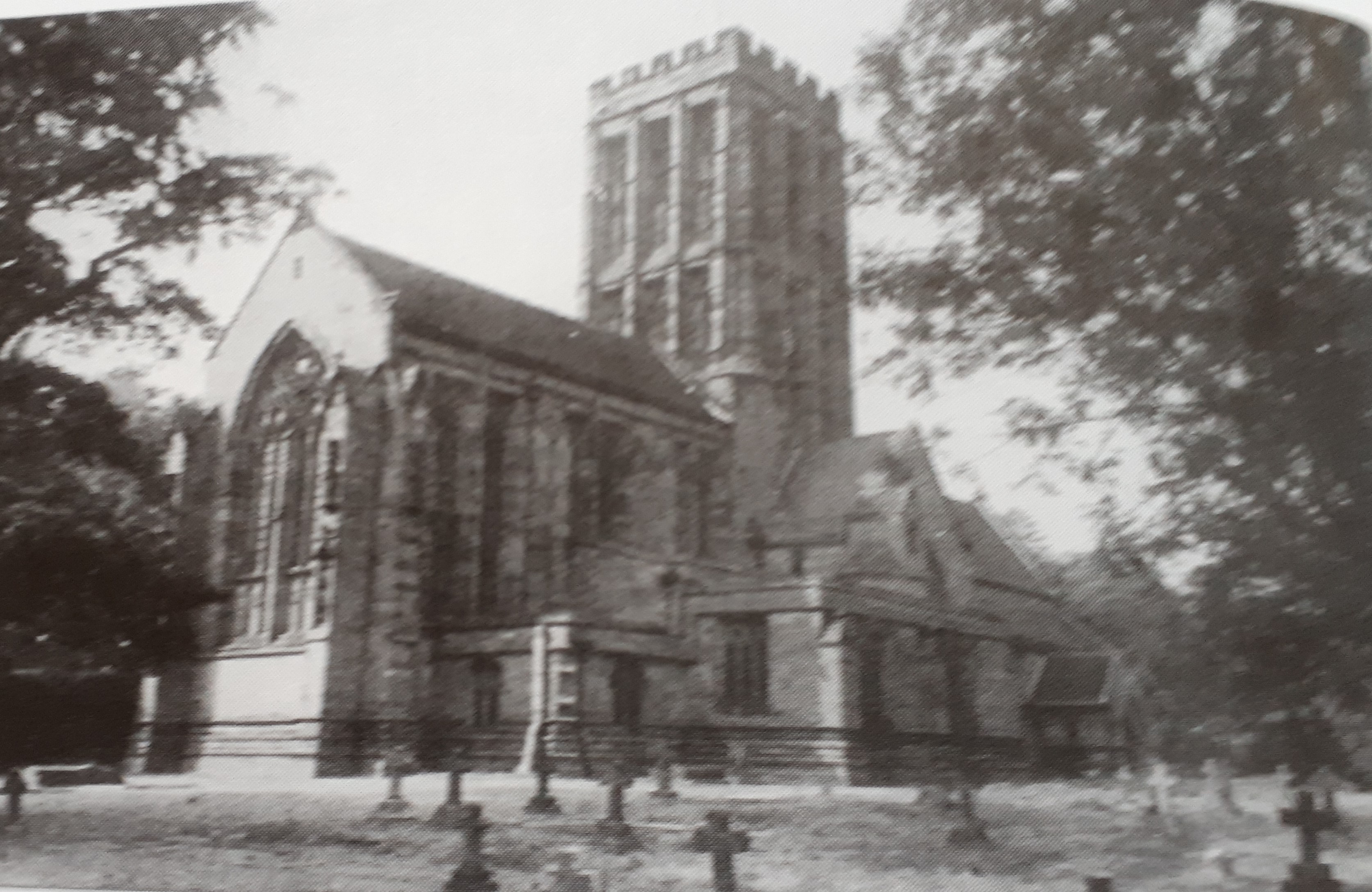
Many stately homes had churches built near them or even a chapel inside them, as was done at Hoar Cross Hall. However, the church that was built in the grounds of the Hall became known as 'The Cathedral of the Midlands' due to its magnificent structure and is generally regarded as one of the finest Victorian churches in the country. It resembles a cathedral in miniature, being more like an English minster than a humble village church.
When Emily Meynell Ingram's husband, Hugo died in 1871 from a hunting accident, she wanted to keep his memory alive. They had only been married for eight years and she had no children to comfort her and so in 1872 she commissioned George Bodley and his partner, Thomas Garner to start work on the church. Emily worked closely with them, in the building of, and later additions to, the church, for she made it her life's work.
By 1876 the church was finished although they did hold a service in the partly finished church on 25th January 1874 by the Bishop of Lichfield. It was the same Bishop who dedicated the church and consecrated the burial ground on 21st April 1876 and a few days later, the body of Hugo Meynell Ingram was removed from St Peter's Church, Yoxall, to its final resting place in the Chantry Chapel of the new church.
Bodley was the first pupil of Sir Gilbert Scott, who was active in the Gothic revival and whose numerous works included London's St Pancreas Station and the Albert Memorial. His son, George and Bodley worked together on the project and created a modern English perpendicular style of church. Specifically, it is English Gothic of the latter half of the 14th century but together Scott and Bodley promoted an ecclesiastical version of the William Morris movement.
George Bodley, Architect C1900
William Morris was an artist, writer and decorator concerned with raising standards of Victorian design and through the Arts and Crafts movement he promoted the creative dignity of craftsmen as opposed to manufactured...
Hoar Cross Hall - A bit of History #54
Viv Wilson | 12th May 2023 |
Life at The Hall

Hoar Cross was part of Needwood Forest, the 11th century lands of Henry de Ferrers. The land was passed down to Henry’s son and subsequent various people over the course of 500 years ending with the Webb family, around the 1730s, who bought the land and house known as the Manor of the Cross. This was quite a large house built on a hill near Yoxall (which is the village next to Hoar Cross). In 1740 the manor house was demolished and later the Hon. Charles Talbot bought the estate for £17,000. Eventually it was sold to Hugo Meynell, who already owned huge amounts of property all over the county and was now about to add another one to his portfolio.
This branch of the Meynell family originated from Leicestershire, namely Quorndon. In the 18th century Hugo Meynell had the title of ‘the father of fox-hunting’ as he had founded the Quorn Hunt in 1750 which became famous around the district. He bred his own strain of foxhounds and was the first person to study fox-h
unting from a scientific point of view. He bought Quorn Hall in 1754 and built stables and kennels there, having 30 horses stabled at its height. In 1758 he became High Sheriff of Staffordshire and Member of Parliament for Lichfield. When his son, Hugo, died in 1800 he sold Quorn Hall to the Earl of Sefton and left to live in Derbyshire; although the family owned large amounts of property all over the Midlands in at least five shires.The Meynell family claim to be descendants of the Norman baron, Hugo de Grand Mesnil, who came over with William the Conqueror. He is said to have died in Leicester in 1093 and his descendants settled in Derbyshire and Yorkshire. The sons of Hugo went off to the First Crusade and a representation of Hugo’s shield can be seen in one of the windows of Hoar Cross Church. Sir Hugo de Mesnil of Langley Mesnil represented his county under Edward III in five parliaments and thus started a long line of descent for the Mesnil family eventually changing the name to Meynell in the ...
Home fit for a King #53
Viv Wilson | 04th May 2023 |
Life at The Hall

With the Coronation of King Charles III almost upon us, this week's blog focuses on the Palace that he now calls home – or the 'Headquarters' of the Royal Family.
This residence is Buckingham Palace which is the administrative headquarters of the monarch of the United Kingdom and where many state occasions take place, but Buckingham Palace was originally known as Buckingham House. The building at the core of today's palace was a large townhouse built for the Duke of Buckingham in 1703 on a site that had been in private ownership for at least 150 years. It was acquired by King George III in 1761 as a private residence for Queen Charlotte and became known as The Queen's House. During the 19th century it was enlarged by architects who constructed three wings around a central courtyard. Buckingham Palace became the London residence of the British monarch on the accession of Queen Victoria in 1837.
The back of Buckingham Palace where the Queen had her garden parties
In the Middle Ages the site of the future palace formed part of the Manor of Ebury. The marshy ground was watered by the river Tyburn, which still flows below the courtyard and south wing of the palace. Where the river was fordable (at Cow Ford), the village of Eye Cross grew – it seems incredible now that there was a village right in the heart of London! Ownership of the site changed hands many times; owners included Edward the Confessor in late Saxon times, and, after the Norman conquest, William the Conqueror. The site was eventually bequeathed to the monks of Westminster Abbey.
In 1531, Henry VIII acquired the Hospital of St James, which became St James' Palace and in 1536 he took the Manor of Ebury from Westminster Abbey. These transfers brought the site of Buckingham Palace back into royal hands for the first time since William the Conqueror had given it away almost 500 years earlier. Although it seemed to be a very glamorous place to live it apparently had a few design faults and only th...
Queen Alexandra - my family #52
Viv Wilson | 28th April 2023 |
Life at The Hall

Here is a final selection of photos from the album of Queen Alexandra, found in the Library of Hoar Cross Hall. Alexandra enjoyed photography as a hobby and in 1908 put together this album of personal photos of her family to be sold for charity. It is a fascinating insight into another world, long gone now. As we lead up to the Coronation of King Charles III it is a reminder of all that has gone before and all that is to come in the future with our hard working royals.
King Edward VII and David
Here is the King in relaxed pose with his grandson, David, who later became King Edward VIII. David became the King in January 1936 and famously abdicated in December of the same year so he could marry Wallis Simpson - his reign lasted just 327 days.
Cowes Week
Alexandra's daughter Victoria (middle) is seen here with Miss Knollys and Lord Knollys at Cowes. Lord Knollys was the private secretary to Edward VII from 1901 – 1913 and accompanied him on all his trips. The annual Cowes Week festivities were during the month of August on the Isle of Wight and the King (when Prince of Wales) would sail his yacht, Britannia very competitively against his nephew, Kaiser Wilhelm II. This went on for many years until the Kaiser won in 1896 and Edward never entered the competition again. In 1909 the Russian Emperor and his family came over for Cowes week causing a security nightmare with two monarchs in one place!
The King of Denmark
This picture shows Alexandra's father, the King of Denmark (centre), Christian IX, on the steps of Bernstorff Palace, his summer residence near Copenhagen. With him are two of his grandsons.
The Palace was originally built for the Foreign Minister, Count Johann Hartwig Ernst von Bernstorff and completed in May 1765. However, Bernstorff left Denmark in 1770 after being dismissed by the regent, Johann Friedrich Struensee. It was designed by the French architect Nicolas-Henri Jardin and remained in the Bernstorff family until 1812. I...
Queen Alexandra - my family #51
Viv Wilson | 18th April 2023 |
Life at The Hall
More photos from the album of Queen Alexandra in the run up to the Coronation showing members of the royal family at leisure in the early part of the 20th century. Alexandra enjoyed photography as a hobby and in 1908 put together an album of her personal photos to be sold for charity. In it are photos of her husband King Edward VII and other royals spending time at Balmoral and Sandringham during their holidays – a rare insight into how the royal family spent their leisure time, which in those days would never have been seen before.
The Emperor of Russia's family
This picture was taken on board the Emperor of Russia's yacht, 'Standart' as they sailed off the coast of Reval, now known as Tallinn in Estonia. Alexandra's sister Dagmar was married to the Emperor of Russia, Alexander III and she can be seen in this picture with her daughter and her four grand-daughters, the children of her son Tsar Nicholas II who, along with his family, were all famously shot in 1918 by Bolshevik revolutionaries. Dagmar never got over their deaths, refusing to believe it, preferring to believe that they had escaped, although in her heart she had probably accepted that they had been killed. Dagmar's second son, Michael, was also shot by the Bolsheviks in 1918 as he had been declared the new Tsar after Nicholas II was forced to abdicate. Many members of the Romanov family were killed although others managed to escape or were already living in other countries at the time of the Revolution. A tragic end to 300 years of Romanov rule.
Family Members
Here stand members of Alexandra's family on board another ship as they sail to Norway and Denmark to see her family. On the left is Alexandra's sister Dagmar, the former Empress of Russia, next to her is Alexandra's daughter, Victoria, then her youngest daughter Maud with her husband, Charles Haakon, the King of Norway (King Haakon VII) on the right. Charles was not only her son-in-law but also her nephew as it was not uncommon fo...
Queen Alexandra - my family #50
Viv Wilson | 13th April 2023 |
Life at The Hall
Queen Alexandra was the daughter-in-law of Queen Victoria as she was married to her eldest son and heir, Edward VII. Her family were from Denmark and although of royal blood they were a distant branch of the royal house of Oldenburg and apparently lived very modestly on her father's army commission. However, in 1852 her father, Prince Christian of Schleswig-Holstein-Sonderburg-Glucksburg, was chosen to succeed his second cousin Frederick VII as King of Denmark thus the family's status rose and they moved into a new official residence, Bernstorff Palace.
Alexandra, or 'Alix' as she was known was born on 1st December 1844, her full name being Alexandra Caroline Marie Charlotte Louise Julia. She had five siblings, an elder brother called Frederik (who became King Frederik VIII of Denmark) and two younger sisters and brothers called Geogios (who became King Georgios I of Greece) Dagmar, Thyra and Valdemar.
At the tender age of sixteen Alexandra was chosen to be the future wife of Albert Edward, Prince of Wales, the son and heir of Queen Victoria. They married eighteen months later in 1863 and she seems to have been popular amongst the ladies of Britain, who copied her style of dress. Her title was Princess of Wales from 1863 to 1901 when the Queen died, the longest that anyone has ever held that title.
Together she and her husband had six children although the sixth child, Alexander, sadly died within a day of being born. Their eldest child Albert was the heir to the throne but he too died at age 28 during a flu pandemic so their second son George became the heir. He also married Albert's fiancee, Mary of Teck, after they became close in their grief at losing Albert. He went on to become George V who was Queen Elizabeth's grandfather and our present King's great-grandfather.
It seems that Alexandra enjoyed photography as a hobby and in 1908 put together an album of her personal photos to be sold for charity. This is the album that I found in the Library of Hoar Cros...
Royal Visitors at Hoar Cross Hall #49
Viv Wilson | 06th April 2023 |
Life at The Hall

With the King's Coronation looming on 6th May in the UK, I thought I'd do some royal family related articles this month starting with royal visitors at the Hall in the 1920s. I also have a book called Queen Alexandra's Christmas Gift Book which was left in the Library and shows personal photos from her own camera which she took of the royal family between 1900-1910 - a rare insight indeed into what the royals did in their leisure time! I will be sharing these photos over the next month leading up to the Coronation and hope you find them as fascinating as I do.
Royal Visitors
From earliest times the king's court has travelled around the kingdom so the king could see first hand what was going on in his realm. When the king showed up, the local subjects were expected to provide food, entertainment, and accommodations in the form of mediaeval banquets. For the King or Queen's subjects this could be very expensive and not all royalty was welcome! However, this was the only way that people could see their King or Queen and know that they were real. Fast forward from the twelve century to the 21st century and royals are still touring the country so their subjects can 'see them and believe in them'.
The Queen's grandparents, King George V and Queen Mary also went on many tours of England including Yorkshire, Derbyshire and the West Midlands, visiting mines and factories. They also visited the wounded in hospitals during the First World War which were often makeshift ones in stately homes such as Clandon Park in Surrey and Belton House in Lincolnshire. Hundreds of Britain's stately homes were turned into military hospitals as the country fast ran out of hospital beds when hundreds of thousands of wounded soldiers returned home. The Meynell family themselves offered their London home to be used during the First World War but it was not needed in the end.
During the King and Queen's tours they would have stopped at nearby stately homes that were big enough to accommodate...
The country house in society #48
Viv Wilson | 31st March 2023 |
Life at The Hall

Country houses are to be found throughout the British Isles and are a peculiarly English phenomenon. Houses range from mediaeval manor houses to classical Palladian mansions, elegant Georgian residences to the Gothic buildings of the Victorian era. A great many have survived for two main reasons: Britain has been spared much of the havoc of war and revolution affecting other countries.
Wentworth Woodhouse, Yorkshire
Wentworth Woodhouse (above) is one of the largest stately homes in Europe and was visited by King George V and Queen Mary in 1912. It is now with the Wentworth Woodhouse Preservation Trust and is much bigger than this photo shows!
The 19th century saw a huge boom in the building of country houses due to the great wealth that was rising up among the upper classes. Most of this wealth came from the Industrial Revolution and swollen incomes from land enclosures. By 1850 the accepted view of the kind of house suitable for an English gentleman has been described as:
“A gentleman's house should be substantial, serious and in a style suitable for country life. It should be dignified, not ostentatious and suitable for family life. It should provide decent quarters for servants and be comfortable but not luxurious.”
Elizabethan and Gothic were endorsed as being of old English style, Elizabethan for English gentlemen and Gothic for Christian English gentlemen, with a religious tone on the increase up to 1870, by which time the Victorian religious revival had started to wane. Wealth in itself didn't guarantee entry into the landed gentry and certainly not into the aristocracy.
Bestwood Lodge, Nottingham - a Gothic style mansion
Bestwood Lodge (above) was built in 1862 in the 14th century Gothic style for the Duke of St. Albans. It is asymmetric with all the Victorian love of ornament and exaggeration. It was occupied by the army during the Second World War and is now a hotel.
It should be noted that the aristocracy or nobility ...
Behind the green baize door #47
Viv Wilson | 23rd March 2023 |
Life at The Hall

"The green baize door - dividing line betwix servant and master.”
All stately homes had at least one green baize door and Hoar Cross Hall was no different. This was the door used by the servants to access the main part of the house unobtrusively and silently so they could go about their work without disturbing the family. The Hall had a spiral staircase at each end of the house for the servants to use and the green baize door on the ground floor opened onto the Garden Corridor which led to the Chapel and the main house, as well as the garden. The green baize door on the first floor opened onto the east wing corridor and guest bedrooms and from this corridor the servants could access the family bedrooms, not by going through the main double doors but by keeping to the inner corridor out of sight! It all sounds very confusing and hopefully they didn't get lost! In many large houses the servants' door hid cramped attic bedrooms and basements, hidden tunnels and corridors contrasting with the grandeur of 'upstairs'. Housemaids were often taught to turn their face to the wall if their employer passed them in the house. Clearly the aristocracy thought they were too grand to be looked upon by a 'lowly' servant!
So why were these doors covered in green (or red) baize cloth? Baize is a sturdy green cloth which insulated against noise and absorbed smells from the kitchens. Brass tacks held the cloth in place and was often very decorative in design (see header picture). Baize dates back to 1525 and a well-known 17th century ditty mentions 'bays' as follows:-
“Hops, heresies, bays and beer
All came to England in just one year.”
It became popular in the mid 18th century and was used mainly for cabinet and closet linings in Europe – also games tables. I'm sure you are all familiar with pool and snooker tables showing off their red and green baize cloth.
Baize was also used as clothing for monks, nuns and soldiers as it was very warm and hard wearing. Is there n...
The Halifax Estates - Garrowby #46
Viv Wilson | 15th March 2023 |
Life at The Hall

Hugo Meynell-Ingram and his wife Emily Charlotte built Hoar Cross Hall to be their home after getting married in 1863. Emily was the daughter of Sir Charles Wood, 1st Viscount Halifax who owned considerable estates in the north of England. Their wealth came from the discovery of coal on their ancestral estate. In addition to this Sir Charles had a very successful political career, owning many seats in Garrowby and Pocklington near York; Hickleton near Doncaster and a home in Belgrave Square, London.
He was a member of the Whig party, which in those days was likened to the Liberal party of today and served as Chancellor of the Exchequer from 1846-52. In the 1850s he became First Lord of the Admiralty and Secretary of State for India. As President for the Board of Control he took major steps in spreading education in India which led to every province having a school and education department. Universities were opened in Calcutta, Bombay, Madras, Punjab and Allahbad. Despite his busy career he married Lady Mary Grey, daughter of Earl Grey of the tea leaf fame and went on to have seven children!
Emily spent her childhood between Hickleton and London and would often visit Buckingham Palace and play with Princesses Victoria, Helena and Louise, Queen Victoria's daughters. This is obviously how she became connected to the royal family and would in later years host King George V and Queen Mary at Temple Newsam and Hoar Cross Hall. In 2005 Queen Elizabeth and the Duke of Edinburgh stayed with Lord Halifax at Garrowby when Royal Ascot was moved to York. Lord James Irwin is also the godson of Camilla, the Queen Consort so there are many royal connections between these two families right up to the present day.
Hickleton Hall on the Halifax Estates
Garrowby is the largest of the Halifax Estates and extends to over 13,000 acres. The estate is located 13 miles east of York on the Vale of York in the west to the edge of the Yorkshire Wolds to the east. Garrowby Ha...
Hoar Cross Hall - Life below stairs #45
Viv Wilson | 10th March 2023 |
Life at The Hall

This week I’ve done a history blog about the servants who lived at the Hall from the 1870s to the 1950s when the Hall became empty. They were an essential part of keeping a big house running but were often not appreciated by the aristocracy as they went about their day to day duties.
The life of a servant in Victorian times was a hard one. They had to rise at 5am to clean and light all the fires and dust and polish the floors, then do a day’s work, often not getting to bed much before midnight. No wonder they didn’t live to a great age in those days! By the end of the 19th century there were nearly one and a half million servants; most young girls went into domestic service when they left school. A large house with neither running water nor electricity would need a lot of help to keep things going. There was also the continuous cooking that needed to be done – for the family above stairs and the servants below. Everyone had meals at different times; the servants would obviously eat before or after they had served the family. The children and nursery staff would eat at around 5pm and then there were the afternoon teas and full English breakfasts! Everything had to be made from scratch of course so the cooks must have been cooking something or other from dawn until dusk. It must have been exhausting!
A kitchen not unlike the one at the Hall
In the grounds there were around 20 gardeners and groundsmen who helped to keep the constant weeds down and tend to the rose bushes and hedges. This in itself would have been a full time job. The kitchen gardens and greenhouses would have provided a lot of the produce they ate as well as the pheasants and other game birds that were reared to be eaten. There was also a carp pool for their fish stock. In total there were about 50 servants employed by the Meynell family which included cooks, housemaids, chambermaids, a lady’s maid, a governess, a nanny, a butler, footmen and a house-keeper among others. All staff w...
The life and times of an upper class family #44
Viv Wilson | 03rd March 2023 |
Life at The Hall
On 11th August 1863, Hugo Francis Meynell Ingram married the Hon. Emily Charlotte, daughter of Sir Charles Wood, Bart, afterwards 1st Viscount Halifax. The Woods were an old gentry family, for many centuries respectable York merchants. They were later to turn grand upon the discovery of coal beneath their ancestral estates. This was the great Barnsley field, with several hundred acres of Britain's deepest and finest coal. Sir Charles Wood was created 1st Viscount Halifax in 1866 and had a very distinguished political career. The family seats of Garrowby, Pocklington and Hickleton (where Emily was born) had been acquired by his father from the Wentworth family; they also owned a London house in Belgrave Square.
Hickleton Hall, Emily's childhood home
Emily Charlotte's mother was Lady Mary Grey, youngest daughter of Charles Grey, 2nd Earl and Whig Prime Minister from 1830-34. It was he who the famous Earl Grey tea was named after, after a special taste was created by adding Oil of Bergemot to black tea. His administration was also responsible for passing the first Reform Act of 1832 which changed how the elections were done and meant that the middle classes could vote also.
Once Hugo and Emily were married they moved to Hoar Cross and lived in Old Hall which was a hunting lodge near to where they were later to build Hoar Cross Hall. Tragically, after moving into the Hall, which took nine years to build, Hugo died from injuries sustained in a riding accident some fourteen months earlier which had left him bed-ridden. Upon her husband's death, Emily's brother, the Hon. Frederick George Lindley Wood, moved from Hickleton and came to live with her. He was a huge help with managing all the estates that Emily had inherited on Hugo's death. He also became her 'reader' as Emily had poor eyesight and couldn't read or write for more than a few minutes.
Old Hall, built around a courtyard
In 1878 Frederick married Lady Mary Lindsay, the third daughter of the Ear...
Gardeners World at Hoar Cross #43
Viv Wilson | 24th February 2023 |
Life at The Hall

In this week's blog I am focusing again on the servants who spent their lives looking after the Meynell family along with their home and gardens. In it’s heyday Hoar Cross Hall had around 28 people employed to keep the 20 acres of grounds tidy and weed free. In Victorian England the most common of all male servants was the gardener. At Hoar Cross the head gardener had numerous under-gardeners known affectionately as ‘digging slaves’! They were responsible for producing fruit, vegetables and growing luxury items in and out of season, much of it under glass. Adjacent to the house was the carp pool and greenhouse area along with a palm house; next to these was a walled kitchen garden. This supplied the house with all its fruit, vegetables and herbs. The palm house produced palms and pot plants along with flowers for the house; these would be brought across to decorate the main rooms when an important function was on.
The ‘bothy’ house was in one corner of the kitchen garden. (A bothy is a simple dwelling on an estate, usually used for gardeners and other workmen). Here lived the ‘bothy boys’ who were young under-gardeners. Their job was simply to sweep the pathways all day and keep the leaves at bay!
The 'bothy boys'
There were two elderly chaps, Mr Knight and Mr Dukes, who were solely responsible for the south garden – however, their task was complicated by the fact that they couldn’t get on with one another! Grass was cut by a horse drawn mower, a task carried out by the chauffeur of all people! One of the family told us that back in the early days the head gardener was pushed around in a wheelchair when he was older, inspecting the lawns – apparently if he saw a weed amongst the grass blades he would tell one of the gardeners to pluck it out straightaway!
Gardeners at work on the hedges
Emily Meynell Ingram employed a Mr Rowley especially to carry out her plans of planting the yew hedges, of which there were many. At each s...
What the Butler Saw! #42
Viv Wilson | 17th February 2023 |
Life at The Hall

Anyone who’s seen Downton Abbey will remember Carson the butler. He is exactly how a butler would have been in the 19th century, a grand, authoritarian figure, commanding respect and awe and most of the servants would have been scared to death of upsetting him! He was dressed like a gentleman of the period and generally ran the household with an iron fist.
Although most big houses had a house steward who was in charge of accounts and general running of the household, a butler was more commonly engaged by the wealthy. They usually started as footmen and worked their way up fro there. Most butlers stayed at the same household until they retired and probably became almost like one of the family!
The butler at Hoar Cross Hall was called Gus Carter and he was with the family for over 40 years, joining the staff in the mid-1930s. When the family left the Hall in the 1950s and bought the smaller Hollybush House in nearby Newborough he went with them until his retirement. He and his wife celebrated their Diamond wedding anniversary in 1972.
The Carters celebrating their anniversary
However, when at the Hall his main duties would have been looking after the wine cellar and silverware or 'plate' as it was known. This was kept in a room next to his bedroom so he could keep an eye on it and make sure no-one stole anything. Similarly with the wine cellar, he would have kept it all under lock and key so none of the servants could have a crafty drink when no-one was looking! There was actually a Chubb walk-in safe in the basement where, I assume, the more valuable items were kept for special occasions. Near to the butler’s room was a Chubb wall safe, which would have been used for keeping guests’ valuables in while they were staying at the Hall. Not unlike a hotel nowadays! He also waited on table at all the meals and at night, secured all doors and windows and checked the fires were safe before retiring to bed. If there was no valet in the house then the butler ...
The Kitchen Maid's Tale #41
Viv Wilson | 08th February 2023 |
Life at The Hall

If you were young, free and single – oh, and very well-to-do – the 1920s were the decade to be a part of. The upper classes had lots of time on their hands and enjoyed post-First World War delights such as the theatre and jazz clubs.Not so for the lower classes, in particular a young girl who was to become the kitchen maid at Hoar Cross Hall in the 1920s. The ‘depression’ after the First World War brought stark poverty to her home and many like her. Her name was Jean Rennie, and she was extremely intelligent having won a scholarship to Glasgow University to study French and music. However, the £5 bursary she got (equivalent to around £250 in today's money) was taken by her father and used to buy whiskey in his local pub. Her hopes of a career in music were dashed and she needed to find employment.
Jean was now known as Jenny and had many jobs as a servant, including one in a castle in the Highlands! She was, in her own words, a good housemaid but never a good servant. With memories of hungry children fresh in her mind she could never get used to the wanton waste of food left on plates, in the homes she worked in. Her mistresses were always untidy with stockings, shoes and underwear “flung everywhere” and powder “spilt lavishly” – this always rankled with her and she never really got used to the ways of the aristocracy.
She gradually travelled down the country and eventually found a job in London. Although she was still a scullery maid, she worked under a skilled chef who taught her much and she hoped for a career as a cook. Her employers were good and so were the wages. When she got the job at Hoar Cross Hall she could not only read a menu (in customary French) but also write one and prepare many of the dishes herself. Lady Dorothy Meynell was very impressed with her and as her husband, Hugo Meynell was about to take a small shooting party to their Laughton estate, she asked Jenny to go with them to do the cooking. Jenny recalled how thrille...
An Edwardian Schoolroom Maid #40
Viv Wilson | 04th February 2023 |
Life at The Hall
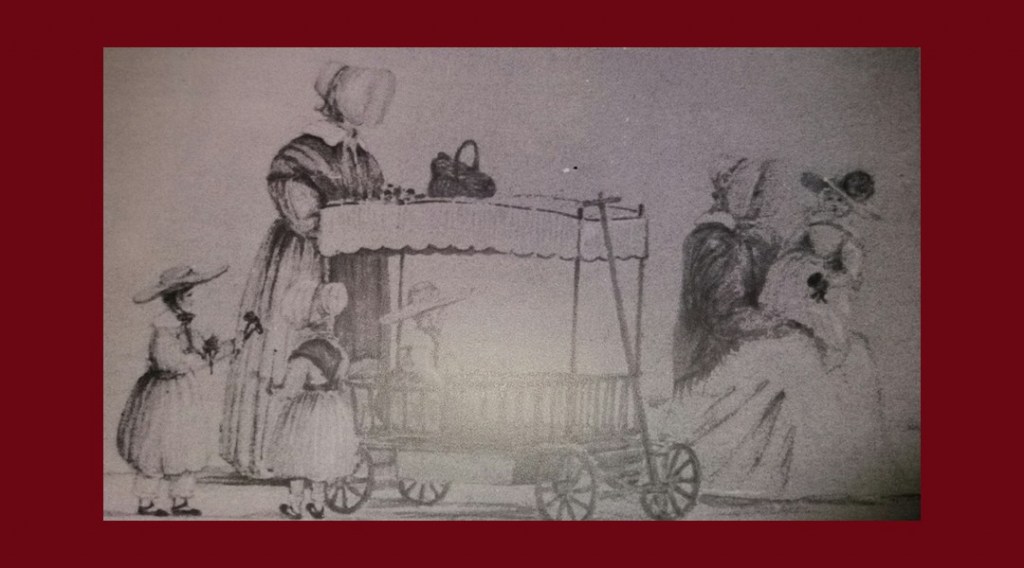
For the first 75 years of Hoar Cross Hall’s history about 50 servants were employed by the Meynell family in the house and grounds. Among these was a young girl of fifteen who started work in 1920 as a Schoolroom Maid. Her name was Miss Inez Sophia Large and she had connections to Hoar Cross through her grand-parents, William and Mary Tooth, who lived in the village where William was the blacksmith; his smithy was just along from the Meynell public house. He had worked on the ironwork of the Hall during its construction in the 1860s. Inez’s aunt, Constance Madeley, was the wife of the landlord at the Buffalo Inn, in nearby Newborough, and it was through her that she secured the job at theHall. Inez’s parents were themselves in service; her mother had been a lady’s maid and her father was a butler for the Spanish Ambassador in London – from which source Inez assumes her Christian name originated.
There was little choice but to go into service in those days (her sister, Beatrice, was also a nursery maid with the Earl and Countess of Lichfield), and she was engaged on a salary of £18 per annum. Her mother made her uniform, which comprised of a morning dress and an afternoon dress, and Lady Dorothy Meynell supplied her cap. She was the personal maid to Lady Dorothy’s eldest daughter, Dorothy, who was just four years younger than Inez. She also looked after Dorothy’s younger sister, Rachael.
The schoolroom at this time was situated just off the main Entrance Hall, and immediately below the nursery. Inez worked under the supervision of Mrs Catt, the housekeeper, Miss Rhodes, the lady’s maid, and the head housemaid, Rose.
Mrs Catt, the housekeeper, on the right - 1918
Her day began at 6am every day and she was so afraid of oversleeping that she kept an alarm clock under her pillow! The first job of the day was always to clean the grates and get the fires lit, then sweep and dust the schoolroom, lay the table for breakfast, call the gove...
The Origins of the Stately Home #39
Viv Wilson | 27th January 2023 |
Life at The Hall

Why are stately homes so called? Stately home actually means 'a large impressive old house with interesting history and usually visited by the public.' Well, I suppose they do look very 'stately' for a start but these houses were also a status symbol for the great families of England, who competed with each other to provide hospitality for the royal household who would travel around England meeting their subjects.
Stately homes were huge mansions which were always beautiful and the epitome of perfect architecture, often designed by famous architects of the day. The gardens too would be perfectly landscaped to show balance, variety, sequence and colour. One of the most famous landscape gardeners of the 18th century was 'Capability' Brown who was very much a 'hands on' gardener and designed many gardens and parklands for the aristocracy, which are still seen and enjoyed today by visitors to these grand houses.
Typical landscaped parkland
All large houses are called different names too and you may have thought that this was down to the size of them, as I did. And this is true to a point but they also tell us what type of person lived there and what the house was used for. For instance, a Palace belongs to a royal household, a Chateau belongs to a King or nobleman and a Manor is always on an estate of a Lord's land. The people who lived in them were usually aristocrats – families of high social rank with a title such as Lord, Lady, Earl, Duke or Baron. Often they were Members of Parliament and Justices of the Peace due to their high education and would act as the local 'law' in their community.
Buckingham Palace has 775 rooms
Most of these houses were built in the 17th and 18th century as manor houses in the heart of an agricultural estate, so effectively they were like farms with a farmhouse albeit a bit grander! The Lords that owned the manor houses would then provide employment for large numbers of indoor and outdoor staff in the rural communi...
Hickleton Hall and the Meynells #38
Viv Wilson | 20th January 2023 |
Life at The Hall

This lovely Grade II listed Georgian house in South Yorkshire was once the childhood home of The Honourable Emily Charlotte Meynell who married Hugo Meynell of Hoar Cross and who, together with Hugo, built Hoar Cross Hall to be their family home in 1873, a hundred years before my family lived there.
The original house was called Hickleton Palace and had been built for Judge Francis Rodes in the 16th century but in 1745 Hickleton Hall was built just to the south of this house after the estate was bought by Godfrey Wentworth in about 1730. Thirty years later he extended the house and added two low wings, one either side, and a servants wing (see header picture).
Emily's father, Charles Wood, 3rd Baronet, inherited the house in 1846. He was MP for Grimsby, Wareham, Halifax and Ripon. He was also Chancellor of the Exchequer from 1846-52 and was created Viscount Halifax in 1866, three years after Emily was married. He died in 1885 at Hickleton Hall, which was then inherited by Emily's brother Charles Lindley Wood, the 2nd Viscount. His grandson, Edward became Viceroy of India from 1926 to 1929 and Foreign Secretary during the Second World War and created Earl of Halifax in 1944. So quite a lineage that she was born into! During the Second World War the house was actually the headquarters of I Corps after the Dunkirk evacuation in May 1940.
Emily was tutored here by a Charles Dodgson who came from Christ Church in Oxford in 1852. He would later become the famous author Lewis Carroll who wrote 'Alice in Wonderland' among other stories. The mirror over the fireplace inspired his story about 'Alice through the looking glass'. When Emily got married in 1863 she took this mirror with her to her new home, Hoar Cross Hall, and for many decades it hung over the fireplace in the Library until the Meynells left in the 1950s. However, the present owner tracked the mirror down and it is now back in the Library on the mantlepiece again where Emily herself used to look at it! ...
The History of Temple Newsam #37
Viv Wilson | 13th January 2023 |
Life at The Hall
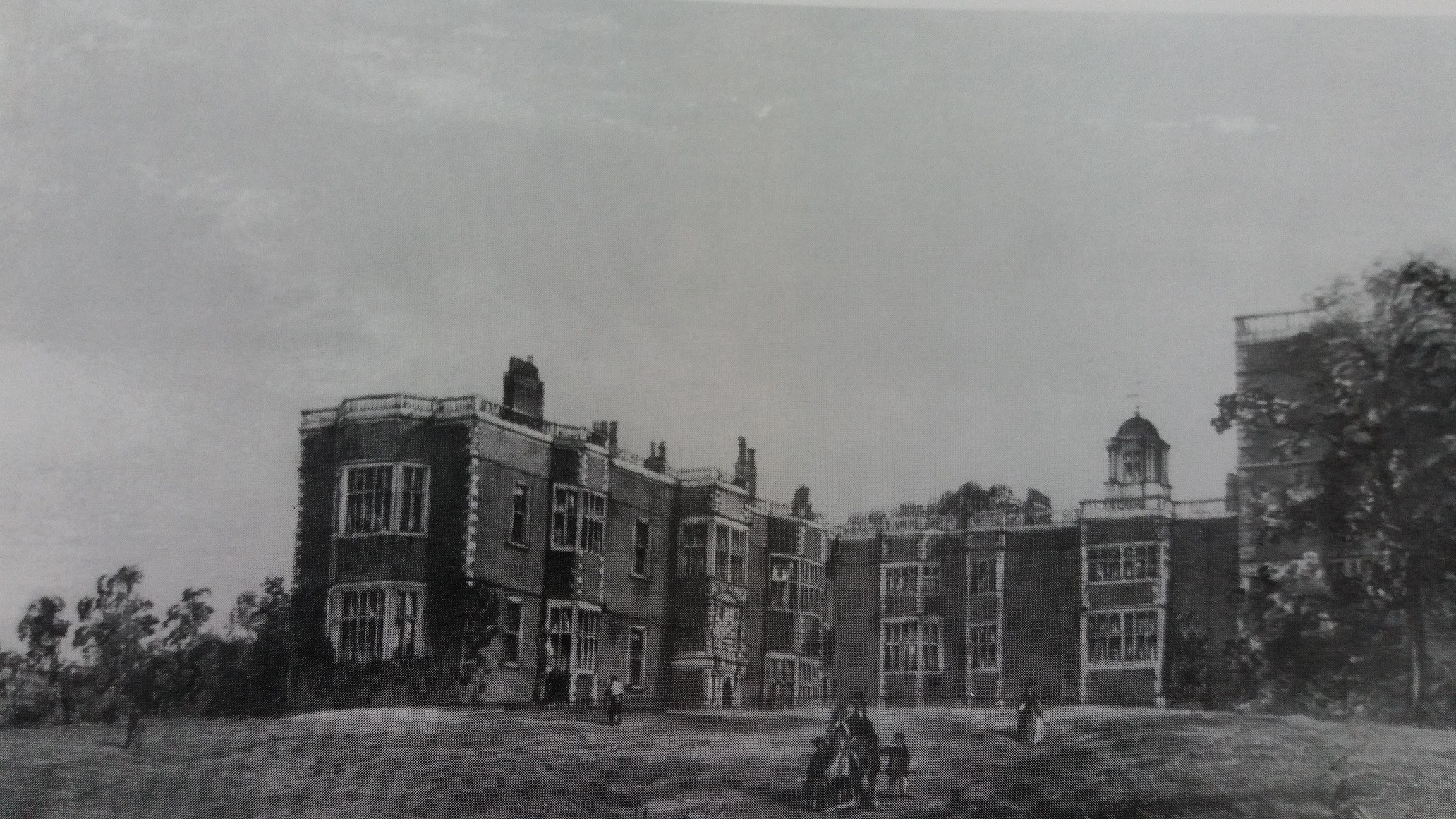
In 1782, Hugo Meynell's grandfather, Hugo Meynell of Quorndon, the 'father of fox hunting', married the Hon. Elizabeth Ingram Shepheard. She was the daughter of Charles Ingram, 9th Viscount Irwin and Lord Ingram. The family seat was Temple Newsam in Yorkshire and this was how the Hoar Cross Meynell family became associated with this great house. Through this marriage of Hugo and Elizabeth, the Meynell family also inherited the Ingram estates in Lincolnshire, acquired by Sir Arthur Ingram in the first half of the 17th century. In 1793 Hugo bought the Hoar Cross estate and built a hunting lodge which was known as Old Hall.
Hugo and Elizabeth had six children, the eldest being Hugo Charles who inherited the Temple Newsam estate from his aunt; however, he had to assume the surname of Ingram in compliance with the terms of the will of the last Lord Irwin. So this was how the Meynell Ingram name came about, something which was quite common with the aristocracy in those days. Hugo Charles went on to marry Georgiana Pigou in 1819; their eldest son was Hugo Francis Meynell Ingram, the last of the descendants of Sir Arthur Ingram to inherit Temple Newsam.
Hugo Francis Meynell Ingram
Temple Newsam had been built by Thomas, Lord Darcy, early in the 16th century. He, coincidentally, had married a Meynell, and a descendant married Elizabeth Meynell, so there are a lot of associations with the Meynells early on. Here the unfortunate Earl of Darnley was born. Married to Mary, Queen of Scots, he was murdered two years later, supposedly by Mary's next husband, the Earl of Bothwell. The house was rebuilt between 1622 and 1637 in Jacobean style by Sir Arthur Ingram and later the grounds were landscaped by 'Capability' Brown, the famous landscape gardener. The Ingrams and their descendants were to own the estate for nearly 300 years before it passed to the Halifax family. The house was sold to the City of Leeds for £30,000 in 1922 and has been a decorative arts...
The War Years and Beyond #36
Viv Wilson | 06th January 2023 |
Life at The Hall

During the Second World War, life in country houses changed dramatically. It was no different at Hoar Cross Hall. The flower borders on the main lawns were turfed over to reduce maintenance and vegetables were grown in areas formerly restricted to flowers. Evacuees from Birmingham came to stay for the duration of the war and they lived in the basement, as it was considered to be the safest place. I imagine that they must have been in the care of the servants as they were living amongst them but it must also have been quite exciting for them to move from a bombed out city to the relative safety of the countryside, although they must have missed their parents of course. Many children in those days never left the cities and towns where they lived and often didn’t know what a cow looked like in real life! To see all the lawns and woods at the Hall must have been incredible for them and no doubt they helped out with the vegetable patches!
Two of these youngsters returned to the Hall in the mid-1980s and spoke to my mum about the kindness they received from the family. They also told her about the ‘secret airfield’ hidden away in a copse behind the Ha-Ha wall (the wall which separated the grounds from the deer park). Apparently aircraft were kept here in readiness for action, it being a Satellite Landing Ground (SLG) site serving Fradley aerodrome, near Lichfield. The Hall was also offered as an Auxiliary Red Cross Hospital during the war but nothing came of this, probably owing to the lack of mains water. However, during the First World War, the Meynell home in London was offered to the War Office and the Red Cross and became a Military Hospital for officers, being used by Francis Meynell himself who was wounded in action.
View from the Deer Park (the copse is on the right)
One feature at the Hall was the daily barometric readings; these had been taken since 1880 up until the Second World War, when readings ceased. The Clerk of Works at Hoar Cross, namely...
A New Year Calamity! #35
Viv Wilson | 30th December 2022 |
Life at The Hall
The New Year’s Eve Balls at Hoar Cross Hall were usually the highlight of the year. After twelve months of hard work, especially running the Mediaeval Banquets twice a week through the winter, we were always ready to see out the year in style with a big new year party. In those days it was always black tie for the men and long dresses for the ladies – usually around 500 people bought tickets for an evening of entertainment with a dance band, disco and a meal. At midnight a man dressed in traditional Scottish regalia, including a kilt and sporran, would pipe in the new year with his bagpipes. Down the Long Gallery he would slowly walk and into the Ballroom with his pipes droning on. When midnight arrived a net full of balloons was dropped onto all the guestsfrom the ceiling, out came the party poppers and hats and everyone joined hands to sing ‘Auld Lang Syne’. Once all the traditional stuff was done the band started up again and we all did the Hokey Cokey, the Conga and other silly dances that only happen on New Year’s Eve!
My parents were having a trial separation around this time so my dad had to run the New Year’s Eve Ball on his own. I helped, as I had before, with the administration; posting out tickets and doing a bit of book-keeping. The week prior to the Ball was spent moving furniture about and cleaning the house up after all the banquet tables and benches were removed. We usually used some of the banquet tables for people to sit at but this particular year my mum had stored them all away in the basement and put a lock on the door – these were her property now! This left my dad in a bit of a quandary about what to do for tables and after a lot of ranting he decided that he would have to hire some. As my dad was well known for being ‘careful’ with his money, he didn’t want to spend too much and hired the cheapest tables and chairs he could. They arrived on the day of the Ball in a van with a man (or two) and they carried them into the B...
A Christmas Haunting! #34
Viv Wilson | 23rd December 2022 |
Life at The Hall
The typewriter keys clattered away as Viv wrote her story. It was coming along nicely and she was feeling pleased with herself. The attic room that she and her brothers had made into their ‘den’ was ideal for getting away from everybody and having some peace and quiet and she quite forgot about the time as she lost herself in the plot. Suddenly she looked up and realized how dark it was getting; the December nights were pulling in and it was already quite dusky by 3.30pm. Quickly she packed her books and folders away and prepared to go downstairs. How she hated being up in the attics when it was getting dark as it was so spooky! The wind was starting to howl outside and the familiar sound of a banging window started. Viv sighed and stood in the doorway of the room – should she go and investigate or leave it? Against her better judgement she walked up the corridor towards the noise and checked all the rooms but as usual all the windows were shut tight. The banging continued along with the familiar prickle down her spine. She needed to get out of here and quick!
As she turned to go back along the corridor towards the other end she could hear people talking but not clearly, just a general babble of voices. Viv was in a complete panic now as she knew there was no-one up there and she started to run along the corridor willing the noises to stop, feeling the knot in her stomach and sensing the sheer terror in her mind as she ran to get away from the voices, the people, the footsteps.
The green baize door banged behind her and Viv breathed a sigh of relief. She’d made it out alive! At least that’s what it felt like; she vowed never to go up to the attics again on her own or in the afternoon. She gradually stopped shaking and went to find her mother who was putting up Christmas decorations in the Library. This was where they spent Christmas Day as, not only was it a nice room, but it had a large fireplace which meant a roaring log fire to keep them warm. Viv for...
Moving On - the end of an era #33
Viv Wilson | 13th December 2022 |
Life at The Hall

After ten years of growing up in a stately home (Hoar Cross Hall), I have come to the end of my story. After my parents’ divorce it was agreed that my mum bought out my dad's half of the house and he had to leave his dream home forever. He and Gavin moved out to live in Burton-on-Trent and my mum carried on running Mediaeval Banquets for a few more years. She and the singer eventually got together much to my dad’s chagrin. The singer spent a lot more time at the Hall helping my mum run the banquets; however, Piers didn’t really get on with him. When he was about 14 years old my dad received a phone call from Piers – he had run away from home and was ringing from the phone box in the Meynell Ingram Arms car park! He told my dad that he was hiding behind a bush and could he come and get him. Of course, my dad was only too happy to fetch him and get him away from my mum and the singer and he set off to find him hiding, as he had said, behind a bush in the darkened car park. Piers continued to live with my dad and he joined in with the go karting along with Gavin and also got very involved with BMX stunts, even having a half pipe in their yard to practice on!
After a couple of years my dad moved to a much bigger house in Burton which had been an old doctors’ surgery that Kev and his family had gone to when Kev was young, ironically! He continued to buy and sell antiques and his interest in motor racing never waned; he often went to local races with his friends. Gavin eventually moved out to live near Norwich with his girlfriend Helen, and they married in 1991. He joined a motor racing team over there and went on to have a very successful career in racing, eventually running his own GP2 motor racing team, iSport International, who became world champions. He also takes amazing photographs of wild animals and birds for a hobby – check out his website here
Piers stayed with my dad and used the large workshops at the new house to renovate cars and sell them, fo...
Moving Out #32
Viv Wilson | 07th December 2022 |
Life at The Hall
And so the day arrived a month or so after our wedding when my dad had to leave Hoar Cross Hall. Ten years after moving in he was now moving out, leaving his dream home for my mum to live in alone. Gavin moved with him and Piers was away at school most of the time. It was a mammoth task as he had so much stuff to move, especially from the basement. He had some heavy machinery too that he’d brought with him from his alabaster days, including a band saw which we used to saw up logs for the huge fireplaces in the main rooms. He had bought a house in nearby Burton-on-Trent which had some outbuildings for a workshop and there he moved to start afresh.
He carried on buying and selling antiques and often went to antiques fairs and sale rooms with his friends. He also continued with the go-karting with Gavin and this kept them busy at weekends. However, the whole experience had left him very bitter and he would constantly talk about it whenever we went round to see him, making visits fraught with tension!
Dad at an antique fair in fancy dress!
However, we carried on with our lives as newly-weds and bought a house in a nearby village. It was completely empty and needed an oven and washing machine amongst other things. My dad was keen to help and offered to buy anything he saw at a sale room as he knew he could get them cheap; and that was how we ended up with a 1950s style twin tub washing machine! Well, it matched the age of the house I suppose! Many a week whilst washing, I cursed my dad for buying it as it always broke down and flooded the kitchen – eventually we threw it out!
A little while later we went to an auction at a large farmhouse that was quite local to us and because of the interesting ‘lots’ it had, quite a few of our well-to-do friends were there too. My dad was also there and told us he’d bought an oven for our new house. He couldn’t wait to tell us that it had only cost him £1. Even in those days £1 was ridiculously cheap, especiall...
Get me to the church on time #31
Viv Wilson | 02nd December 2022 |
Life at The Hall

And so our wedding day at Hoar Cross Hall arrived bright and clear, all thoughts of solicitors, legals, fights and arrests behind us! Myself and my bridesmaids went to get our hair done in the morning and Kev slapped a piece of steak on his jaw to bring the swelling down after the rather unfortunate fight at his stag do. Fortunately, the bruise didn’t show up too much on the photos! My brother Gavin drove my dad’s Mercedes Benz car all the way down the drive and back up the road to the church – this is one of the drawbacks of having a church next door to your house; you don’t get to drive all through the town with everyone looking at you! At least a small crowd of locals were gathered around the gate to the church as we got out, and we had a few photos taken then walked down the aisle to ‘Here comes the bride’.
However, as Kev had not attended the rehearsal (remember, he was in someone’s shower!), he didn’t have a clue what was going on or where to stand or anything! When we came to say our vows, the vicar got his name wrong and so I nearly married a ‘Derek’. There was much whispering at the front as we told him the correct name. Again, when I put my ring on the Bible, the vicar thought it was two rings as I had a Russian wedding ring with three bands. He started to say ‘with these rings……’ and once again, there was much whispering at the front as we explained that it was only my ring!
The church where we got married
And then, just as we were on our knees to receive the blessing, Chris Meek (my dad’s old racing driver) walked in with a beautiful model on his arm. She was wearing a short cheesecloth dress and with the sun behind her it was completely see through! Anyone who remembers the Lady Di photo will know what I mean! We heard a sharp intake of breath as the whole congregation turned to face the door – talk about upstaging the bride!
Finally, the ceremony was over and I was married to Kev (not Derek) and as we walked o...
Get me to the church on time! #30
Viv Wilson | 25th November 2022 |
Life at The Hall
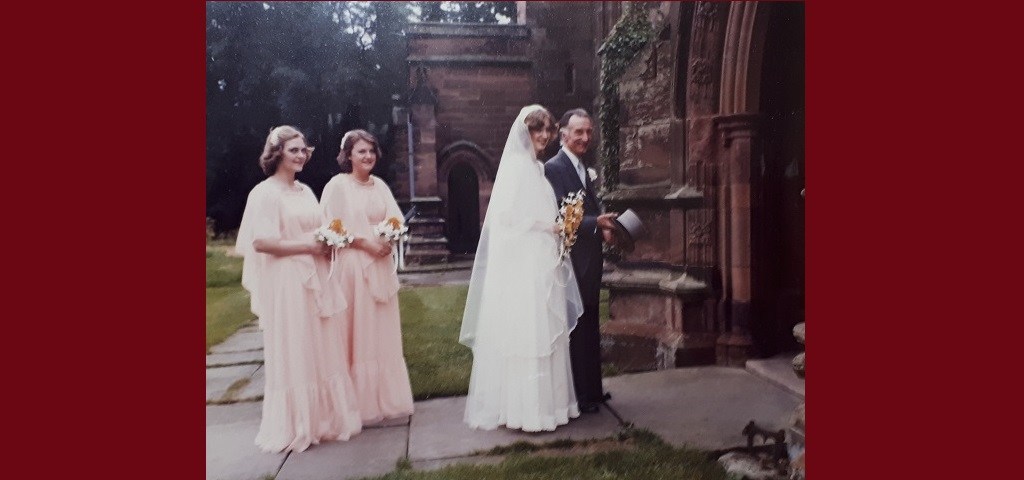
My dad was having to move out of Hoar Cross Hall and we had decided to bring our wedding forward so we that we could get married in the church in the grounds and then have the reception afterwards in the Hall, which was after all our family home. The wedding preparations were going quite well and as we knew lots of musicians it wasn’t hard to find a local band and a DJ to do the disco. A friend of my dad’s offered to do the catering and the bar was set up with plenty of kegs from the local brewery in Burton on Trent. I had two bridesmaids and we all went to Birmingham one day to choose our dresses and shoes – it was all kept very simple really as I had no help or advice from my mum as most brides do. Kev’s parents had eloped after the war and got married in a register office with two witnesses dragged off the street, so they had no idea what you did to plan a wedding! I managed to find a church near to Kev’s house and sorted out the reading of the banns. Then we went to the vicarage across the road from my house and booked the date. The vicar told us in no uncertain terms that he would expect us to be there when the banns were read. However, as we never got up before lunch on a Sunday, try as we might, we never actually managed to hear our own banns being read!
It was almost as bad at the wedding rehearsal. I went to the church with my dad and the two bridesmaids but Kev never managed to get there as he was fitting a shower for someone! I don’t think the vicar was very impressed with us!
The church where we married (in the grounds)
The nearer it got to our wedding date the more we worried about my mum turning up. It wasn’t that I didn’t want her there but that my dad told us we couldn’t possibly have her there as he would ‘see red’ and a row would ensue. We really didn’t want a huge argument on our wedding day but knowing my dad’s temper we weren’t sure that he would be able to control himself so he offered to see his solicit...
Lest We Forget #28
Viv Wilson | 11th November 2022 |
Life at The Hall
During the two World Wars the Meynell family of Hoar Cross Hall served their country alongside many others from all walks of life. After each war there was huge social upheaval, especially for women, who had been doing what was traditionally 'mens work' during the war and weren't prepared to go back to domesticity. At the time of the First World War Frederick Meynell and Lady Mary Meynell were living at the Hall with their five children. Their four sons all served in the war and their daughter Margaret served in the Red Cross as a volunteer.
Their eldest son Francis was a Major but was wounded in action in 1917 with severe wounds to his back. He was moved from the Duchess of Westminster Hospital to the Meynell Hospital in Lennox Gardens, London, the home of his mother, Lady Mary. She had offered her house to the War Office and the Red Cross, and it had become a Military Hospital for officers.
When the Second World War started in 1939 the next generation of Meynells stepped up to help out. Francis had married Lady Dorothy and their eldest son Hugo also served as an officer and was awarded the Military Cross, although he was seriously injured at Al Alamein leading to his early death in 1960. Their daughter, also Dorothy, moved back to Hoar Cross at the outbreak of war and joined the Joint War Organisation of the Red Cross and St John, which meant travelling overseas to Africa, Sicily and Italy.
One of the Meynell's overseas photos
My own father served in the Royal Army Service Corps (RASC) as a despatch rider because he owned a motor bike and had been racing it at Donington Park during the 1930s. He served in North Africa and Al Alamein as did Hugo Meynell. Who knows - they could have crossed paths during the war, my dad never dreaming for a moment that he would one day own Hugo's house! After North Africa he moved to Italy and spent a lot of time in Bari and Naples eventually moving up towards Belgium. He kept diaries of his time during the war an...
See you in Court #27
Viv Wilson | 04th November 2022 |
Life at The Hall

The saga of my parents’ split continued as we grew up in our stately home, although their behaviour was anything but stately for most of the time! Seven years of arguing and fighting were about to come to an end and the solicitors had finally agreed on a date to go to court. We carried on helping my dad to run the Hall and he still went to his boat in Caernarfon at weekends to get away from the house but we were all getting weary of it now. We were young adults and wanting to get on with our own lives. After five years together we were hoping to get married at some point so we were glad that it was finally going to be sorted out one way or another.
Gavin was now involved with a band who regularly supported The Jam so he was often travelling around the country with them. Piers had been sent to a local boarding school so we saw even less of him than before. My mum continued to live in the West Wing apartment and was now seeing the singer who sang at the banquets. My dad sat on his own most nights with only the parrot for company. When he found out about the singer it started a fresh load of outbursts from him as he now felt that my mum and her admirer were trying to take his house and business off him! He constantly ranted on about it and often threatened to shoot the singer with his gun – I don’t think he would have done but then again, with his temper, who knows! This latest twist in the story did nothing for my dad’s sanity and my mum was still hoping to have him committed and kept making appointments for him with the psychiatrist. Once again, the Police were called every week informing them of the threats on the singer’s life and they eventually took my dad’s gun licence off him just in case anything did happen!
The original suits of armour that were swapped over
We tried to keep out of the way as much as possible and stayed in Burton all week, where we worked, and came home at weekends where we would meet up with our friends and party in the ap...
Alice - the ghost in the mirror #26
Viv Wilson | 28th October 2022 |
Life at The Hall
In 1865 Lewis Carroll wrote another story about Alice following on from ‘Alice in Wonderland’. It was called ‘Alice through the Looking Glass’. In this story Alice climbs onto the mantlepiece over the fireplace in her lounge and finds that she can climb through the mirror into another world which is reversed, just like a reflection. Once again, she encounters strange figures in a world dominated by a chess set and nursery rhyme characters, among others. But what inspired Lewis Carroll to write about a little girl having lots of adventures?
In the 1850s Charles Dodgson (Carroll’s real name) studied at Christ Church in Oxford. A new dean, Henry Liddell, started around about that time and brought with him his wife and young family. One of his daughters was called Alice and this little girl was widely thought to be the inspiration behind his stories but Carroll always denied this. In 1852 he became a tutor for the children of Charles Wood of Hickleton Hall in Yorkshire. During the summer a friend of the children, Mary Heath, stayed at the hall and this is the little girl believed to be his inspiration for Alice. But also, the room in which he taught the children had a lovely mirror over the mantlepiece which is exactly the same as the picture of the mirror in his story ‘Alice through the Looking Glass’. So it seems that lots of things from that time inspired him!
Alice in Lewis Carroll's book
When Charles Wood’s daughter Emily got married in 1863 she took the mirror with her to her new home, Hoar Cross Hall, and there it hung over the fireplace in the Library for many decades until the Meynells left in the 1950s.And so herein lies the connection between Alice and the Hall! Fast forward to the 1990s when Hoar Cross Hall had a new owner, Steve Joynes. He converted the Hall into a Spa Hotel and managed to source a lot of the original furniture from the Victorian era when Emily Meynell (nee Wood) lived there with her husband, Hugo. He found the ...
Whodunit in the Library #24
Viv Wilson | 08th October 2022 |
Life at The Hall

When we first moved to Hoar Cross Hall, growing up in a stately home seemed an idyllic way to live – and lots of fun if you’re a child. This rambling old house full of empty rooms and secret doors, wild gardens and woods to explore, was in some ways a dream come true for our family, certainly for my father. But as we turned from children to teenagers the isolation and lack of public transport was frustrating. Coupled with this was my parents' fighting and subsequent split, living at each end of the house and battling for the house and business through their solicitors.
The small gardens we loved to explore
The effect this had on me, as the eldest child who perhaps saw more of it than my brothers, was that I started to have awful pains/cramps in my stomach. Whenever Kev and I were out I would often double up in agony and once I was in such pain in a local bar that the landlord rang for an ambulance and I was whisked off to hospital with suspected appendicitis. After a full examination I was told there was nothing wrong but that it was probably my nerves affecting me. After a visit to my GP he told me it was nerves and prescribed Valium tablets (now known as Diazepam) which was a drug that relaxed you when you felt under stress. Both my parents were already on this medication and we would often borrow each other’s tablets if one of us ran out! I now realise what a ridiculous situation this was – Valium was a powerful drug to be taken for 2-3 months but back in the 70s I was freely given it (aged 17) and was not monitored at all by the GP. I took it for well over a year and mixed it with alcohol totally oblivious to the effects it might have on me – one of them being that I frequently had horrendous hallucinations. My dad was already visiting a psychiatrist each week and my mum took me to see one too! Our family really was falling apart at the seams!
However, the feud went on and my dad was still selling items from the house unbeknown to my mum. He ...
The Graveyard Shift #23
Viv Wilson | 30th September 2022 |
Life at The Hall
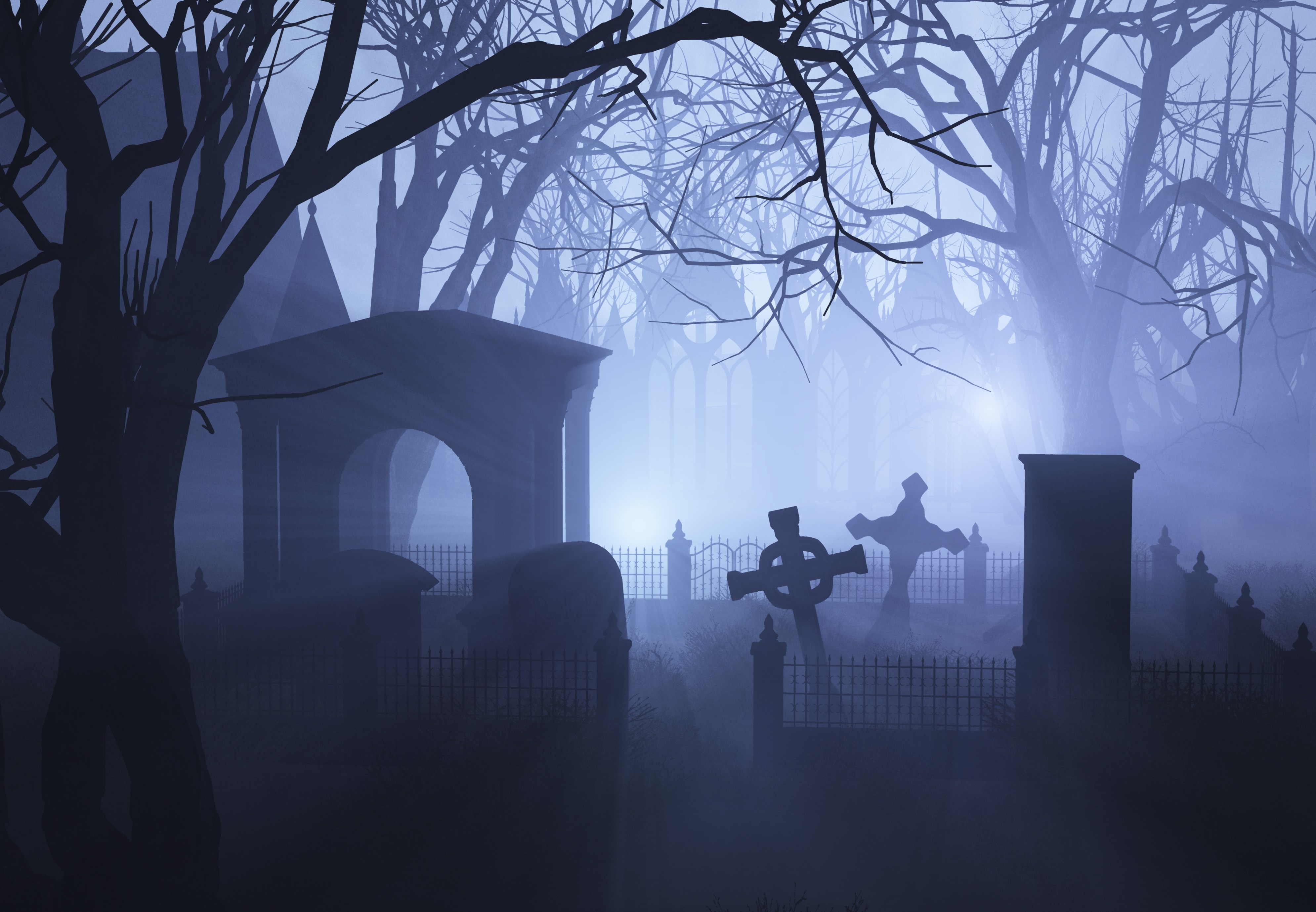
Life carried on at Hoar Cross Hall as best it could in difficult circumstances. My dad continued to go to Arms and Armour Fairs to buy and sell antiques and we also went to a mediaeval banquet in Cheshire one night, although it wasn’t anywhere near as good as ours! Once or twice we took my dad out with our friends to Derby, where he originated from, and that seemed to cheer him up. But he really needed to get away from the house for longer periods of time and when he saw a boat advertised for sale at Caernarvon he jumped at the chance and bought it. It was an ex lifeboat called The Bembo so quite sturdy, although in need of a lick of paint and a bit of TLC. The town of Caernarvon is in Wales and is host to a huge castle where the Prince of Wales (now King Charles) had his investiture in 1969. The Bembo was moored by the harbour and the town was full of quaint, narrow streets which we loved to explore. Once he had bought the boat he would go away at weekends and usually took my brothers Gavin or Piers along with him. My mum jumped at the chance of making me go as well so she could keep me away from Kev, but after a couple of times on my own Kev decided to come along too, and was able to help fix the electrics on the boat amongst other things.
Caernarvon Castle in the 1970s
When my dad went away at weekends during the summer months Kev and I would open the house to the public. As well as a bad atmosphere between my parents there was also a bad atmosphere between me and my mum and mum and Kev, so we were all trying to avoid each other! My mum had taken over the West Wing apartment when the tenants left, leaving my dad with one less rental income. She was also putting Yale locks on all the rooms that she used in the house as well as any storage rooms used for the banquets. This infuriated my dad who obviously didn’t have access to them once the locks went on. One of these rooms was the cupboard off the Entrance Hall which held the meter boxes, so we now had...
Suits you Sir! #22
Viv Wilson | 23rd September 2022 |
Life at The Hall
When we moved to Hoar Cross Hall in 1970 the organ in the private chapel wasn’t working as the house had been empty for 20 years. It was such a shame as it had been designed by George Bodley, the famous organ maker of the 19th century. The chapel itself had been added about 25 years after the house was built at the staggering cost of just under £1000! When one of the visitors to the house said he could fix the organ, my dad readily agreed. This chap really loved organs and volunteered his services free of charge just for the love of mending this musical work of art; my dad was over the moon! Alas, after removing all the pipes and laying them out in the basement, he found that he couldn’t carry on with the renovations and we never saw him again!
The Bodley organ
Enter Kev, my then boyfriend, who saw the organ in pieces and offered to try and fix it - we spent many an hour in the chapel and basement trying to work out which pipe went where and how to make it play again. But it was quite complicated and it was an ongoing project for some time – still, it kept us busy!
My parents' divorce was getting quite bad by now and I had to accompany my dad to the solicitors on more than one occasion, mainly for moral support but also to back up what was happening in the house between my parents as I witnessed quite a lot of arguments and fights. The solicitor explained to my dad that his antique collection would be classed as ‘chattels’ in the marriage and my mum would be entitled to half of it. My dad went berserk as usual and vowed that she wouldn’t have any of his antiques as they were his means of earning money and not part of the domestic furniture. However, as he was classed as self employed, his collection was deemed part of the family belongings. The Mediaeval Banquets business was now in my mum’s name as a limited company and she ran them herself, separate from my dad. My dad still got the rent money from the apartments and the takings from the h...
A Home fit for a King #21
Viv Wilson | 17th September 2022 |
Life at The Hall
In this week's blog I am focusing on the royal family again and the stately homes which they grew up in.
The main residence for the Royal family is Buckingham Palace which is the administrative headquarters of the monarch of the United Kingdom and where many state occasions take place, but Buckingham Palace was originally known as Buckingham House. The building at the core of today's palace was a large townhouse built for the Duke of Buckingham in 1703 on a site that had been in private ownership for at least 150 years. It was acquired by King George III in 1761 as a private residence for Queen Charlotte and became known as The Queen's House. During the 19th century it was enlarged by architects who constructed three wings around a central courtyard. Buckingham Palace became the London residence of the British monarch on the accession of Queen Victoria in 1837.
Buckingham Palace in 1837 showing Marble Arch on the left
In the Middle Ages the site of the future palace formed part of the Manor of Ebury. The marshy ground was watered by the river Tyburn, which still flows below the courtyard and south wing of the palace. Where the river was fordable (at Cow Ford), the village of Eye Cross grew – it seems incredible now that there was a village right in the heart of London! Ownership of the site changed hands many times; owners included Edward the Confessor in late Saxon times, and, after the Norman conquest, William the Conqueror. The site was eventually bequeathed to the monks of Westminster Abbey.
In 1531, Henry VIII acquired the Hospital of St James, which became St James' Palace and in 1536 he took the Manor of Ebury from Westminster Abbey. These transfers brought the site of Buckingham Palace back into royal hands for the first time since William the Conqueror had given it away almost 500 years earlier. Although it seemed to be a very glamorous place to live it apparently had a few design faults and only the state rooms were gilded and colourful. It wa...
Royal Visitors at Hoar Cross Hall #20
Viv Wilson | 10th September 2022 |
Life at The Hall
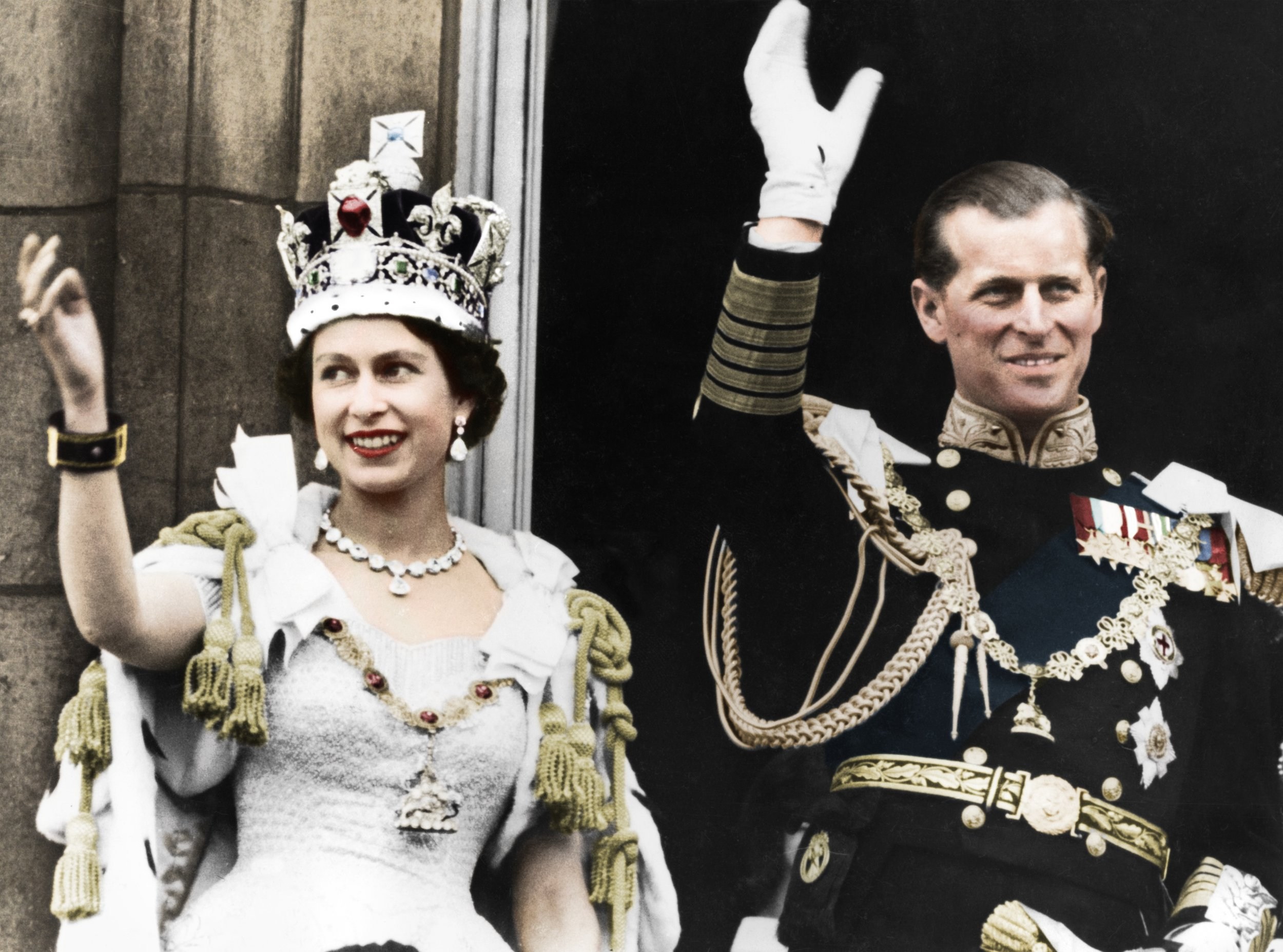
From earliest times the King's court has traveled around the kingdom so the King could see first hand what was happening in his realm. When the King showed up, the local subjects were expected to provide food, entertainment, and accommodations in the form of mediaeval banquets. For the King or Queen's subjects this could be very expensive and not all royalty was welcome! However, this was the only way that people could see their King or Queen and know that they were real. Fast forward from the twelve century to the 21st century and royals are still touring the country so their subjects can 'see them and believe in them'.
Although I published this blog in June to celebrate the Platinum Jubilee of Queen Elizabeth, I felt it was fitting to publish it again upon hearing the sad news of her death.
The Queen's grandparents, King George V and Queen Mary went on many tours of England including Yorkshire, Derbyshire and the West Midlands, visiting mines and factories. They also visited the wounded in hospitals during the First World War which were often makeshift ones in stately homes such as Clandon Park in Surrey and Belton House in Lincolnshire. Hundreds of Britain's stately homes were turned into military hospitals as the country fast ran out of hospital beds when hundreds of thousands of wounded soldiers returned home. The Meynell family themselves offered their London home to be used during the First World War but it was not needed in the end.
During the King and Queen's tours they would have stopped at nearby stately homes that were big enough to accommodate themselves and their entourage, which would include servants, private secretaries and equerries. The whole household would be in an uproar as servants rushed to get ready guest rooms and bathrooms along with the extra space needed for the royal servants. This scenario was acted out in a Downton Abbey episode when King George V and Queen Mary came to stay for a few days. In actual fact the storyline was based o...
Like Father, Like Sons #19
Viv Wilson | 02nd September 2022 |
Life at The Hall

As previously mentioned in earlier blogs my dad used to be a racing driver during the 1950s and ran his own team in the 1960s, travelling all over Europe in his trusty Volkswagon van with his two mechanics and driver. He didn’t have big sponsorship money behind him and most of it was done on a shoestring but he came back with lots of funny stories of their van breaking down or some rural ‘hotel’ that they had stayed in. From each country that he visited he always brought me back a doll dressed in the traditional costume of that country. There was quite a collection and I still have them; I used to put them on display in the Library when our house was open to the public.
My dolls - can you see your country represented?
Because of this background in motor racing, Gavin wanted to start kart racing when he was about 14 and kept pestering my dad to get him a kart. Dad promised that he would take him to the races but said he didn’t have time to do the preparations and so Gavin had to learn the hard way how to do it! He made lots of mistakes early on, including the engine nearly falling off in one race, but he got there in the end!
As he got better he moved into the seniors when he was 16 and started to win trophies – now he was getting serious! He raced at a place called Chasewater near Lichfield and finished second twice in the regional championships, regularly winning races against over 40 other drivers. The Welsh Championships found him coming in 5th. He also did some British championship races against 160 other drivers around the country, finishing in the top 30 but as he never had new tyres like most of the top drivers, it stopped him moving all the way up. The kart racing created a new interest for my dad and he was glad to get out of the house at weekends since splitting up with my mum. The atmosphere at home was always tense and if they accidentally bumped into each other in a corridor somewhere it would usually spark an argument. Kev and I wou...
Ghouls Galore! #18
Viv Wilson | 13th August 2022 |
Life at The Hall

One of the great things about living in a stately home is that you can have a wild party with the loudest of music – and no-one will hear it! I was now going out with Kev, whom I had met at college. Mum was a bit disappointed that my sensible boyfriend and I had parted company after 18 months of an on/off relationship but she accepted Kev into the fold and eventually met all the other members of the band. I think she wanted to put her mind at rest that they were a bunch of nice lads and not a drug crazed rock band eating bats! Which of course they were! No – I’m only kidding! After the awful split up at Christmas my parents were now living at each end of the house – what a carry on – some nights were spent with my mum and other nights with my dad as we tried to spread our affections and loyalties between them. But sometimes it was hard and I was glad to leave the oppressive atmosphere at home and stayed out after college as much as possible, spending time with Kev and the band.
Of course we all still liked to party like most young people and we often held parties in the west wing apartment at the Hall where we had got to know the latest residents there. A large crowd of people would meet up at the Meynell, the local pub in the village, and then we would all troop up to the Hall at closing time and sneak into the west wing via the basement door, which was the way in for the people who lived in the apartments. Up the spiral staircase we would all go and eventually we got to our destination, trying to beat the time switches which kept the lights on until we got there. We were always terrified that the lights would ‘time out’ before we got to the next one along the basement passageway and everyone would be making ghostly sounds and chasing each other into dark rooms off the main route. Good job no-one could hear us!
The spooky basement corridor
As everyone had heard about the ghost stories at the Hall, occasionally at these parties we would make ...
Hoar Cross Hall - a bit of history #17
Viv Wilson | 05th August 2022 |
Life at The Hall

If you love to read up on the history of old houses then you'll love to hear about all the generations of people that lived at Hoar Cross Hall. Hoar Cross was part of Needwood Forest, the 11th century lands of Henry de Ferrers. The land was passed down to Henry’s son and subsequent various people over the course of 500 years ending with the Webb family, around the 1730s, who bought the land and house known as the Manor of the Cross. This was quite a large house built on a hill near Yoxall (which is the village next to Hoar Cross). In 1740 the manor house was demolished and later the Hon. Charles Talbot bought the estate for £17,000. Eventually it was sold to Hugo Meynell, who already owned huge amounts of property all over the county.
This branch of the Meynell family originated from Leicestershire, namely Quorndon. In the 18th century Hugo Meynell had the title of ‘the father of fox-hunting’ as he had founded the Quorn Hunt in 1750 which became famous around the district. He bred his own strain of foxhounds and was the first person to study fox-hunting from a scientific point of view. He bought Quorn Hall in 1754 and built stables and kennels there, having 30 horses stabled at its height. In 1758 he became High Sheriff of Staffordshire and Member of Parliament for Lichfield. When his son, Hugo, died in 1800 he sold Quorn Hall to the Earl of Sefton and left to live in Derbyshire; although the family owned large amounts of property all over the Midlands in at least five shires.
The Meynell family claim to be descendants of the Norman baron, Hugo de Grand Mesnil, who came over with William the Conqueror. He is said to have died in Leicester in 1093 and his descendants settled in Derbyshire and Yorkshire. The sons of Hugo went off to the First Crusade and a representation of Hugo’s shield can be seen in one of the windows of Hoar Cross Church. Sir Hugo de Mesnil of Langley Mesnil represented his county under Edward III in five parliaments and thus started a...
Skools out for Summer #16
Viv Wilson | 28th July 2022 |
Life at The Hall
When Hugo and Emily Meynell built Hoar Cross Hall it included a whole estate with it, namely kitchen gardens, greenhouses, stables, a farm and cottages. Old Hall (their original home) was also on the estate and was accessed via a private road, which ran from the main road. By the time the seventies came along the stable block and Old Hall were private houses and another part of Old Hall had been made into a children’s home. Emily Meynell had started this home in the Victorian days, calling it ‘The Home of the Good Shepherd’ but it was for boys only at that time. When we were at the Hall it was a mixed home and run by a husband and wife couple. They used to have fetes there in the summer and we would sometimes play there as they had lots of climbing frames and slides which made our summer holidays much more fun!
The private road also joined up to our woods near the driveway and this is the road I walked along every day, up to the main road, to catch the bus to school. It was about half a mile but I hated walking through the woods, especially in the winter when the mornings were darker. I was growing up now and keeping different secrets from my parents than the previous escapades with my brothers, Gavin and Piers; I had started smoking! Going into Uttoxeter every day meant I could buy cigarettes for 30p a pack and smoke them on the way home. I often went up to our attic room to do my homework and write stories but also to have a crafty cigarette. I had also started to help myself to the odd bottle of mead from the banquet stock and kept it hidden in the attic – all typical teenage stuff!
One day, whilst walking round Uttoxeter at lunchtime, I saw a newspaper board telling everyone about a streaker that had run through the town the day before – what was this? A man running naked for the fun of it? On further investigation I found that this was the latest craze from America – but why anyone would want to do it in our cold country was beyond me!
Stre...
Hysterical Productions #15
Viv Wilson | 21st July 2022 |
Life at The Hall
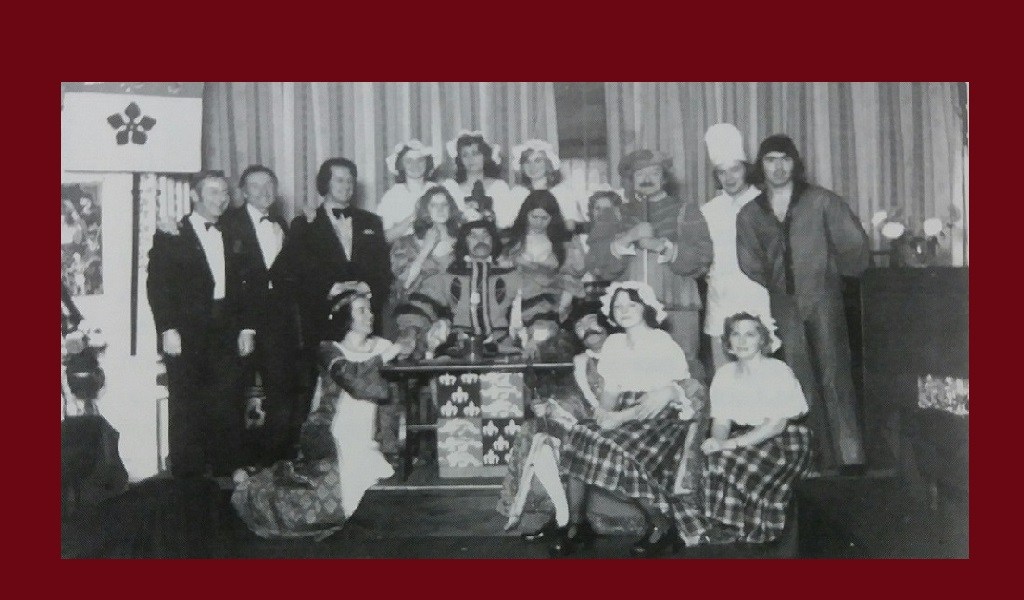
By the end of 1974 we had done about 40 banquets at Hoar Cross Hall and they were still going strong. Most of the original cast were still with us but we were on our second King now and also doing our own catering and bar, whereas when we first started, we had a catering firm in to do it all. Every weekend over 200 people came to sample our Noble Brose, Roast Lambe and Saracen’s Delight and sing along to ‘I’m Henry VIII’ whilst drinking beer, wine and mead. But it was a very adult environment for 15 year old girls to work in; a few of my school friends also worked at the banquets as wenches and we were constantly being chatted up by men who bought us drinks all evening. The cast were all married men but that didn’t seem to bother them and one or two of my friends were always sneaking off with one or other of them. But despite the seventies shenanigans the nights were always a good laugh and there were lots of funny things that happened. Myra (the fire-eater’s wife) and I always did the cloakroom and one time this lady took her coat off and as she did so her halter neck top came undone and she stood there in her bra and skirt for all to see!
The banquet menu
Once the banquets started we would join in with the singing, even standing behind the main act and pretending to be the backing group. My dad once wore a sombrero and shook maracas to a Latin song while we threw petals all over him – don’t ask me why! It certainly wasn't very mediaeval! The next day, when cleaning up, we would find all sorts of things which people had left behind: scarves, perfume, money, cigarettes and even a set of false teeth left on the mantelpiece! I had found a little hidey hole in the wooden panelling in the Long Gallery; a small 6” square door which pushed open when pressed in the right place and I would keep things in there which I found – especially the cigarettes!
Mediaeval maracas!
In the middle of all this busyness my dad still found time to go ...
Rags to Riches #14
Viv Wilson | 01st July 2022 |
Life at The Hall
Before we moved to Hoar Cross Hall in Staffordshire we lived in Derbyshire. My family originated from Derby and my parents were married there in July 1952. Mum was 19 and dad was 36 so quite a bit older. They both lived in Derby and were very arty; my dad went to the Derby Sketching Club in his free time and my mum attended art college. I’m not sure where they met but it was either at something art related or at a dance, as was usual in those days. My dad was a sculptor by trade; I think his interest was sparked by seeing all the beautiful alabaster in Italian churches during the war. After the war he set up his own business making alabaster lamps, bowls and candlesticks among other things (see header picture). He would go to the alabaster mines at Chellaston near Derby and bring back huge slabs which were then cut down to smaller sizes at his works in Crosby Street. He also owned a car as well as his own business so was quite the catch for my mum! After they married he built a little bungalow next to the works for them to live in, which is still there after all these years although the works have now been demolished.
The bungalow at the end of this drive
For someone from his background, owning your own business was something of an achievement, being born the illegitimate son of a servant girl during the First World War. Even his birth is a story in itself as his mother worked at a nearby stately home as a servant and fell for the son of the house. My mum told me all about it years later – how they had fallen in love and were ‘walking out’ together even though it was forbidden in those days for the aristocracy to mix with the servants. However, the son went off to fight in the First World War then caught tuberculosis and sadly died so my grandmother had to bring my dad up alone with help from her own parents, and without getting married (this is where my dad gets his double-barrel surname from). When my dad was about 4 years old my grandmother marr...
Mediaeval Mayhem! #13
Viv Wilson | 22nd June 2022 |
Life at The Hall
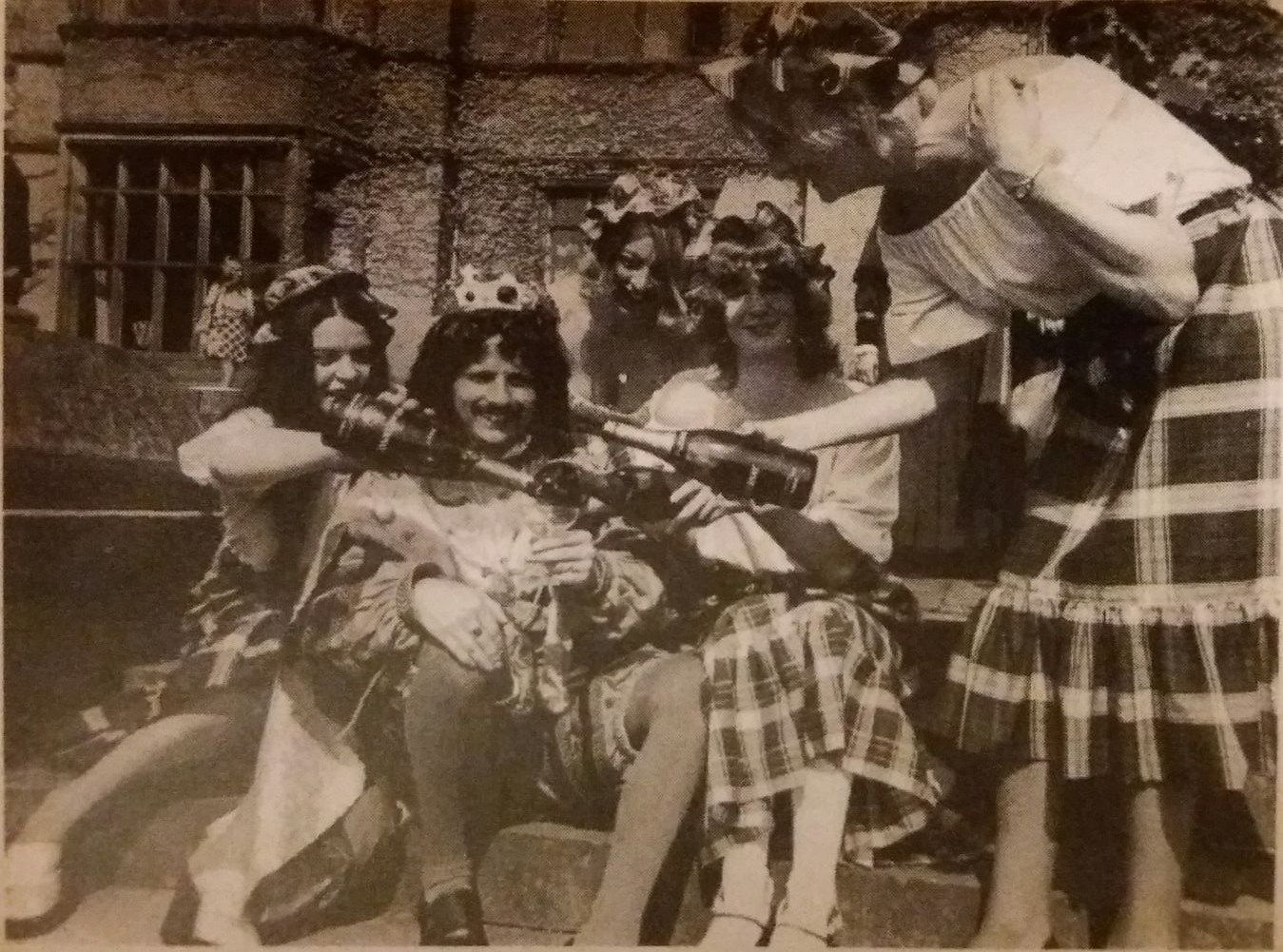
It was the end of the summer season at Hoar Cross Hall in 1973 and rehearsals had started for the new venture of Mediaeval Banquets. All the cast would come round to the house each week for rehearsals and my mum and one or two other ladies were busy making the skirts and blouses for the wenches. My mum also made about 200 bibs which the guests were going to be wearing as eating five courses with a dagger can be quite messy! We had a King, a Jester, a Fire-eater, a Halberdier, an organist and various wenches and serving ladies. To launch the banquets my parents decided to hold a Press Reception about a month before and so we all gathered at the Hall one day in early September. There were lots of nibbles and quite a lot of champagne flowing and the newspapers and radio stations turned up to take lots of photos of us all in various poses and record interviews with the cast (see header picture). It was a lovely, warm Autumn day and many of the photos were taken outdoors. I remember it turning out to be quite a party, even though it started at 9.30 in the morning; as the day wore on the organist started playing a few of the songs we would be doing at the banquets, and everyone started dancing and singing along – it was 4pm by the time we finished!
And so arrived the day of the first banquet. All the furniture and costumes from the Chinese Room and Ballroom had been removed and put into storage elsewhere in the house. A local carpenter had made long tables and benches to seat about 200 guests in the Ballroom, which was now known as the Banqueting Hall. We had employed caterers to do the food and the Chinese Room was used as a food preparation area next to the kitchen/café. A bar had been built in the middle of the Long Gallery. I had to sew numbers onto the coat hangers for the cloakroom – it took all day to do 100 hangers! The afternoon was spent laying the tables with mugs, daggers and serviettes. Before 7pm we went to get changed into our mediaeval dresses; Myr...
More Tea Vicar? #12
Viv Wilson | 15th June 2022 |
Life at The Hall
During the long summer holidays it was easy to get bored. As there was no public transport from Hoar Cross and no children living nearby, we three children had to make our own entertainment and we were always having adventures and getting up to mischief – a bit like the Famous Five but without the dog! We would roam around the village or explore the basement. My dad was a hoarder and had kept all sorts of stuff over the years including gas masks and field phones from World War 2.
The old Servants Hall was now my dad’s workshop and he spent a lot of time down there restoring antiques to sell. He had one of the field phones in his workshop and the other one was in our kitchen at the opposite end of the house. To operate them you would wind a handle on the side and a bell would ring on the phone at the other end. This was how my parents communicated especially when my mum wanted to tell my dad the dinner was ready! But we also had fun playing with them too and would ring each other up when we played games.
A field phone like the ones we used
In the grounds was The Church of the Holy Angels. Mrs Meynell Ingram commissioned Bodley to commence work on the church in 1872 in memory of her husband who had died the previous year. It was generally regarded as one of the finest Victorian churches in the country and was known locally as the “Cathedral of the Midlands”. It was indeed a huge church (for a village) and always open to the public so we would sometimes go and have a look inside. On one occasion there was no-one around so Gavin and I lit all the candles in the church as we thought it looked really pretty and brightened the place up a bit. Oh dear – that was definitely not the right thing to do! A strongly worded letter was sent to my dad from the vicar telling him in no uncertain terms that he should be disciplining his children a lot better than he was. My dad hit the roof about this as he didn’t like people telling him what to do and he was b...
Eat, Drink & Be Merry #11
Viv Wilson | 08th June 2022 |
Life at The Hall
By 1973 we had been at Hoar Cross Hall for 3 years and our lives were always busy, by keeping on top of the weeds and with the general upkeep of the house. My dad expected us children to help as much as possible, which we hated, and much of our time was spent trying to hide from him to get out of doing the chores. But sometimes we didn’t mind and we happily pulled an old trolley into the woods every now and then to collect wood for the fires and sometimes as a family we would spend a day clearing parts of the woods and grounds. My mum had hired a lady from the village to help with the housework and we had also taken on a retired chap called Mr Hickman to do some gardening. My brother Gavin and I had found some huge barrels which had been left behind, possibly from the wine and beer cellars, and we had great fun learning to walk on them like they did in the circus! We also built a treehouse in one of the huge cedar trees which lined the path to the church. As per usual the three of us would hide up there and watch the visitors walk by on their way to the church, as this was also open to the public, then we would make animal noises or suchlike and throw pine cones into nearby bushes to make them jump! It was also a good place to hide from our dad!
Clearing the woods
The visitors continued to come on a regular basis and my parents tried to think up different ideas to attract them. At one end of the terrace, near to the old grass tennis courts (still with two foot high grass on them!) they made a playground, which was fun for us too. My dad continued to buy and sell antiques and was often at local auctions and occasionally made trips to London for sales at Sothebys or Christies auction houses. I once went with him and we spotted the actor Rodney Bewes from The Likely Lads TV programme – he pulled up next to Sothebys in his Rolls Royce!
Barrels in the Beech Walk
My dad’s antique collection continued to grow as he couldn’t resist a bargain and he...
Royal visitors at Hoar Cross Hall #10
Viv Wilson | 29th May 2022 |
Life at The Hall
From earliest times the king's court has traveled around the kingdom so the king could see first hand what was going on in his realm. When the king showed up, the local subjects were expected to provide food, entertainment, and accommodations usually in the form of mediaeval banquets. For the King or Queen's subjects this could be very expensive and not all royalty was welcome! However, this was the only way that people could see their King or Queen and know that they were real. Fast forward from the twelve century to the 21st century and royals are still touring the country so their subjects can 'see them and believe in them'.
The Queen's grandparents, King George V and Queen Mary also went on many tours of England including Yorkshire, Derbyshire and the West Midlands, visiting mines and factories. They also visited the wounded in hospitals during the First World War which were often makeshift ones in stately homes such as Clandon Park in Surrey and Belton House in Lincolnshire. Hundreds of Britain's stately homes were turned into military hospitals as the country fast ran out of hospital beds when hundreds of thousands of wounded soldiers returned home. The Meynell family themselves offered their London home to be used during the first world war but it was not needed in the end.
During the King and Queen's tours they would have stopped at nearby stately homes that were big enough to accommodate themselves and their entourage, which would include servants, private secretaries and equerries. The whole household would be in an uproar as servants rushed to get ready guest rooms and bathrooms along with the extra space needed for the royal servants. This scenario was acted out in a Downton Abbey episode when King George V and Queen Mary came to stay for a few days. In actual fact the storyline was based on true events when they stayed at a stately home called Wentworth Woodhouse in Rotherham in 1912. They were guests of Earl Fitzwilliam and their stay was to includ...
Motor Racing Days #9
Viv Wilson | 25th May 2022 |
Life at The Hall

Although my blogs are about living at Hoar Cross Hall, I would just like to give a bit of background about my dad’s racing career in the years leading up to moving to the Hall as this will set the scene for later instalments of my story.
As mentioned in my first blog my dad used to be a racing driver but he actually started off racing motor cycles in the 1930s. Because of this he became a despatch rider during the Second World War and spent a lot of time in North Africa. After the war he started racing motor bikes at nearby Donington Park and he raced there up to the beginning of the 1950s. After that he moved onto cars and drove a Cooper 500cc (which is the equivalent to Formula 3) along with the likes of Graham Hill and Sterling Moss. At the end of the 1950s he moved into Formula 2. Of course in those days it was completely different and much more ‘fun’, unlike more recent times where it has become a big money business. My dad didn’t have a rich family to support him or financial backers and probably did it all on a shoestring knowing him! He told me that he would always ‘take it easy’ and wasn’t too bothered about winning; drivers always got their ‘start’ money and he was satisfied with that. Accidents meant expensive repairs!
My dad as a despatch rider - WW2 in Africa
During the 1960s he raced Lotus Elites and I have never forgotten the time, aged just 5 years old, when he took me for a spin around Mallory Park. I remember it all very clearly, even now. He strapped me into the car, watched by the mechanics in the pits. My poor mother was worried to death and kept asking if I’d be alright! My dad was his usual self, flouting the rules, and continued to do a few laps around the circuit with me clinging petrified to the side of the seat - I have been terrified of speed ever since – can you imagine that happening today!
My dad with his first racing car in the 1950s
My dad would spend a lot of his time tinkering about on th...
Ghostbusters #8
Viv Wilson | 18th May 2022 |
Life at The Hall
People were always coming to Hoar Cross Hall to either hire the house or to have a look around. In 1973, because of all the media interest in our ghosts, we had a couple of professional ghost hunters asking to stay over one night to try and find the source of the noises. They brought cases full of recording equipment and set it all up in one of the attic rooms. Rather them than me I thought! Then I had a brilliant idea and went off to tell my brother Gavin all about it. As mentioned in my first blog the attic and basement had a row of bells which the family used to summon the servants. Before the three men arrived we spent all day trying out all the bells to see which ones were which. We found that one of the bell pulls in the Chase Dressing Room made one of the bells in the attic ring. We also found that the bell pull in the Morrey Bedroom rang a bell in the basement and a bell in the attic rang a bell in the Long Gallery! Gosh, these people must have been hearing bells ring all day long!
Anyhow, the plan was that we would ring one of the bells right outside their room and when next day they told us about the noises we would tell them that the room for that bell was no longer there – it had been knocked down when the old kitchens had been demolished! Then they would realise that it must have been a ghost ringing the bell and listen to their recordings quivering in fear! Gavin and I were so excited we could hardly sleep that night. Before we went to bed we rang the bell quite a few times until we were satisfied that they had heard it then went to sleep. Next day we went up to see them expecting to hear all about the ringing bells but they said they never heard anything! What a disappointment – our trick had failed even though they had all that fancy equipment to record any eerie sounds! Actually they probably realised we had played a trick on them and pretended they hadn't heard it but we still had fun doing it!
The bells along the attic corridor
Eve...
Calendar Girls and Front Covers #7
Viv Wilson | 11th May 2022 |
Life at The Hall

During our time at Hoar Cross Hall people would occasionally hire the house for a day’s filming. Calen During the summer of 1973 a photographer from London hired the place for a day and he brought two models with him, one English and one German, and they were taking photos for a glamour calendar. We were told to keep right out of the way as they were taking photos in the gardens as well as the house. Naturally we wanted to see everything that was going on and my younger brother Gavin especially was very keen to watch – so much so that he found a pair of binoculars to follow all the proceedings! We managed to find all sorts of hiding places eventually settling in our attic room to keep tabs on everything. From the attic we could access the roof which was flat in places and meant that we could view all the grounds at the front of the house and the back. We often came up here to run around and explore and in the summer it was a great place to sun-bathe in private - not sure if our parents were aware that we did this!
View from the rooftop rooms
The girls wore wigs and hair pieces and were being photographed in military jackets with swords and other accessories from the house. They posed either topless or scantily clad in the gardens and in front of a pair of wrought iron gates (by Robert Bakewell, renowned Derbyshire ironsmith) right at the bottom of the garden. These gates linked the Ha-Ha wall. This was a wall which bordered the grounds and had a small ditch on the other side – the reason was that the ditch stopped the deer from jumping the wall; for on the other side was a deer park, although the deer had long since run off and it was just a field when we were there. The Ha-Ha wall is a French invention, the idea being that the recessed design element gives an uninterrupted view of the landscape beyond, so a small wall above ground and the rest below ground next to the ditch which also stopped animals jumping into the garden. It was so called due to ...
Huntin', Shootin' and Fishin' #6
Viv Wilson | 04th May 2022 |
Life at The Hall

Most stately homes have the obligatory hunting, shooting and fishing and Hoar Cross Hall was no exception during the Meynell family’s time there. We didn't participate in any of these but, however, the Meynell and South Staffs Hunt used to meet locally to do a spot of fox hunting. They would all gather at different venues around the area and enjoy a drink before setting off. One of their usual places was the Meynell Ingram Arms Public House at the bottom of the village. In February 1972 they had their ‘meet’ at the Hall. We, as the host family, got all dressed up to meet and greet them and local helpers served drinks, usually sherry. I had no interest in horses (unusual for a girl my age!) but the horses with their scarlet coated riders did look very impressive. The pack of hounds were everywhere, sniffing and panting and waiting for the off. My dad tried to make conversation with the Master of the Hounds by asking “So these are the dogs are they?” to which he received a curt “They’re hounds Mr Bickerton-Jones, not dogs!” Oh dear, mustn’t go upsetting the local gentry!
We hated the idea of a little fox being terrorised by a pack of dogs – sorry, hounds - and being ripped to pieces. Gavin and I were actually playing in the woods once when the hunt went by quite near to us – the fox literally ran right past us at such a speed it was incredible! We hoped he would get away and tried to think up all sorts of plans to divert the hunt away from the fox, finally pointing them in the wrong direction as they got near to us! Years later someone we knew rode in the hunt for the first time and came home with blood on her forehead – this was her initiation into joining up; the blood of the fox daubed all over her brow to show it was her first time! It seemed so barbaric.
The Meynell Arms where the hunt would meet
The other ‘sport’ was shooting pheasants. This was something that was started by Henry VIII when guns became easier to handle back ...
The Grand Opening #5
Viv Wilson | 27th April 2022 |
Life at The Hall
And so we move into 1971 and the preparation of Hoar Cross Hall so we could open it to the public by Easter. During the run up to buying the house my dad had been buying furniture, carpets and paintings like crazy and I remember our previous home being jam packed with chaise longues, sideboards and carved chests as well as all the suits of armour that he already had. This furniture was now set out in all the rooms. My mum’s collection of Victorian costumes were on display in the Ballroom as well as my dad’s collection of silver plated ‘display’ armour, which hung around the panelled walls; the suits of armour and the many paintings they had lined the Long Gallery and other rooms. The old Dining Room was renamed The Chinese Room as my dad had quite a collection of Chinese armour, swords and wall hangings – and even a Burmese Palace Chair (see header picture). Display cabinets bought in sale rooms showed off smaller items. The biggest excitement though was seeing our house advertised on the local TV channel!
The Damask Room was turned into Lady Dorothy’s Boudoir complete with an 18th century four poster bed, an original bed complete with canopy and hanging curtains slept in by aristocrats throughout the centuries. I used to love lying on the bed with the curtains closed imagining myself in another era – once I lay down on the bed and fell asleep. When I awoke and climbed out from behind the drapes it was to a roomful of visitors staring open mouthed at me!
In another room my dad had his racing car surrounded by displays and photos of his racing career. The Entrance Hall was turned into a café area next to the kitchen, which had once been the old Butler’s Pantry, and my job was to bake scones and make sandwiches for the hungry visitors and groups that often came for a day out. Although I would make the scones earlier in the day, we would always leave a few in the oven so that there was a lovely smell of home baking floating around the house – a su...
DIY Stately Home #4
Viv Wilson | 19th April 2022 |
Life at The Hall

We moved into Hoar Cross Hall during the summer holidays and my parents quickly realised they had a lot of work on their hands to make the place habitable as well as to earn some money from it. As previously mentioned, there was an East Wing and a West Wing to the house. My dad decided to convert the first floor rooms of each wing into three separate apartments; he had done this at our previous house. This would generate income from rents until we got the main house open to the public. It wasn’t a big job to convert the rooms as the East Wing had four main rooms and two bathrooms already there, which would have been used as guest bedrooms in Victorian times. He made these into two one-bedroom apartments with a bit of clever stud walling here and there and made small kitchens in the spaces which connected the lounge and bedroom, probably once used as cupboard space. The spiral staircase with it’s green baize door opened onto the inner landing next to the apartments which is how the servants would have accessed these rooms when bringing the family breakfast trays in the mornings. Where children were to be seen and not heard, servants were to be neither seen nor heard by members of the family and all the areas to the house were accessed via the spiral staircases and then inner hallways and corridors so they could go about their duties quickly and quietly.
The same green baize door was also used by the tenants to get to their homes after a hard day's work, although, like the servants, they had to walk along the basement corridor from the opposite end of the house then climb two flights of stone stairs to get there! No heating of course in the winter months along the corridors either!
My dad spent a lot of his time at auction houses buying and selling antiques and so he went back there again to source carpets and kitchen equipment. He also installed huge electric heaters to keep our new tenants warm. The West Wing was smaller than the East Wing so was made into a ...
Things that go bump in the night #3
Viv Wilson | 13th April 2022 |
Life at The Hall
Going to sleep in a big old house is quite scary when you’re young but going to sleep in a big old house that’s haunted is even more scary!! That first winter at Hoar Cross Hall was like that. Every time there was a windy night I could hear a window banging in the attic – all night long it kept me awake. The next day I would go upstairs to close it but there would be no windows open or even loose. They were all tightly shut as they had been for 20 years. I remember standing there in the attic rooms feeling a tingling down my spine and goose bumps all over as I felt the atmosphere closing in on me - and I quickly legged it back downstairs!
On other nights I would hear people walking along the attic corridor (the attic was the floor right above our bedroom floor) and then at other times I could hear heavy furniture being dragged about – yet there was nothing up there as the rooms were all empty! Other members of the family heard it too and also people that stayed overnight, so it wasn’t the imaginings of a frightened child. There was also nobody else in the house at that point, apart from our family and they definitely weren’t walking about the house at 3am. I loved reading about old houses, mysteries and ghosts but when you’re actually in the middle of it in real life, it’s a bit different!
The haunted attic corridor
My parents also heard noises in their bedroom. It sounded like a room full of people talking, like at a party. They couldn’t work out if it was birds nesting under the eaves so they slept in another room down the corridor to see if they still heard it – and sure enough, they did! What was going on? Had we disturbed some lost souls forever wandering in the attics?
One night my mum was woken up by the sight of a little girl ‘floating’ over the bed. She said the girl was wearing a long nightdress and mop cap and seemed to be stretching her arms out to my mum as if she was asking for help. She floated all around the bed sca...
Moving Day Arrives #2
Viv Wilson | 06th April 2022 |
Life at The Hall
My parents took vacant possession of Hoar Cross Hall in 1970 and the whole process of moving house was done over the summer months. We lived about 20 miles away in an old vicarage with a large garden and lots of outbuildings. This house was about 200 years old and they say Bonnie Prince Charlie marched past it on his way to battle back in the day, for all you history buffs out there! Actually I love history and I think my interest was fuelled by living in these historic houses as a child. My dad used to be a racing driver in the 1950s and before that he did motorcycle racing, often at nearby Donnington Park. During the 1960s he ran his own team, Shardlow Motor Racing, travelling all over Europe to race at all the famous circuits, so the outbuildings were always full of bits of racing cars and their engines! All this stuff had to be moved and my dad did most of it by travelling back and forth each day with vans and trailers full of the contents of our house and outbuildings – an enormous undertaking!
He knew some students and used to pick them up en route to help and they also stayed on to help tame the gardens which were very overgrown, the grass standing about 2 feet high. As I’m sure you can imagine, after nearly 20 years of neglect, the gardens were a sorry sight having once been very grand. Apparently, when the house was built, there were 20 gardeners and the head gardener was pushed around in his wheelchair inspecting all the borders and paths; if he saw a weed it was quickly removed! I couldn’t imagine the grounds ever looking as good as they used to but we certainly had a good try and started attacking the hedges and grass as soon as we moved in. If anyone saw the Chester Zoo mini-series in 2014 about an ordinary family moving into a huge old house to start a zoo then that is exactly what it was like for us. When I saw that programme it brought back so many memories of those early months at the Hall when we were struggling to get the place back into sh...
Growing up in a stately home #1
Viv Wilson | 30th March 2022 |
Life at The Hall

It was the summer of 1970, Mungo Jerry was at the top of the hit parade and we were about to move house. But not to any old house – to a 70 roomed mansion in 20 acres of grounds! For years my dad had collected antiques, ever since he was a young boy of 12, and it was his dream to own a large house where he could put them on show to the general public. In the 1970s he owned the largest private collection of arms and armour in the country and his dream was about to be realised; but little did we know what a nightmare would unfold before us.
Hoar Cross Hall was the home of the Meynell Ingram family who originated from Leicestershire. Hugo Meynell of Quorndon was the High Sheriff of Staffordshire and Member of Parliament for Lichfield and the family owned considerable property in Staffordshire, Shropshire and Derbyshire. He bought the Hoar Cross estate in 1793 and built a hunting lodge there known as Old Hall and founded the Meynell Hunt. It seemed the family lived here for many years until Hugo’s grandson, also Hugo, got married in 1863 and decided to build the present Hall for him and his wife, Emily Charlotte. The house took nine years to build and was eventually finished in 1871. Hugo and Emily had already moved in, but their new life together was soon to be cut short by a tragic accident. Fourteen months earlier at Birch Wood on their estate Hugo had a horse riding accident and had been bed-ridden ever since – he died in May of that year. They had no children and Emily built The Church of the Holy Angels in the grounds of the hall in memory of her husband. This is the church that I got married in almost a hundred years later. On Hugo’s death Emily inherited many large estates and they say she was a double millionairess – which in those days was a huge amount of money! And so we moved to this house with all its history and tragedies in the summer of 1970.
Old Hall - the original home of the Meynells
My family consisted of my mum and dad and two y...
The origins of the stately home #43
Viv Wilson | 24th March 2022 |
Life at The Hall

So why are stately homes so called? Stately home actually means 'a large impressive old house with interesting history and usually visited by the public.' Well, I suppose they do look very 'stately' for a start but these houses were also a status symbol for the great families of England, who competed with each other to provide hospitality for the royal household who would travel around England meeting their subjects.
Stately homes were huge mansions which were always beautiful and the epitome of perfect architecture, often designed by famous architects of the day. The gardens too would be perfectly landscaped to show balance, variety, sequence and colour. One of the most famous landscape gardeners of the 18th century was 'Capability' Brown who was very much a 'hands on' gardener and designed many gardens and parklands for the aristocracy, which are still seen and enjoyed today by visitors to these grand houses.
All large houses are called different names too and you may have thought that this was down to the size of them, as I did. And this is true to a point but they also tell us what type of person lived there and what the house was used for. For instance, a Palace belongs to a royal household, a Chateau belongs to a King or nobleman and a Manor is always on an estate of a Lord's lands. The people who lived in them were usually aristocrats – families of high social rank with a title such as Lord, Lady, Earl, Duke or Baron. Often they were Members of Parliament and Justices of the Peace due to their high education and would act as the local 'law' in their community.
Most of these houses were built in the 17th and 18th century as manor houses in the heart of an agricultural estate, so effectively they were like farms with a farmhouse albeit a bit grander! The Lords that owned the manor houses would then provide employment for large numbers of indoor and outdoor staff in the rural community. It also provided the owner with income from rents and produce. When the...
Hickleton Hall and the Meynells #43
Viv Wilson | 16th March 2022 |
Life at The Hall
This lovely Grade II listed Georgian house in South Yorkshire was once the childhood home of The Honourable Emily Charlotte Meynell who married Hugo Meynell of Hoar Cross and who, together with Hugo, built Hoar Cross Hall to be their family home in 1873.
The original house was called Hickleton Palace and had been built for Judge Francis Rodes in the 16th century but in 1745 Hickleton Hall was built just to the south of this house after the estate was bought by Godfrey Wentworth in about 1730. Thirty years later he extended the house and added two low wings, one either side, and a servants wing.
Emily's father, Charles Wood, 3rd Baronet, inherited the house in 1846. He was MP for Grimsby, Wareham, Halifax and Ripon. He was also Chancellor of the Exchequer from 1846-52 and created Viscount Halifax in 1866, three years after Emily was married. He died in 1885 at Hickleton Hall, which was then inherited by Emily's brother Charles Lindley Wood, the 2nd Viscount. His grandson, Edward became Viceroy of India from 1926 to 1929 and Foreign Secretary during the Second World War and created Earl of Halifax in 1944. So quite a lineage that she came from! During the Second World War the house was actually the headquarters of I Corps after the Dunkirk evacuation in May 1940.
Emily was one of eight children, having five brothers and two sisters, although one brother, John, died in infancy as was common in those days. It must have been a bustling household with so many little ones running around keeping the nursemaids on their toes! Hickleton was not as huge as Hoar Cross Hall, probably half the size, but it did still have servants quarters, stables and even a brewhouse. One of the last brewhouses to operate within a country house was at Hickleton. Apparently, payments for staff beer ('beer money') was a further perquisite to their wages. This was, in part, a quaint survival from the days when servants drank beer instead of tea. Many houses had a brewhouse. Beer was particularly...
The life and times of an upper class family #42
Viv Wilson | 06th March 2022 |
Life at The Hall
On 11th August 1863, Hugo Francis Meynell Ingram married the Hon. Emily Charlotte, daughter of Sir Charles Wood, Bart, afterwards 1st Viscount Halifax. The Woods were an old gentry family, for many centuries respectable York merchants. They were later to turn grand upon the discovery of coal beneath their ancestral estates. This was the great Barnsley field, with several hundred acres of Britain's deepest and finest coal. Sir Charles Wood was created 1st Viscount Halifax in 1866 and had a very distinguished political career. The family seats of Garrowby, Pocklington and Hickleton (where Emily was born) had been acquired by his father from the Wentworth family; they also owned a London house in Belgrave Square.
Emily Charlotte's mother was Lady Mary Grey, youngest daughter of Charles Grey, 2nd Earl and Whig Prime Minister from 1830-34. It was he who the famous Earl Grey tea was named after, after a special taste was created by adding oil of bergemot to black tea. His administration was also responsible for passing the first Reform Act of 1832 which changed how the elections were done and meant that the middle classes could vote also.
Once Hugo and Emily were married they moved to Hoar Cross and lived in Old Hall which was a hunting lodge near to where they were later to build Hoar Cross Hall. Tragically, after moving into the Hall, which took nine years to build, Hugo died from injuries sustained in a riding accident some fourteen months earlier which had left him bed-ridden. Upon her husband's death, Emily's brother, the Hon. Frederick George Lindley Wood, moved from Hickleton and came to live with her. He was a huge help with managing all the estates that Emily had inherited on Hugo's death. He also became her 'reader' as Emily had poor eyesight and couldn't read or write for more than a few minutes.
Hickleton House, Emily's childhood home
In 1878 Frederick married Lady Mary Lindsay, the third daughter of the Earl of Crawford and Balcarres. However,...
Behind the Green Baize Door #41
Viv Wilson | 28th February 2022 |
Life at The Hall
“The green baize door - dividing line betwix servant and master.”
All stately homes had at least one green baize door and Hoar Cross Hall was no different. This was the door used by the servants to access the main part of the house unobtrusively and silently so they could go about their work without disturbing the family. The Hall had a spiral staircase at each end of the house for the servants to use and the green baize door on the ground floor opened onto the Garden corridor which led to the Chapel and the main house, as well as the garden. The green baize door on the first floor opened onto the east wing corridor and guest bedrooms and from this corridor the servants could access the family bedrooms, not by going through the main double doors but by keeping to the inner corridor out of sight then up a couple of steps and through a smaller door leading onto the bedroom corridor, avoiding the main staircase that the family used. In many houses the servants' door hid cramped attic bedrooms and basements, hidden tunnels and corridors contrasting with the grandeur of 'upstairs'. Housemaids were often taught to turn their face to the wall if their employer passed them in the house. Clearly the aristocracy thought they were too grand to be looked upon by a 'lowly' servant!
So why were these doors covered in green (or red) baize cloth? Baize is a sturdy green cloth which insulated against noise and absorbed smells from the kitchens. Brass tacks held the cloth in place and was often very decorative in design (see header picture). Baize dates back to 1525 and a well-known 17th century ditty mentions 'bays' as follows:-
“Hops, heresies, bays and beer
All came to England in just one year.”
It became popular in the mid 18th century and was used mainly for cabinet and closet linings in Europe – also games tables. I'm sure you are all familiar with pool and snooker tables showing off their red and green baize cloth.
Baize was also used as clothing for monks...
Temple Newsam and the Meynells #40
Viv Wilson | 19th February 2022 |
Life at The Hall
Hoar Cross Hall was built by Hugo and Emily Meynell Ingram in 1871 and this week I am delving into the family background of Hugo to explain how Emily came to own the Temple Newsam estate after his death.
In 1782, Hugo's grandfather, Hugo Meynell of Quorndon, the 'father of fox hunting', married the Hon. Elizabeth Ingram Shepheard. She was the daughter of Charles Ingram, 9th Viscount Irwin and Lord Ingram. The family seat was Temple Newsam in Yorkshire and this was how the Meynell family became associated with this great house. Through this marriage of Hugo and Elizabeth, the Meynell family also inherited the Ingram estates in Lincolnshire, acquired by Sir Arthur Ingram in the first half of the 17th century. In 1793 Hugo bought the Hoar Cross estate and built a hunting lodge which was known as Old Hall.
Old Hall, the Meynells' first home
Hugo and Elizabeth had six children, the eldest being Hugo Charles who inherited the Temple Newsam estate from his aunt; however, he had to assume the surname of Ingram in compliance with the terms of the will of the last Lord Irwin. So this was how the Meynell Ingram name came about, something which was quite common with the aristocracy in those days. Hugo Charles went on to marry Georgiana Pigou in 1819; their eldest son was Hugo Francis Meynell Ingram, the last of the descendants of Sir Arthur Ingram to inherit Temple Newsam.
Emily in her dog cart riding around Temple Newsam
Temple Newsam had been built by Thomas, Lord Darcy, early in the 16th century. He, coincidentally, had married a Meynell, and a descendant married Elizabeth Meynell, so there are a lot of associations with the Meynells early on. Here the unfortunate Earl of Darnley was born. Married to Mary, Queen of Scots, he was murdered two years later, supposedly by Mary's next husband, the Earl of Bothwell. The house was rebuilt between 1622 and 1637 in Jacobean style by Sir Arthur Ingram and later the grounds were landscaped by 'Capabil...
The War Years and Beyond #39
Viv Wilson | 14th February 2022 |
Life at The Hall
During the Second World War, life in country houses changed dramatically. It was no different at Hoar Cross Hall. The flower borders on the main lawns were turfed over to reduce maintenance and vegetables were grown in areas formerly restricted to flowers. Evacuees from Birmingham came to stay for the duration of the war and they lived in the basement, as it was considered to be the safest place. I imagine that they must have been in the care of the servants as they were living amongst them but it must also have been quite exciting for them to move from a bombed out city to the relative safety of the countryside, although they must have missed their parents of course. Many children in those days never left the cities and towns where they lived and often didn’t know what a cow looked like in real life! To see all the lawns and woods at the Hall must have been incredible for them although I’m not sure if they were allowed to wander around the grounds.
Two of these youngsters returned to the Hall in the mid-1980s and spoke to my mum about the kindness they received from the family. They also told her about the ‘secret airfield’ hidden away in a copse behind the ha-ha wall (the wall separating the bottom of the grounds and the deer park). Apparently aircraft were kept here in readiness for action, it being a Satellite Landing Ground (SLG) site serving Fradley aerodrome, near Lichfield. The Hall was also offered as an Auxiliary Red Cross Hospital during the war but nothing came of this, probably owing to the lack of mains water. However, during the First World War, the Meynell home in London was offered to the War Office and the Red Cross and became a Military Hospital for officers, being used by Francis Meynell himself who was wounded in action.
The copse on the right which hid the plane
One feature at the Hall was the daily barometric readings; these had been taken since 1880 up until the Second World War, when readings ceased. The Clerk of Works at ...
Gardeners' World #38
Viv Wilson | 07th February 2022 |
Life at The Hall
In it’s heyday Hoar Cross Hall had around 28 people employed to keep the 20 acres of grounds tidy and weed free. In Victorian England the most common of all male servants was the gardener. At Hoar Cross the head gardener had numerous under-gardeners known affectionately as ‘digging slaves’! They were responsible for producing fruit, vegetables and growing luxury items in and out of season, much of it under glass. Adjacent to the house was the carp pool and greenhouse area along with a palm house; next to these was a walled kitchen garden (see header picture). This supplied the house with all its fruit, vegetables and herbs. The palm house produced palms and pot plants along with flowers for the house; these would be brought across to decorate the main rooms when an important function was on.
The ‘bothy’ house was in one corner of the kitchen garden. (A bothy is a simple dwelling on an estate, usually used for gardeners and other workmen). Here lived the ‘bothy boys’ who were young under-gardeners. Their job was simply to sweep the pathways all day and keep the leaves at bay!
There were two elderly chaps, Mr Knight and Mr Dukes, who were solely responsible for the south garden – however, their task was complicated by the fact that they couldn’t get on with one another! Grass was cut by a horse drawn mower, a task carried out by the chauffeur of all people! One of the family told us that back in the early days the head gardener was pushed around in a wheelchair when he was older, inspecting the lawns – apparently if he saw a weed amongst the grass blades he would tell one of the gardeners to pluck it out straightaway!
A horse drawn mower used at one of Emily Meynell's houses
Emily Meynell Ingram employed a Mr Rowley especially to carry out her plans of planting the yew hedges, of which there were many. At each side of the garden was a long walk bordered by yew hedges down to the ha-ha wall at the bottom. Across the bottom of the gardens ...
What the Butler Saw! #37
Viv Wilson | 31st January 2022 |
Life at The Hall
Anyone who’s seen Downton Abbey will remember Carter the butler. He is exactly how a butler would have been in the 19th century and, strangely enough, the butler at Hoar Cross Hall during the early part of the 20th century was also called Carter!
Although most big houses had a house steward who was in charge of accounts and general running of the household, a butler was more commonly engaged by the wealthy. He was usually a grand, authoritarian figure, commanding respect and awe and most of the servants would have been scared to death of upsetting him! He was dressed like a gentleman of the period and generally ran the household with an iron fist.
As I said, the butler at the Hall was called Gus Carter and he was with the family for over 40 years, joining the staff in the mid-1930s. When the family left the Hall in the 1950s and bought the smaller Hollybush House in nearby Newborough he went with them until his retirement. He and his wife celebrated their Diamond wedding anniversary in 1972.
Mr & Mrs Carter celebrating their Diamond Anniversary
However, when at the Hall his main duties would have been looking after the wine cellar and silverware or plate as it was known. This was kept in a room next to his bedroom so he could keep an eye on it and make sure no-one stole anything. Similarly with the wine cellar, he would have kept it all under lock and key so none of the servants could have a crafty drink when no-one was looking. There was actually a Chubb walk-in safe in the basement where, I assume, the more valuable items were kept for special occasions. Near to the butler’s room was a Chubb wall safe, which would have been used for keeping guests’ valuables in while they were staying at the Hall. Not unlike a hotel nowadays! He also waited on table at all the meals and at night, secured all doors and windows and checked the fires were safe before retiring to bed. If there was no valet in the house then the butler would also have been responsi...
The Kitchen Maid's Story #36
Viv Wilson | 23rd January 2022 |
Life at The Hall
If you were young, free and single – oh, and very well-to-do – the 1920s were the decade to be a part of. The upper classes had lots of time on their hands and enjoyed post-First World War delights such as the theatre and jazz clubs.
Not so for the lower classes, in particular a young girl who was to become the kitchen maid at Hoar Cross Hall in the 1920s. The ‘depression’ after the First World War brought stark poverty to her home and many like her. Her name was Jean Rennie, and she was extremely intelligent having won a scholarship to Glasgow University to study French and music. However, the £5 bursary she got was taken by her father and used to buy whiskey in his local pub. Her hopes of a career in music were dashed and she needed to find employment.
Jean was now known as Jenny and had many jobs as a servant, including one in a castle in the Highlands! She was, in her own words, 'a good housemaid but never a good servant'. With memories of hungry children fresh in her mind she could never get used to the wanton waste of food left on plates, in the homes she worked in. Her mistresses were always untidy with stockings, shoes and underwear “flung everywhere” and powder “spilt lavishly” – this always rankled with her and she never really got used to the ways of the aristocracy.
Jean as a young woman
She gradually travelled down the country and eventually found a job in London. Although she was still a scullery maid, she worked under a skilled chef who taught her much and she hoped for a career as a cook. Her employers were good and so were the wages. When she got the job at Hoar Cross Hall she could not only read a menu (in customary French) but also write one and prepare many of the dishes herself. Lady Dorothy Meynell was very impressed with her and as her husband, Hugo Meynell was about to take a small shooting party to their Laughton estate, she asked Jenny to go with them to do the cooking. Jenny recalled how thrilled she was to...
Hoar Cross Hall - Life Below Stairs #35
Viv Wilson | 09th January 2022 |
Life at The Hall
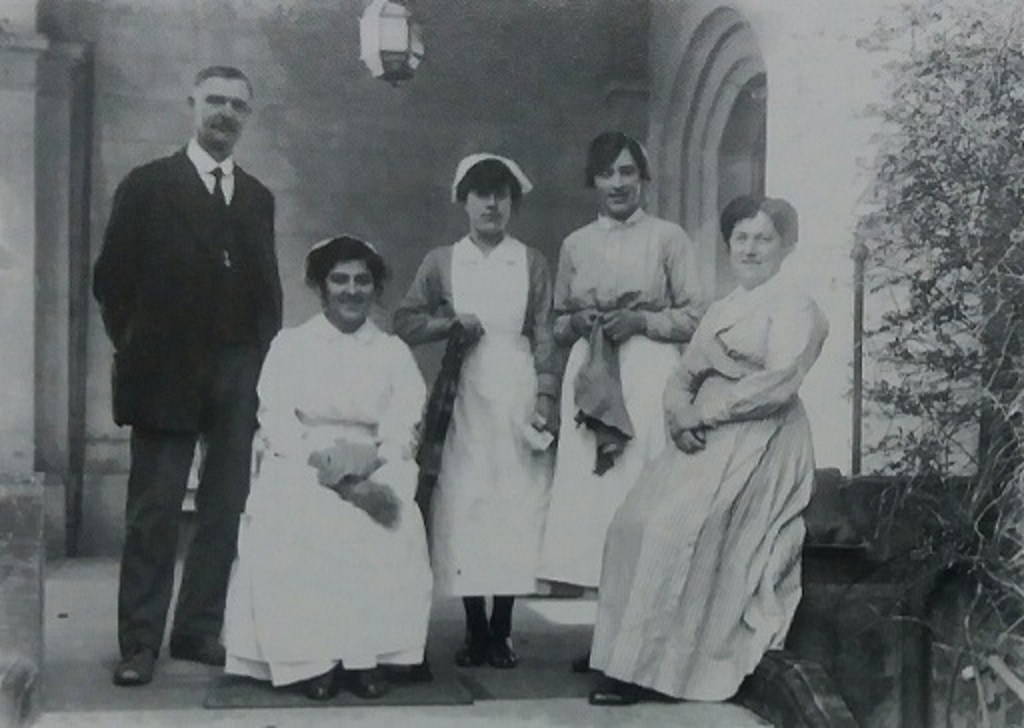
This week I’ve done a history blog about the servants who lived at Hoar Cross Hall from the 1870s to the 1950s when the Hall became empty. They were an essential part of keeping a big house running but were often not appreciated by the aristocracy as they went about their day to day duties.
The life of a servant in Victorian times was a hard one. They had to rise at 5am to clean and light all the fires and dust and polish the floors, then do a day’s work, often not getting to bed much before midnight. No wonder they didn’t live to a great age in those days! By the end of the 19th century there were nearly one and a half million servants; most young girls went into domestic service when they left school. A large house with neither running water nor electricity would need a lot of help to keep things going. There was also the continuous cooking that needed to be done – for the family above stairs and the servants below. Everyone had meals at different times; the servants would obviously eat before or after they had served the family. The children and nursery staff would eat at around 5pm and then there were the afternoon teas and full English breakfasts! Everything had to be made from scratch of course so the cooks must have been cooking something or other from dawn until dusk. It must have been exhausting!
In the grounds there were around 20 gardeners and groundsmen who helped to keep the constant weeds down and tend to the rose bushes and hedges. This in itself would have been a full time job. The kitchen gardens and greenhouses would have provided a lot of the produce they ate as well as the pheasants and other game birds that were reared to be eaten. There was also a carp pool for their fish stock. In total there were about 50 servants employed by the Meynell family which included cooks, housemaids, chambermaids, lady’s maid, a governess, a nanny, a butler, footmen and a house-keeper among others. All staff were expected to attend the 9am service which...
A New Year Calamity #34
Viv Wilson | 03rd January 2022 |
Life at The Hall
The New Year’s Eve Balls at the Hall were usually the highlight of the year. After twelve months of hard work, especially running the Mediaeval Banquets twice a week through the winter, we were always ready to see out the year in style with a big new year party. In those days it was always black tie for the men and long dresses for the ladies – usually around 500 people bought tickets for an evening of entertainment with a dance band, disco and a meal. At midnight a man dressed in traditional Scottish regalia, including a kilt and sporran, would pipe in the new year with his bagpipes. Down the Long Gallery he would slowly walk and into the Ballroom with his pipes droning on. When midnight arrived a net full of balloons was dropped onto all the guests from the ceiling, out came the party poppers and hats and everyone joined hands to sing ‘Auld Lang Syne’. Once all the traditional stuff was done the band started up again and we all did the Hokey Cokey, the Conga and other silly dances that only happen on New Year’s Eve! It was always great fun and I loved to dress up in my long dress.
My parents were having a trial separation around this time so my dad had to run the New Year’s Eve Ball on his own. I helped, as I had before, with the administration; posting out tickets and doing a bit of book-keeping. The week prior to the Ball was spent moving furniture about and cleaning the house up after all the banquet tables and benches were removed. We usually used some of the banquet tables for people to sit at but this particular year my mum had stored them all away in the basement and put a lock on the door – these were her property now! This left my dad in a bit of a quandary about what to do for tables and after a lot of ranting he decided that he would have to hire some. As my dad was well known for being ‘careful’ with his money, he didn’t want to spend too much and hired the cheapest tables and chairs he could. They arrived on the day of the Ball in...
Alice - the ghost in the mirror #32
Viv Wilson | 29th December 2021 |
Life at The Hall

Here is another ghost story for the Christmas season associated with Hoar Cross Hall. By an amazing co-incidence Lewis Carroll and Emily Meynell (who built the Hall) became acquainted when she was a child. This is their story -
In 1865 Lewis Carroll wrote another story about Alice following on from ‘Alice in Wonderland’. It was called ‘Alice through the Looking Glass’. In this story Alice climbs onto the mantlepiece over the fireplace in her lounge and finds that she can climb through the mirror into another world which is reversed, just like a reflection. Once again, she encounters strange figures in a world dominated by a chess set and nursery rhyme characters, among others. But what inspired Lewis Carroll to write about a little girl having lots of adventures?
In the 1850s Charles Dodgson (Carroll’s real name) studied at Christ Church in Oxford. A new dean, Henry Liddell, started around about that time and brought with him his wife and young family. One of his daughters was called Alice and this little girl was widely thought to be the inspiration behind his stories but Carroll always denied this.
In 1852 he briefly became a tutor for the children of Charles Wood of Hickleton Hall in Yorkshire. One of his children was Emily Meynell (nee Wood) who later owned Hoar Cross Hall. During the summer a friend of Emily's, Mary Heath, stayed at their home and this is the little girl believed to be his inspiration for Alice. But also, the room in which he taught the children had a lovely mirror over the mantlepiece which is exactly the same as the picture of the mirror in his story ‘Alice through the Looking Glass’. So it seems that lots of things from that time inspired him!
A drawing from the book showing the mirror
When Emily got married in 1863 she took the mirror with her to her new home, Hoar Cross Hall, and there it hung over the fireplace in the Library for many decades until the Meynells left in the 1950s.
And so herein lies the connec...
The Haunting of Hoar Cross Hall #32
Viv Wilson | 20th December 2021 |
Life at The Hall
The typewriter keys clattered away as Viv wrote her story. It was coming along nicely and she was feeling pleased with herself. The attic room that she and her brothers had made into their ‘den’ was ideal for getting away from everybody and having some peace and quiet and she quite forgot about the time as she lost herself in the plot. Suddenly she looked up and realized how dark it was getting; the December nights were pulling in and it was already quite dusky by 3.30pm. Quickly she packed her books and folders away and prepared to go downstairs. How she hated being up in the attics when it was getting dark as it was so spooky! The wind was starting to howl outside and the familiar sound of a banging window started. Viv sighed and stood in the doorway of the room – should she go and investigate or leave it? Against her better judgement she walked up the corridor towards the noise and checked all the rooms but as usual all the windows were shut tight. The banging continued along with the familiar prickle down her spine. She needed to get out of here and quick! As she turned to go back along the corridor towards the other end she could hear people talking but not clearly, just a general babble of voices. Viv was in a complete panic now as she knew there was no-one up there and she started to run along the corridor willing the noises to stop, feeling the knot in her stomach and sensing the sheer terror in her mind as she ran to get away from the horrifying sounds.
The green baize door banged behind her and Viv breathed a sigh of relief. She’d made it out alive! At least that’s what it felt like; she vowed never to go up to the attics again on her own or in the afternoon. She gradually stopped shaking and went to find her mother who was putting up Christmas decorations in the Library. This was where they spent Christmas Day as, not only was it a nice room, but it had a large fireplace which meant a roaring log fire to keep them warm. Viv forgot about the att...
Christmas High Jinks! #31
Viv Wilson | 13th December 2021 |
Life at The Hall
The sounds of La Golondrina floated through the air as Viv sat at the grand piano. How pleased she was that someone had asked them to look after this fine musical instrument for a few months. Having learned to play when she was younger, this gave Viv the opportunity to brush up on her skills as a pianist and she was thoroughly enjoying it. The piano was in the Library and suited the room perfectly. She could hear her father and an antique dealer talking in the Long Gallery as they haggled over the price of a painting that he was selling. Viv gazed out of the window as she played and thought back to the Midsummer’s Eve Ball that they’d had a few months ago. It had been a huge success and so many people were there – more than she’d ever seen in one place. She had worn her long dress and her best friend had stayed the night so that she had someone of her own age there. She and her friend had sold raffle tickets to the guests, which had been fun and a good way to mix with everyone. Now her thoughts headed towards Christmas and the New Year’s Eve Ball that they were planning. It was so exciting having all these Balls and dances; it made Viv feel very grown up when she wore her evening gown and slingback shoes. However, Christmas was first and she began to wonder what gifts she would get.
“Let’s go out for a bit, I’m bored!” Gavin’s voice ran ahead of him into the Library and made Viv jump.
“OK, I suppose we could. I’ve been playing for ages now, I could do with a break,” answered Viv. “Where’s Pap?” Viv used their little brother’s nickname.
“He’s gone to his friends’ house to play – that’s why I’m bored!”
They wandered out of the Library and grabbed their coats; the weather was turning quite cold now and the nights were drawing in. As they headed out of the back door, stopping to check the guinea pigs first, their feet followed the path down towards the church, which stood on the edge of the grounds. A low stone wall su...
Panto Pranks! #30
Viv Wilson | 05th December 2021 |
Life at The Hall

During the 1970s Hoar Cross Hall was used from time to time for local community activities and one such event was the production in 1978 of a traditional pantomime, ‘Midnight and a Journey back to Happiness’. It was written by local people, Robert Leighton from Yoxall and the Hon. Alexandra Meynell, daughter-in-law of Mrs Jean Meynell whom we had purchased the Hall from. The words and music were written by local songwriter, David Matthews, who had written songs for quite a few pop artists during the 1960s, his most famous being Matt Munro’s ‘We’re gonna change the world’. So off to a good start there!
For those of you who don’t reside in the UK and have no idea what a pantomime is, it is a musical play with slapstick comedy based on a children’s nursery story or fairy tale, usually produced at Christmas. It’s mainly for children but adults tend to love them too as there is always a lot of audience participation, especially when the villain walks on and everyone boos and hisses or shouts “He’s behind you!”.
The aim was to involve as many people as possible, particularly the youngsters, and adults and children from around the area of Hoar Cross were invited to participate in the event, forming a group known as ‘The Overdraft Players’! About 80 people took part altogether including three ‘retired’ semi-professionals. A huge, three-tiered, sectional wooden stage was built for the venture and sited in the Ballroom. Local people got involved with set design and costumes; another lady arranged and produced the ballet routines.
Gavin and Piers were involved of course but Gavin broke his arm a couple of weeks before the show started so ended up with the minor but important role of working the hands of the large clock that stood to one side of the stage! I felt really sorry for him as he had to stand behind the clock and no-one could see him – however, the clock was a major part of the story which involved the lead actors going back in tim...
Moving Out #29
Viv Wilson | 29th November 2021 |
Life at The Hall
And so the day arrived a month or so after our wedding when my dad had to leave Hoar Cross Hall. Ten years after moving in he was now moving out, leaving his dream home for my mum to live in alone. Gavin moved with him and Piers was away at school most of the time. It was a mammoth task as he had so much stuff to move, especially from the basement. He had some heavy machinery too that he’d brought with him from his alabaster days, including a band saw which we used to saw up logs for the huge fireplaces in the main rooms. He had bought a house in nearby Burton-on-Trent which had some outbuildings for a workshop and there he moved to start afresh.
He carried on buying and selling antiques and often went to antiques fairs and sale rooms with his friends. He also continued with the go-karting with Gavin and this kept them busy at weekends. However, the whole experience had left him very bitter and he would constantly talk about it whenever we went round to see him, making visits fraught with tension!
However, we carried on with our lives as newly-weds and bought a house in a nearby village. It was completely empty and needed an oven and washing machine amongst other things. My dad was keen to help and offered to buy anything he saw at a sale room as he knew he could get them cheap; and that was how we ended up with a 1950s style twin tub washing machine! Well, it matched the age of the house I suppose! Many a week whilst washing, I cursed my dad for buying it as it always broke down and flooded the kitchen – eventually we threw it out!
A little while later we went to an auction at a large farmhouse that was quite local to us and because of the interesting ‘lots’ it had, quite a few of our well-to-do friends were there too. My dad was also there and told us he’d bought an oven for our new house. He couldn’t wait to tell us that it had only cost him £1. Even in those days £1 was ridiculously cheap, especially for an oven! He said it was in one of the out...
Here Comes the Bride (Part 2) # 28
Viv Wilson | 22nd November 2021 |
Life at The Hall
And so our wedding day at Hoar Cross Hall arrived bright and clear, all thoughts of solicitors, legals, fights and arrests behind us! Myself and my bridesmaids went to get our hair done in the morning and Kev slapped a piece of steak on his jaw to bring the swelling down after the rather unfortunate fight at his stag do. Fortunately, the bruise didn’t show up too much on the photos! Gavin drove my dad’s Mercedes Benz car all the way down the drive and back up the road to the church – this was one of the drawbacks of having a church in your grounds; you don’t get a nice long drive through the town where everyone can see you! Never mind, a small crowd of locals were gathered around the gate to the church and we got out, had a few photos taken and walked down the aisle to ‘Here comes the bride’.
However, as Kev had not attended the rehearsal (remember, he was fixing someone’s shower!), he didn’t have a clue what was going on or where to stand or anything! When we came to say our vows, the vicar got his name wrong and so I nearly married a ‘Derek’. There was much whispering at the front as we told him the correct name. Again, when I put my ring on the Bible, the vicar thought it was two rings as I had a Russian wedding ring with three bands. He started to say ‘with these rings……’ and once again, there was much whispering at the front as we explained that it was only one ring!
And then, just as we were on our knees to receive the blessing, Chris Meek (my dad’s old racing driver) walked in with a beautiful model on his arm. She was wearing a short cheesecloth dress and with the sun behind her it was completely see through! Anyone who remembers the Lady Di photo will know what I mean! We heard a sharp intake of breath as the whole congregation turned to face the door – talk about upstaging the bride!
Father of the Bride poses with the Ferrari
Finally, the ceremony was over and I was married to Kev (not Derek) and as we walked out ...
Here comes the bride (Part 1) #27
Viv Wilson | 15th November 2021 |
Life at The Hall
Now my dad was having to move out of Hoar Cross Hall we had decided to bring our wedding forward so that we could get married in the church in the grounds and then have the reception afterwards in the Hall, which was after all our family home. The wedding preparations were going quite well and as we knew lots of musicians it wasn’t hard to find a local band and a DJ to do the disco. A friend of my dad’s offered to do the catering and the bar was set up with plenty of kegs from the local brewery in Burton on Trent. I had two bridesmaids and we all went to Birmingham one day to choose our dresses and shoes – it was all kept very simple really as I had no help or advice from my mum as most brides do. Kev’s parents had eloped after the war and got married in a register office with two witnesses dragged off the street, so they had no idea what you did to plan a wedding! I managed to find a church near to Kev’s house and sorted out the reading of the banns. Then we went to the vicarage across the road from my house and booked the date. The vicar told us in no uncertain terms that he would expect us to be there when the banns were read. However, as we never got up before lunch on a Sunday, try as we might, we never actually managed to hear our own banns being read!
It was almost as bad at the wedding rehearsal. I went to the church with my dad and the two bridesmaids but Kev never managed to get there as he was fitting a shower for someone! I don’t think the vicar was very impressed with us!
The nearer it got to our wedding date the more we worried about my mum turning up. It wasn’t that I didn’t want her there but that my dad told us we couldn’t possibly have her there as he would ‘see red’ and a row would ensue. We really didn’t want a huge argument on our wedding day but knowing my dad’s temper we weren’t sure that he would be able to control himself so he offered to see his solicitor to see if he had any suggestions. The solicitor suggeste...
The Tax Man Cometh! #26
Viv Wilson | 08th November 2021 |
Life at The Hall

My parents’ court case was finally over and my dad had six months to leave the family home, Hoar Cross Hall. In the meantime my mum had to find the funds to buy him out and he had to find another house to live in. He also had an awful lot of stuff to move too! He eventually found a house in nearby Burton-on-Trent but as it was obviously a lot smaller he had to get rid of a lot of his possessions and one of the first things to go was his Lotus Elite. He advertised it in the local paper but instead of getting a phone call from a likely buyer, the first call was from the local tax office. Back in those days they used to check advertisements in the newspapers and they had spotted this expensive car for sale and thought they would check it out. They actually thought it was my mum’s car and it transpired that they were keeping an eye on her. They didn’t know that my parents were getting a divorce so when they spoke to my dad he quickly informed them of that fact and told them that this was why he was selling his car. He also told them that she was making a lot of money from the banquets; money which he had no access to.
This then led to a few meetings between the tax man and my dad. Of course, my dad was in his element thinking of more ways to get his revenge on my mum! What better way than to shop her to the tax people. He knew that she didn’t tell them exactly how many guests came to the banquets each week. It was usually around 200-240 but I think the tax office were told slightly less than that! My dad was happy to tell them that my mum always did the book-keeping as he was useless at that sort of thing and so he feigned ignorance!
I have always kept a diary and during the time of the banquets I used to keep accurate records of how many people came along to them. When I told this to my dad he jumped up and down in glee and quickly informed the tax office! A meeting was arranged with them and I went along with my dad (and my diaries) to prove the numbers. It ...
Race Day Parties! #25
Viv Wilson | 30th October 2021 |
Life at The Hall

My dad used to be a racing driver so he was often invited to parties and open days at various racing circuits. He naturally knew lots of racing people and on this particular occasion he was invited to an Open Day at Donington Park. Tom Wheatcroft, a local entrepreneur, had bought Donington Park in the 1970s as he owned the largest collection of Grand Prix cars in the world at that time. In 1973 he opened a museum there to house them all and called it the Donington Grand Prix Exhibition. This sadly closed in 2018. Donington became the favoured home of the British round of the MotoGP motorcycling championships but he was really hoping to bring Formula 1 racing back to the track and a bid was put in in 2007. Unfortunately the 2008 global crash put a stop to this as they lost financial backing and the bid went to Silverstone who now host the Grand Prix every year.
The Donington Exhibition
However, in 1977 he re-opened the track for cars and this was the Open Day that we all went along to. There were lots of different races with old cars as well as new. My dad used to race his motor bike there before the war and he was invited to join in with the historic bike racing – he jumped at the chance of riding a bike again and did really well, at the age of 61!
Kev and I went along with my brothers and we all got dressed up in our Sunday best, Kev wearing a jacket and me in a large floppy hat and heels – we looked as if we were going to a wedding not a race meeting! But dad assured us that we needed to look the part as there was a big party afterwards in a marquee with all the top racing people in attendance – ‘racing royalty’ we called them. People like Bob Gerrard, who was one of the top racing drivers of the post war era – he and his wife were always very expensively dressed and hosted one of the marquee parties. There was also a VIP marquee which we managed to sneak into when no-one was looking. After ordering our drinks at the bar, Kev asked how mu...
Whodunit in the Library #24
Viv Wilson | 18th October 2021 |
Life at The Hall

When we first moved to Hoar Cross Hall, growing up in a stately home seemed an idyllic way to live – and lots of fun if you’re a child. This rambling old house full of empty rooms and secret doors, wild gardens and woods to explore, was in some ways a dream come true for our family, certainly for my dad. But as we turned from children to teenagers the isolation and lack of public transport was frustrating. Coupled with this was my parents fighting and subsequent split, living at each end of the house and battling for the house and business through their solicitors.
The effect this had on me, as the eldest child who perhaps saw more of it than my brothers, was that I started to have awful pains/cramps in my stomach. Whenever Kev and I were out I would often double up in agony and once I was in such pain in a local bar that the landlord rang for an ambulance and I was whisked off to hospital with suspected appendicitis. After a full examination I was told there was nothing wrong but that it was probably my nerves affecting me. After a visit to my GP he told me it was anxiety and prescribed Valium tablets (now known as Diazepam) which was a drug to relax you when you felt under stress. Both my parents were already on this medication and we would often borrow each other’s tablets if one of us ran out!
I now realise what a ridiculous situation this was – Valium was a powerful drug to be taken for 2-3 months but back in the 70s I was freely given it (aged 17) and was not monitored at all by the GP. I took it for well over a year and mixed it with alcohol totally oblivious to the effects it might have on me – one of them being that I frequently had horrendous hallucinations. My dad was already visiting a psychiatrist each week and my mum took me to see one too! Our family really was falling apart at the seams!
However, the feud went on and my dad was still selling items from the house unbeknown to my mum. He had a beautiful wooden musical box which played pret...
The Graveyard Shift #23
Viv Wilson | 10th October 2021 |
Life at The Hall
Life carried on at Hoar Cross Hall as best it could in difficult circumstances. My dad continued to go to Arms and Armour Fairs to buy and sell antiques and we also went to a mediaeval banquet in Cheshire one night, although it wasn’t anywhere near as good as ours! Once or twice we took my dad out with our friends to Derby, where he originated from, and that seemed to cheer him up. But he really needed to get away from the house for longer periods of time and when he saw a boat advertised for sale at Caernarvon he jumped at the chance and bought it. It was an ex lifeboat called The Bembo so quite sturdy, although in need of a lick of paint and a bit of TLC. The town of Caernarvon is in Wales and is host to a huge castle where the Prince of Wales (Prince Charles) had his investiture in 1969. The Bembo was moored by the harbour in full view of the castle and the town was full of quaint, narrow streets which we loved to explore. Once he had bought the boat he would go away at weekends and usually took Gavin or Piers along with him. My mum jumped at the chance of making me go as well so she could keep me away from Kev, but after a couple of times on my own Kev decided to come along too, and was able to help fix the electrics on the boat amongst other thing
Caernarvon Castle in the 1970s
When my dad went away at weekends during the summer months Kev and I would open the house to the public. As well as a bad atmosphere between my parents there was also a bad atmosphere between me and my mum and mum and Kev, so we were all trying to avoid each other! My mum had taken over the West Wing apartment when the tenants left, leaving my dad with one less rental income. She was also putting Yale locks on all the rooms that she used in the house as well as any storage rooms used for the banquets. This infuriated my dad who obviously didn’t have access to them once the locks went on. One of these rooms was the cupboard off the Entrance Hall which held the meter boxes, so...
Suits you Sir! #22
Viv Wilson | 05th October 2021 |
Life at The Hall
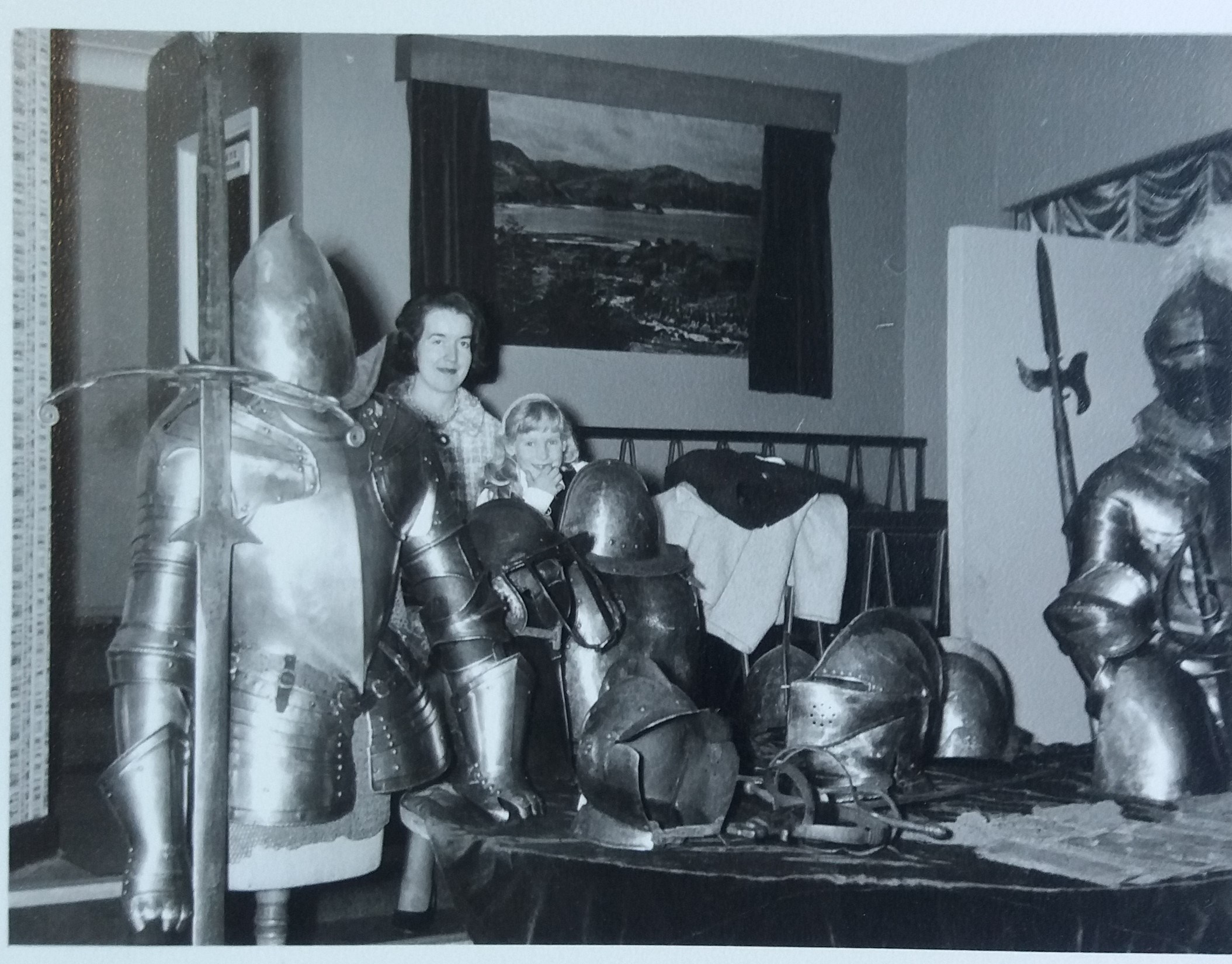
When we moved to Hoar Cross Hall in 1970 the organ in the private chapel wasn’t working as the house had been empty for 20 years. It was such a shame as it had been designed by Bodley, the famous organ maker of the 19th century. The chapel itself had been added about 25 years after the house was built at the staggering cost of just under £1000! When one of the visitors to the house said he could fix the organ, my dad readily agreed. This chap really loved organs and volunteered his services free of charge just for the love of mending this musical work of art; my dad was over the moon! Alas, after removing all the pipes and laying them out in the basement, he found that he couldn’t carry on with the renovations and we never saw him again!
The Bodley organ
When Kev saw the organ in pieces he offered to try and fix it and we spent many an hour in the chapel and basement trying to work out which pipe went where and how to make it play again. But it was quite complicated and it was an ongoing project for some time – still, it kept us busy!
The divorce was getting quite bad by now and I had to accompany my dad to the solicitors on more than one occasion, mainly for moral support but also to back up what was happening in the house between my parents as I witnessed quite a lot of arguments and fights. The solicitor explained to my dad that his antique collection would be classed as ‘chattels’ in the marriage and my mum would be entitled to half of it. My dad went berserk as usual and vowed that she wouldn’t have any of his antiques as they were his means of earning money and not part of the domestic furniture. However, as he was classed as self employed, his collection was deemed part of the family belongings. The Mediaeval Banquets business was now in my mum’s name as a limited company and she ran them herself, separate from my dad. My dad still got the rent money from the apartments and the takings from the house when it was open to the public,...
Midnight Pool Parties #21
Viv Wilson | 27th September 2021 |
Life at The Hall
After leaving school I spent a year at Burton-on-Trent Technical College studying to be a secretary but my year at college had come to an end - now to find a job! It didn’t take too long as there was plenty of employment around in the seventies and I was soon offered a position with a small engineering firm in Burton. As I didn’t drive there was still the problem of me getting to work and dad managed to talk the residents of our apartments into taking me, as they were going to Burton every day as well, and it would save him coming out twice a day (no doubt he was thinking about the petrol he would save too!)
Kev, my boyfriend, and the band were getting a few gigs around the area and after singing with them for a little while I gave it up and let a more professional singer take over – I needed to work on my confidence first! We still went to the '76 Club' though to see live music – it was the start of the punk era and we saw the Sex Pistols there when they were just starting out – I have to say they didn’t get a very good reception as they couldn’t even start the first song properly and were actually booed off stage which was a ‘first’ for that club. Their ‘punk’ behaviour almost started a riot in what was normally a peaceful hippy venue!
76 Club poster
My mum still wasn’t convinced that Kev was the right person for me and was becoming quite determined to split us up. She tried to talk me into giving Kev up for six months "to see if you still feel the same way afterwards" but we didn’t want to be parted. When he walked 7 miles from Burton to see me my mum asked him to dig one of the rose borders (our borders were about 30 feet long!) as a way of proving himself. He did it too, bless him! We were very determined to stay together but my mum started to plan ways to prevent this – one of her schemes (we discovered) was to suggest to the local Police that Kev’s band were all taking drugs which led to the drug squad regularly foll...
Like Father, Like Sons #20
Viv Wilson | 20th September 2021 |
Life at The Hall
As mentioned in earlier blogs my dad used to be a racing driver during the 1950s and ran his own team in the 1960s, travelling all over Europe in his trusty Volkswagon van with his two mechanics and driver. He didn’t have big sponsorship money behind him and most of it was done on a shoestring but he came back with lots of funny stories of their van breaking down or some rural ‘hotel’ that they had stayed in. From each country that he visited he always brought me back a doll dressed in the traditional costume of that country. There was quite a collection and I still have them; I used to put them on display in the Library when our house was open to the public.
Because of this background in motor racing, my brother Gavin wanted to start kart racing when he was about 14 and kept pestering my dad to get him a kart. Dad promised that he would take him to the races but said he didn’t have time to do the preparations and so Gavin had to learn the hard way how to do it! He made lots of mistakes early on, including the engine nearly falling off in one race, but he got there in the end!
As he got better he moved into the seniors when he was 16 and started to win trophies – now he was getting serious! He raced at a place called Chasewater near Lichfield and finished second twice in the regional championships, regularly winning races against over 40 other drivers (see header pictures). The Welsh Championships found him coming in 5th. He also did some British championship races against 160 other drivers around the country, finishing in the top 30 but as he never had new tyres like most of the top drivers, it stopped him moving all the way up. The kart racing created a new interest for my dad and he was glad to get out of the house at weekends since splitting up with my mum. The atmosphere at home was always tense and if they accidentally bumped into each other in a corridor somewhere it would usually spark an argument. Kev and I would keep the house open to the pub...
Hoar Cross Hall - Life below stairs #19
Viv Wilson | 13th September 2021 |
Life at The Hall
This week I’ve done a historical blog about the servants who lived at the Hall from the 1870s to the 1950s when the Hall became empty. They were an essential part of keeping a big house running but were often not appreciated by the aristocracy as they went about their day to day duties.
The life of a servant in Victorian times was a hard one. They had to rise at 5am to clean and light all the fires and dust and polish the floors, then do a day’s work, often not getting to bed much before midnight. No wonder they didn’t live to a great age in those days! By the end of the 19th century there were nearly one and a half million servants; most young girls went into domestic service when they left school. A large house with neither running water nor electricity would need a lot of help to keep things going. There was also the continuous cooking that needed to be done – for the family above stairs and the servants below. Everyone had meals at different times; the servants would obviously eat before or after they had served the family. The children and nursery staff would eat at around 5pm and then there were the afternoon teas and full English breakfasts! Everything had to be made from scratch of course so the cooks must have been cooking something or other from dawn until dusk. It must have been exhausting!
In the grounds there were around 20 gardeners and groundsmen who helped to keep the constant weeds down and tend to the rose bushes and hedges. This in itself would have been a full time job. The kitchen gardens and greenhouses would have provided a lot of the produce they ate as well as the pheasants and other game birds that were reared to be eaten. There was also a carp pool for their fish stock. In total there were about 50 servants employed by the Meynell family which included cooks, housemaids, chambermaids, lady’s maid, a governess, a nanny, a butler, footmen and a house-keeper among others. All staff were expected to attend the 9am service which was...
Ghouls Galore #18
Viv Wilson | 06th September 2021 |
Life at The Hall
One of the great things about living in a stately home is that you can have a wild party with the loudest of music – and no-one will hear it! I was now going out with Kev, whom I had met at college. Mum was a bit disappointed that my sensible boyfriend and I had parted company after 18 months of an on/off relationship but she accepted Kev into the fold and eventually met all the other members of the band. I think she wanted to put her mind at rest that they were a bunch of nice lads and not a drug crazed rock band eating bats! Which of course they were! No – I’m only kidding! After the awful split up at Christmas my parents were now living at each end of the house – what a carry on – some nights were spent with my mum and other nights with my dad as we tried to spread our affections and loyalties between them. But sometimes it was hard and I was glad to leave the oppressive atmosphere at home and stayed out after college as much as possible, spending time with Kev and the band.
Of course we all still liked to party like most young people and we often held parties in the west wing apartment at the Hall where we had got to know the latest residents there. A large crowd of people would meet up at the Meynell, the local pub in the village, and then we would all troop up to the Hall at closing time and sneak into the west wing via the basement door, which was the way in for the people who lived in the apartments. Up the spiral staircase we would all go and eventually we got to our destination, trying to beat the time switches which kept the lights on until we got there. We were always terrified that the lights would ‘time out’ before we got to the next one along the basement passageway and everyone would be making ghostly sounds and chasing each other into dark rooms off the main route. Good job no-one could hear us!
The spooky basement corridor
As everyone had heard about the ghost stories at the Hall, occasionally at these parties we would ma...
Becoming a Rock Chick #17
Viv Wilson | 31st August 2021 |
Life at The Hall

My schooldays were coming to an end now and I absolutely couldn’t wait to leave. The school itself was an old Victorian grammar school in Uttoxeter which still had wooden desks with inkwells in them! Even the teachers wore their mortar boards and gowns just like the ones at Eton and Harrow – or the Beano! However, in the last two years there I had made a few good friends and we would go into town every lunch time to meet up with a group of guys that worked at the local J. C. Bamford firm. They were all into motor bikes and one of the first films I watched was ‘Easy Rider’. They also went to a lot of concerts to see live music, something which was totally new to me – I’d only seen dance bands at the New Year’s Eve Balls (yawn), even though I loved music. They opened my eyes (and ears) to a new type of music and always bought me a ticket for the next concert they went to but my mum would always say ‘No’, much to my disgust!
Eventually I started dating one of the lads who was actually 21 so a bit older than my 16 years but as he was quite sensible my mother approved of him and eventually let me go to concerts with him. Over the space of a few months we saw Jack the Lad, Dr Feelgood, Status Quo and The Who. The Who were incredible and Keith Moon even smashed his drum kit up as their grand finale! We also went to this really cool place called The Highwayman. Up to this point my only socialising was at the banquets with my parents watching my every move – now I could get out and away from them as my boyfriend had a car! I loved the dark, smoky atmosphere of this place with its loud rock music – we would go there in a convoy of minis and motor bikes, driving fast through the lanes. With places like this to go to, life could only get better – couldn’t it?
In September I started college in Burton-on-Trent – another big change for me. It was nice to be in an environment where I was treated a bit more like an adult and I could wear my own clothes ...
Hysterical Productions #16
Viv Wilson | 16th August 2021 |
Life at The Hall
By the end of 1974 we had done about 40 banquets at Hoar Cross Hall and they were still going strong. Most of the original cast were still with us but we were on our second King now and also doing our own catering and bar, instead of an outside firm coming in. Every weekend over 200 people came to sample our Noble Brose, Roast Lambe and Saracen’s Delight and sing along to ‘I’m Henry VIII’ whilst drinking beer, wine and mead.
But it was a very adult environment for 15 year old girls to work in; a few of my school friends also worked at the banquets as wenches and we were constantly being chatted up by men who bought us drinks all evening (even though we were well underage). But despite the seventies shenanigans the nights were always a good laugh and there were lots of funny things that happened. Myra (the fire-eater’s wife) and I always did the cloakroom and one time this lady took her coat off and as she did so her halter neck top came undone and she stood there in her bra and skirt for all to see!
The banquet menu
Once the banquets started we would join in with the singing, even standing behind the main act and pretending to be the backing group. Another member of the cast would wear a sombrero and shake maracas to a Latin song while we threw petals all over him – don’t ask me why! The next day, when cleaning up, we would find all sorts of things which people had left behind: scarves, perfume, money, cigarettes and even a set of false teeth left on the mantelpiece! I had found a little hidey hole in the wooden panelling in the Long Gallery; a small 6” square door which pushed open when pressed in the right place and I would keep things in there which I found – especially the cigarettes!
In the middle of all this busyness my dad still found time to go to arms and armour exhibitions, one in particular in Birmingham around the time of the IRA bombings, which was quite scary to see and also the Racing Car Show at London’s Olympia. This...
Rags to Riches #15
Viv Wilson | 08th August 2021 |
Life at The Hall
My family originated from Derby and my parents were married there in July 1952. Mum was 19 and dad was 36 so quite a bit older. They both lived in Derby and were very arty; my dad went to the Derby Sketching Club in his free time and my mum attended art college. I’m not sure where they met but it was either at something art related or at a dance, as was usual in those days. My dad was a sculptor by trade; I think his interest was sparked by seeing all the beautiful alabaster in Italian churches during the war. After the war he set up his own business making alabaster lamps, bowls and candlesticks among other things (see header picture). He would go to the alabaster mines at Chellaston near Derby and bring back huge slabs which were then cut down to smaller sizes at his works in Crosby Street. He also owned a car as well as his own business so was quite the catch for my mum! After they married he built a little bungalow next to the works for them to live in, which is still there after all these years although the works have now been demolished.
My parents' wedding day in 1952
For someone from his background, owning your own business was something of an achievement, being born the illegitimate son of a servant girl during the First World War. Even his birth is a story in itself as his mother worked at a nearby stately home as a servant and fell for the son of the house. My mum told me all about it years later – how they had fallen in love and were ‘walking out’ together even though it was forbidden in those days for the aristocracy to mix with the servants. However, before they could be married the son went off to the First World War and caught tuberculosis - he sadly died so my grandmother had to bring my dad up alone with help from her own parents, and without getting married (this is where my dad gets his double-barrel surname from). When my dad was about 4 years old my grandmother married a sailor and they had a little girl, my Aunty Dorothy. He t...
Hoar Cross Hall - a bit of history #14
Viv Wilson | 01st August 2021 |
Life at The Hall
Hoar Cross was part of Needwood Forest, the 11th century lands of Henry de Ferrers. The land was passed down to Henry’s son and subsequent various people over the course of 500 years ending with the Webb family, around the 1730s, who bought the land and house known as the Manor of the Cross. This was quite a large house built on a hill near Yoxall (which is the village next to Hoar Cross). In 1740 the manor house was demolished and later the Hon. Charles Talbot bought the estate for £17,000. Eventually it was sold to Hugo Meynell, who already owned huge amounts of property all over the county.
This branch of the Meynell family originated from Leicestershire, namely Quorndon. In the 18th century Hugo Meynell had the title of ‘the father of fox-hunting’ as he had founded the Quorn Hunt in 1750 which became famous around the district. He bred his own strain of foxhounds and was the first person to study fox-hunting from a scientific point of view. He bought Quorn Hall in 1754 and built stables and kennels there, having 30 horses stabled at its height. In 1758 he became High Sheriff of Staffordshire and Member of Parliament for Lichfield. When his son, Hugo, died in 1800 he sold Quorn Hall to the Earl of Sefton and left to live in Derbyshire; although the family owned large amounts of property all over the Midlands in at least five shires.
The Meynell family claim to be descendants of the Norman baron, Hugo de Grand Mesnil, who came over with William the Conqueror. He is said to have died in Leicester in 1093 and his descendants settled in Derbyshire and Yorkshire. The sons of Hugo went off to the First Crusade and a representation of Hugo’s shield can be seen in one of the windows of Hoar Cross Church. Sir Hugo de Mesnil of Langley Mesnil represented his county under Edward III in five parliaments and thus started a long line of descent for the Mesnil family eventually changing the name to Meynell in the 1600s.
In 1782 Hugo married Elizabeth Ingram Shephear...
Skools out for summer #13
Viv Wilson | 26th July 2021 |
Life at The Hall
When Hugo and Emily Meynell built Hoar Cross Hall it included a whole estate with it, namely kitchen gardens, greenhouses, stables, a farm and cottages. Old Hall (their original home) was also on the estate and was accessed via a private road, which ran from the main road. By the time the seventies came along the stable block and Old Hall were private houses and another part of Old Hall had been made into a children’s home. Emily Meynell had started this home in the Victorian days, calling it ‘The Home of the Good Shepherd’ but it was for boys only at that time. When we were there it was a mixed home and run by a husband and wife couple. They used to have fetes there in the summer and we would sometimes play there as they had lots of climbing frames and slides. At one of the fetes I was standing next to a crockery smashing stall and a piece of crockery cut my head open causing a huge gash. I ran all the way home screaming and crying with blood pouring down my face – no-one could stop me – and was taken to the nearby hospital to have it stitched up. I still have a huge scar from that cut but luckily no-one can see it!
The private road also joined up to our woods near the driveway and this is the road I walked along every day, up to the main road, to catch the bus to school. It was about half a mile but I hated walking through the woods, especially in the winter when the mornings were darker. I was growing up now and keeping different secrets from my parents than the previous escapades with my brothers, Gavin and Piers; I had started smoking! Going into Uttoxeter every day meant I could buy cigarettes for 30p a pack and smoke them on the way home. I often went up to our attic room to do my homework and write stories but also to have a crafty cigarette. I had also started to help myself to the odd bottle of mead from the banquet stock and kept it hidden in the attic – all typical teenage stuff!
One day, whilst walking round Uttoxeter at lunchtime, I saw a...
More Tea Vicar? #12
Viv Wilson | 18th July 2021 |
Life at The Hall
Life at Hoar Cross Hall was always busy but during the long summer holidays it was easy to get bored. As there was no public transport from Hoar Cross and no other families living nearby, we three children had to make our own entertainment and we were always having adventures and getting up to mischief – a bit like the Famous Five but without a dog! We would roam around the village or explore the basement. My dad was a hoarder and had kept all sorts of stuff over the years including gas masks and field phones from World War 2. The old Servants Hall was now my dad’s workshop and he spent a lot of time down there restoring antiques to sell. He had one of the field phones in his workshop and the other one was in our kitchen at the opposite end of the house. To operate them you would wind a handle on the side and a bell would ring on the phone at the other end. This was how my parents communicated especially when my mum wanted to tell my dad the dinner was ready! But we also had fun playing with them too and would often ring each other up or call my mum from the basement.
In the grounds was The Church of the Holy Angels. Emily Meynell Ingram commissioned Bodley to commence work on the church in 1872 in memory of her husband who had died the previous year. It was generally regarded as one of the finest Victorian churches in the country and was known locally as the “Cathedral of the Midlands”. It was indeed a huge church (for a village) and always open to the public so we would sometimes go and have a look inside. On one occasion there was no-one around so Gavin and I lit all the candles in the church as we thought it looked really pretty and brightened the place up a bit. Oh dear – that was definitely not the right thing to do! A strongly worded letter was sent to my dad from the vicar telling him in no uncertain terms that he should be disciplining his children a lot better than he was. My dad hit the roof about this as he didn’t like people telling him wha...
Ventures New! #10
Viv Wilson | 05th July 2021 |
Life at The Hall
VENTURES NEW
We were now in our third year at Hoar Cross Hall and our lives were always busy keeping on top of the weeds and general upkeep of the house. My dad expected us children to help as much as possible, which we hated, and much of our time was spent trying to hide from him to get out of doing the chores. But sometimes we didn’t mind and we happily pulled an old trolley into the woods every now and then to collect wood for the fires and sometimes as a family we would spend a day clearing parts of the woods and grounds. My mum had hired a lady from the village to help with the housework and we had also taken on a retired chap called Mr Hickman to do some gardening. My brother Gavin and I had found some huge barrels which had been left behind, possibly from the wine and beer cellars when the monks lived in the house, and we had great fun learning to walk on them like they did in the circus! We also built a treehouse in one of the huge cedar trees which lined the path to the church. As per usual the three of us would hide up there and watch the visitors walk by on their way to the church, as this was also open to the public, then we would make animal noises or suchlike and throw pine cones into nearby bushes to make them jump! It was also a good place to hide from our dad!
The barrels left behind by the monks
The visitors continued to come on a regular basis and my parents tried to think up different ideas to attract them. At one end of the terrace, near to the old grass tennis courts (still with two foot high grass on them!) they made a playground, which was fun for us too. My dad continued to buy and sell antiques and was often at local auctions and occasionally made trips to London for sales at Sothebys or Christies auction houses. I once went with him and we spotted the actor Rodney Bewes from The Likely Lads TV programme – he pulled up next to Sothebys in his Rolls Royce!
Me with my mum at an antiques fair
My dad’s antique collec...
Motor Racing Days #9
Viv Wilson | 28th June 2021 |
Life at The Hall

MOTOR RACING DAYS
Although my blogs are about living at Hoar Cross Hall, I would just like to give a bit of background about my dad’s racing career in the years leading up to moving to the Hall as this will set the scene for later instalments of my story.
As mentioned in my first blog my dad used to be a racing driver but he actually started off racing motor cycles in the 1930s. Because of this he became a despatch rider during the Second World War and spent a lot of time in North Africa. After the war he started racing motor bikes at nearby Donington Park and he raced there up to the beginning of the 1950s. After that he moved onto cars and drove a Cooper 500cc (which is the equivalent to Formula 3) along with the likes of Graham Hill and Sterling Moss. At the end of the 1950s he moved into Formula 2. Of course in those days it was completely different and much more ‘fun’, unlike more recent times where it has become a big money business. My dad didn’t have a rich family to support him or financial backers and probably did it all on a shoestring knowing him! He told me that he would always ‘take it easy’ and wasn’t too bothered about winning; drivers always got their ‘start’ money and he was satisfied with that. Accidents meant expensive repairs!
My dad as a despatch rider in North Africa
During the 1960s he raced Lotus Elites and I have never forgotten the time, aged just 5 years old, when he took me for a spin around Mallory Park. I remember it all very clearly, even now. He strapped me into the car, watched by the mechanics in the pits. My poor mother was worried to death and kept asking if I’d be alright! My dad was his usual self, flouting the rules, and continued to do a few laps around the circuit with me clinging petrified to the side of the seat - I have been terrified of speed ever since – can you imagine that happening today!
My dad would spend a lot of his time tinkering about on the car once it was back home and the...
Ghostbusters! #8
Viv Wilson | 14th June 2021 |
Life at The Hall
GHOSTBUSTERS!
People were always coming to Hoar Cross Hall to either hire the place or to have a look around. In 1973, because of all the media interest in our ghosts, we had a couple of professional ghost hunters asking to stay over one night to try and find the source of the noises. They brought cases full of recording equipment and set it all up in one of the attic rooms. Rather them than me I thought! Then I had a brilliant idea and went off to tell my brother Gavin all about it. As mentioned in my first blog the attic and basement had a row of bells which the family used to summon the servants. Before the three men arrived we spent all day trying out all the bells to see which ones were which. We found that one of the bell pulls in the Chase Dressing Room made one of the bells in the attic ring. We also found that the bell pull in the Morrey Bedroom rang a bell in the basement and a bell in the attic rang a bell in the Long Gallery! Gosh, these people must have been hearing bells ring all day long!
The attic corridor showing bells on the left
Anyhow, the plan was that we would ring one of the bells right outside their room and when next day they told us about the noises we would tell them that the room for that bell was no longer there – it had been knocked down when the old kitchens had been demolished! Then they would realise that it must have been a ghost ringing the bell and listen to their recordings quivering in fear! Gavin and I were so excited we could hardly sleep that night. Before we went to bed we rang the bell quite a few times until we were satisfied that they had heard it then went to sleep. Next day we went up to see them and to ask if they'd heard anything. Apparently they had heard our ringing bell and gone on the prowl around the attics to see what (or who!) was causing it. They had heard lots of people chattering and thought there was a party going on somewhere but everywhere was in darkness. Then, as they made their way back to ...
Calendar Girls and Front Covers #7
Viv Wilson | 07th June 2021 |
Life at The Hall
CALENDAR GIRLS AND FRONT COVERS
During our time at Hoar Cross Hall people would occasionally hire the house for a day’s filming or whatever. During the summer of 1973 a photographer from London hired the house and grounds for a day and he brought two models with him, one English and one German - they were taking photos for a glamour calendar! We children were told to keep right out of the way as they were taking photos in the gardens as well as the house. Naturally we wanted to see everything that was going on and my younger brother Gavin especially was very keen to watch – so much so that he found a pair of binoculars to follow all the proceedings! We managed to find all sorts of hiding places eventually settling in our attic room to keep tabs on everything. From the attic we could access the roof which was flat in places and meant that we could view all the grounds at the front of the house and the back. We often came up here to run around and explore and in the summer it was a great place to sun-bathe in private - not sure if our parents were aware that we did this!
The Bakewell gates before restoration
The girls wore wigs and hair pieces and were being photographed in military jackets with swords and other accessories from the house. They posed either topless or scantily clad in the gardens and in front of a pair of wrought iron gates (by Robert Bakewell, renowned Derbyshire ironsmith) right at the bottom of the garden. These gates linked the Ha-Ha wall. This was a wall which bordered the grounds and had a small ditch on the other side – the reason was that the ditch stopped the deer from jumping the wall; for on the other side was a deer park, although the deer had long since run off and it was just a field when we were there. The Ha-Ha wall is a French invention, the idea being that the recessed design element gives an uninterrupted view of the landscape beyond, so a small wall above ground and the rest below ground next to the ditch whic...
Huntin', Shootin' and Fishin' #6
Viv Wilson | 30th May 2021 |
Life at The Hall
HUNTIN’, SHOOTIN’ AND FISHIN’
Most stately homes have the obligatory hunting, shooting and fishing and Hoar Cross Hall was no exception during the Meynell family’s time there. We didn't take part in any of these activities but the Meynell and South Staffs Hunt used to meet locally to do a spot of fox hunting. They would all gather at different venues around the area and enjoy a drink before setting off. One of their usual places was the Meynell Ingram Arms Public House at the bottom of the village. In February 1972 they had their ‘meet’ at the Hall. We, as the host family, got all dressed up to meet and greet them and local helpers served drinks, usually sherry (see header picture). I had no interest in horses (unusual for a girl my age!) but the horses with their scarlet coated riders did look very impressive. The pack of hounds were everywhere, sniffing and panting and waiting for the off. My dad tried to make conversation with the Master of the Hounds by asking “So these are the dogs are they?” to which he received a curt “They’re hounds Mr Bickerton-Jones, not dogs!” Oh dear, mustn’t go upsetting the local gentry!
We hated the idea of a little fox being terrorised by a pack of dogs – sorry, hounds - and being ripped to pieces. Gavin and I were actually playing in the woods once when the hunt went by quite near to us – the fox literally ran right past us at such a speed it was incredible! We hoped he would get away and tried to think up all sorts of plans to divert the hunt away from the fox, finally pointing them in the wrong direction as they got near to us! Years later someone we knew rode in the hunt for the first time and came home with blood on her forehead – this was her initiation into joining up; the blood of the fox daubed all over her brow to show it was her first time! It seemed so barbaric.
The other ‘sport’ was shooting pheasants. This was something that was started by Henry VIII when guns became easier to handl...
The Grand Opening #5
Viv Wilson | 24th May 2021 |
Life at The Hall
A few months after moving in preparations at Hoar Cross Hall were going well, so that we could open it to the public by Easter. During the run up to buying the house my dad had been buying furniture, carpets and paintings like crazy and I remember our previous home being jam packed with chaise longues, sideboards and carved chests as well as all the suits of armour that he already had. This furniture was now set out in all the rooms. My mum’s collection of Victorian costumes were on display in the Ballroom as well as my dad’s collection of silver plated ‘display’ armour, which hung around the panelled walls; the suits of armour and the many paintings they owned lined the Long Gallery and other rooms. The old Dining Room was renamed The Chinese Room as my dad had quite a collection of Chinese armour, swords and wall hangings – and even a Burmese Palace Chair (see header picture). Display cabinets bought in sale rooms showed off smaller items. The biggest excitement though was seeing our house advertised on the local TV channel!
The Damask Room was turned into Lady Dorothy’s Boudoir complete with an 18th century four poster bed, an original bed complete with canopy and hanging curtains slept in by aristocrats throughout the centuries. I used to love lying on the bed with the curtains closed imagining myself in another era – once I lay down on the bed and fell asleep. When I awoke and climbed out from behind the drapes it was to a roomful of visitors staring open mouthed at me!
In another room my dad had his racing car surrounded by displays and photos of his racing career. The Entrance Hall was turned into a café area next to the kitchen, which had once been the old Butler’s Pantry, and my job was to bake scones and make sandwiches for the hungry visitors and groups that often came for a day out. Although I would make the scones earlier in the day, we would always leave a few in the oven so that there was a lovely smell of home baking floating aro...
Our mansion gets a facelift #4
Viv Wilson | 18th May 2021 |
Life at The Hall
OUR MANSION GETS A FACELIFT!
We moved into Hoar Cross Hall during the summer holidays and my parents quickly realised that they had a lot of work on their hands to make the place habitable as well as to earn some money from it. As previously mentioned, there was an East Wing and a West Wing to the house. My dad decided to convert the first floor rooms of each wing into three separate apartments; he had done this at our previous house. This would generate income from rents until we got the main house open to the public. It wasn’t a big job to convert the rooms as the East Wing had four main rooms and two bathrooms already there, which would have been used as guest bedrooms in Victorian times. He made these into two one-bedroom apartments with a bit of stud walling here and there and made small kitchens in the spaces which connected the lounge and bedroom, probably once used as cupboard space. The spiral staircase with it’s green baize door opened onto the inner landing next to the apartments and this is how the servants would have accessed these rooms when bringing the family breakfast trays in the mornings. Where children were to be seen and not heard, servants were to be neither seen nor heard by members of the family and all the areas to the house were accessed via the spiral staircases and then inner hallways and corridors so they could go about their duties quickly and quietly.
My dad spent a lot of his time at auction houses buying and selling antiques and so he went back there again to source carpets and kitchen equipment. He also installed huge electric heaters to keep our new tenants warm. The West Wing was smaller than the East Wing so was made into a two-bedroomed apartment. The tenants entered the house through the basement entrance and used the spiral staircases to get to their homes – so they were a bit like the servants of old, neither seen nor heard by us!
The next change to make was to our own rooms so we could move downstairs and have a big...
Things that go bump in the Night #3
Viv Wilson | 09th May 2021 |
Life at The Hall
THINGS THAT GO BUMP IN THE NIGHT!
Going to sleep in a big old house is quite scary when you’re young but going to sleep in a big old haunted house is even more scary!! That first winter at Hoar Cross Hall was like that. The attic rooms were on the floor above our bedrooms – there were about fifteen rooms which had been used for the servant girls to sleep in. Every time there was a windy night I could hear a window banging in the attic – all night long it kept me awake. The next day I would go upstairs to close it but there would be no windows open or even loose. They were all tightly shut as they had been for 20 years. I remember standing there in those dusty rooms feeling a tingling down my spine and goose bumps all over as I felt the atmosphere closing in on me - and I quickly legged it back downstairs!
On other nights I would hear people walking along the attic corridor and then at other times I could hear heavy furniture being dragged about – yet there was nothing up there as the rooms were all empty! Other members of the family heard it too and also people that stayed overnight, so it wasn’t the imaginings of a frightened child. There was also nobody else in the house at that point, apart from our family and they definitely weren’t walking about the house at 3am. I loved reading about old houses, mysteries and ghosts but when you’re actually in the middle of it in real life, it’s a bit different!
The haunted attic corridor
My parents also heard noises from their bedroom. It sounded like a room full of people talking, like at a party. They couldn’t work out if it was birds nesting under the eaves so they slept in another room down the corridor to see if they still heard it – and sure enough, they did! What was going on? Had we disturbed some lost souls forever wandering in the attics?
One night my mum was woken up by the sight of a little girl ‘floating’ over the bed. She said the girl was wearing a long nightdress and mop ...
An Englishman's Home is his Mansion! #2
Viv Wilson | 02nd May 2021 |
Life at The Hall

AN ENGLISHMAN'S HOME IS HIS MANSION!
My parents took vacant possession of Hoar Cross Hall in 1970 and the whole process of moving house was done over the summer months. We lived about 20 miles away in an old vicarage with a large garden and lots of outbuildings. This house was about 200 years old and they say Bonnie Prince Charlie marched past it on his way to battle back in the day, for all you history buffs out there! Actually I love history and I think my interest was fuelled by living in these historic houses as a child. My dad used to be a racing driver in the 1950s and before that he did motorcycle racing, often at nearby Donnington Park. During the 1960s he ran his own team, Shardlow Motor Racing, travelling all over Europe to race at all the famous circuits, so the outbuildings were always full of bits of racing cars and their engines! All this stuff had to be moved and my dad did most of it by travelling back and forth each day with vans and trailers full of the contents of our house and outbuildings – an enormous undertaking!
Moving in!
He knew some students and used to pick them up en route to help and they also stayed on to help tame the gardens which were very overgrown, the grass standing about 2 feet high. As I’m sure you can imagine, after nearly 20 years of neglect, the gardens were a sorry sight having once been very grand. Apparently, when the house was built, there were 20 gardeners and the head gardner was pushed around in his wheelchair inspecting all the borders and paths; if he saw a weed it was quickly removed! I couldn’t imagine the grounds ever looking as good as they used to but we certainly had a good try and started attacking the hedges and grass as soon as we moved in. If anyone saw the Chester Zoo mini-series in 2014 about an ordinary family moving into a huge old house to start a zoo then that is exactly what it was like for us. When I saw that programme it brought back so many memories of those early months at the...
My Dad Bought a Mansion #1
Viv Wilson | 26th April 2021 |
Life at The Hall
MY DAD BOUGHT A MANSION!
It was the summer of 1970, Mungo Jerry was at the top of the hit parade and we were about to move house. But not to any old house – to a 70 roomed mansion in 20 acres of grounds! For years my dad had collected antiques, ever since he was a young boy of 12, and it was his dream to own a large house where he could put them on show to the general public. In the 1970s he owned the largest private collection of arms and armour in the country and his dream was about to be realised; but little did we know what a nightmare would unfold before us.
Hoar Cross Hall was the home of the Meynell Ingram family who originated from Leicestershire. Hugo Meynell of Quorndon was the High Sheriff of Staffordshire and Member of Parliament for Lichfield and the family owned considerable property in Staffordshire, Shropshire and Derbyshire. He bought the Hoar Cross estate in 1793 and built a hunting lodge there known as Old Hall and founded the Meynell Hunt. It seemed the family lived here for many years until Hugo’s grandson, also Hugo, got married in 1863 and decided to build the present Hall for him and his wife, Emily Charlotte. The house took nine years to build and was eventually finished in 1871. Hugo and Emily had already moved in, but their new life together was soon to be cut short by a tragic accident. Fourteen months earlier at Birch Wood on their estate Hugo had a horse riding accident and had been bed-ridden ever since – he died in May of that year. They had no children and Emily built The Church of the Holy Angels in the grounds of the hall in memory of her husband. This is the church that I got married in almost a hundred years later. On Hugo’s death Emily inherited many large estates and they say she was a double millionairess – which in those days was a huge amount of money! And so we moved to this house with all its history and tragedies in the summer of 1970.
My family consisted of my mum, Gwynyth and dad, William (or Bill as he...
Temple Newsam and the Meynells #42
Viv Wilson | 18th April 2021 |
Life at The Hall
TEMPLE NEWSAM AND THE MEYNELLS: Following on from last week's blog about Emily Meynell Ingram's family background, this week I am delving into the family background of Emily's husband Hugo which explains how Emily came to own the Temple Newsam estate after his death.
In 1782, Hugo's grandfather, Hugo Meynell of Quorndon, the 'father of fox hunting', married the Hon. Elizabeth Ingram Shepheard. She was the daughter of Charles Ingram, 9th Viscount Irwin and Lord Ingram. The family seat was Temple Newsam in Yorkshire and this was how the Meynell family became associated with this great house. Through this marriage of Hugo and Elizabeth, the Meynell family also inherited the Ingram estates in Lincolnshire, acquired by Sir Arthur Ingram in the first half of the 17th century. In 1793 Hugo bought the Hoar Cross estate and built a hunting lodge which was known as Old Hall.
Hugo and Elizabeth had six children, the eldest being Hugo Charles who inherited the Temple Newsam estate from his aunt; however, he had to assume the surname of Ingram in compliance with the terms of the will of the last Lord Irwin. So this was how the Meynell Ingram name came about, something which was quite common with the aristocracy in those days. Hugo Charles went on to marry Georgiana Pigou in 1819; their eldest son was Hugo Francis Meynell Ingram, the last of the descendants of Sir Arthur Ingram to inherit Temple Newsam.
Temple Newsam had been built by Thomas, Lord Darcy, early in the 16th century. He, coincidentally, had married a Meynell, and a descendant married Elizabeth Meynell, so there are a lot of associations with the Meynells early on. Here the unfortunate Earl of Darnley was born. Married to Mary, Queen of Scots, he was murdered two years later, supposedly by Mary's next husband, the Earl of Bothwell. The house was rebuilt between 1622 and 1637 in Jacobean style by Sir Arthur Ingram and later the grounds were landscaped by 'Capability' Brown, the famous landscape...
The War Years and Beyond #40
Viv Wilson | 14th March 2021 |
Life at The Hall
THE WAR YEARS AND BEYOND: During the Second World War, life in country houses changed dramatically. It was no different at Hoar Cross. The flower borders on the main lawns were turfed over to reduce maintenance and vegetables were grown in areas formerly restricted to flowers. Evacuees from Birmingham came to stay for the duration of the war and they lived in the basement, as it was considered to be the safest place. I imagine that they must have been in the care of the servants as they were living amongst them but it must also have been quite exciting for them to move from a bombed out city to the relative safety of the countryside, although they must have missed their parents of course. Many children in those days never left the cities and towns where they lived and often didn’t know what a cow looked like in real life! To see all the lawns and woods at the Hall must have been incredible for them although I’m not sure if they were allowed to wander around the grounds.
Two of these youngsters returned to the Hall in the mid-1980s and spoke to my mum about the kindness they received from the family. They also told her about the ‘secret airfield’ hidden away in a copse behind the ha-ha wall (the wall separating the boundary of the grounds and the deer park). Apparently aircraft were kept here in readiness for action, it being a Satellite Landing Ground (SLG) site serving Fradley aerodrome, near Lichfield. The Hall was also offered as an Auxiliary Red Cross Hospital during the war but nothing came of this, probably owing to the lack of mains water. However, during the First World War, the Meynell home in London was offered to the War Office and the Red Cross and became a Military Hospital for officers, being used by Francis Meynell himself who was wounded in action.
The deer park with copse (right) which hid the plane
One feature at the Hall was the daily barometric readings; these had been taken since 1880 up until the Second World War, when rea...
Gardeners' World at Hoar Cross #39
Viv Wilson | 07th March 2021 |
Life at The Hall
GARDENERS’ WORLD AT HOAR CROSS: In it’s heyday Hoar Cross Hall had around 28 people employed to keep the 20 acres of grounds tidy and weed free. In Victorian England the most common of all male servants was the gardener. At Hoar Cross the head gardener had numerous under-gardeners known affectionately as ‘digging slaves’! They were responsible for producing fruit, vegetables and growing luxury items in and out of season, much of it under glass. Adjacent to the house was the carp pool and greenhouse area along with a palm house; next to these was a walled kitchen garden. This supplied the house with all its fruit, vegetables and herbs. The palm house produced palms and pot plants along with flowers for the house; these would be brought across to decorate the main rooms when an important function was on.
The ‘bothy’ house was in one corner of the kitchen garden. (A bothy is a simple dwelling on an estate, usually used for gardeners and other workmen). Here lived the ‘bothy boys’ who were young under-gardeners. Their job was simply to sweep the pathways all day and keep the leaves at bay!
There were two elderly chaps, Mr Knight and Mr Dukes, who were solely responsible for the south garden – however, their task was complicated by the fact that they couldn’t get on with one another! Grass was cut by a horse drawn mower, a task carried out by the chauffeur of all people! One of the family told us that back in the early days the head gardener was pushed around in a wheelchair when he was older, inspecting the lawns – apparently if he saw a weed amongst the blades of grass he would tell one of the gardeners to pluck it out straightaway!
Emily Meynell Ingram employed a Mr Rowley especially to carry out her plans of planting the yew hedges, of which there were many. At each side of the garden was a long walk bordered by yew hedges down to the ha-ha wall at the bottom. Across the bottom of the gardens were smaller square gardens (including the step...
What the Butler Saw! #38
Viv Wilson | 28th February 2021 |
Life at The Hall
WHAT THE BUTLER SAW! Anyone who’s seen Downton Abbey will remember Carter the butler. He is exactly how a butler would have been in the 19th century and, strangely enough, the butler at the Hall during the early part of the 20th century was also called Carter!
Although most big houses had a house steward who was in charge of accounts and general running of the household, a butler was more commonly engaged by the wealthy. He was usually a grand, authoritarian figure, commanding respect and awe and most of the servants would have been scared to death of upsetting him! He was dressed like a gentleman of the period and generally ran the household with an iron fist.
As I said, the butler at the Hall was called Gus Carter and he was with the family for over 40 years, joining the staff in the mid-1930s. When the family left the Hall in the 1950s and bought the smaller Hollybush House in nearby Newborough he went with them until his retirement. He and his wife celebrated their Diamond wedding anniversary in 1972.
Mr and Mrs Carter on their Diamond Wedding Anniversary
However, when at the Hall his main duties would have been looking after the wine cellar and silverware or plate as it was known. This was kept in a room next to his bedroom so he could keep an eye on it and make sure no-one stole anything. Similarly with the wine cellar, he would have kept it all under lock and key so none of the servants could have a crafty drink when no-one was looking. There was actually a Chubb walk-in safe in the basement where, I assume, the more valuable items were kept for special occasions. Near to the butler’s room was a Chubb wall safe, which would have been used for keeping guests’ valuables in while they were staying at the Hall. Not unlike a hotel nowadays! He also waited on table at all the meals and at night, secured all doors and windows and checked the fires were safe before retiring to bed. If there was no valet in the house then the butler would also ha...
The Kitchen Maid's Story #37
Viv Wilson | 21st February 2021 |
Life at The Hall

THE KITCHEN MAID’S STORY: If you were young, free and single – oh, and very well-to-do – the 1920s were the decade to be a part of. The upper classes had lots of time on their hands and enjoyed post-First World War delights such as the theatre and jazz clubs.
Not so for the lower classes, in particular a young girl who was to become the kitchen maid at Hoar Cross Hall in the 1920s. The ‘depression’ after the First World War brought stark poverty to her home and many like her. Her name was Jean Rennie, and she was extremely intelligent having won a scholarship to Glasgow University to study French and music. However, the £5 bursary she got was taken by her father and used to buy whiskey in his local pub. Her hopes of a career in music were dashed and she needed to find employment.
Jean was now known as Jenny and had many jobs as a servant, including one in a castle in the Highlands! She was, in her own words, a good housemaid but never a good servant. With memories of hungry children fresh in her mind she could never get used to the wanton waste of food left on plates, in the homes she worked in. Her mistresses were always untidy with stockings, shoes and underwear “flung everywhere” and powder “spilt lavishly” – this always rankled with her and she never really got used to the ways of the aristocracy.
She gradually travelled down the country and eventually found a job in London. Although she was still a scullery maid, she worked under a skilled chef who taught her much and she hoped for a career as a cook. Her employers were good and so were the wages. When she got the job at Hoar Cross Hall she could not only read a menu (in customary French) but also write one and prepare many of the dishes herself. Lady Dorothy Meynell was very impressed with her and as her husband, Hugo Meynell was about to take a small shooting party to their Laughton estate, she asked Jenny to go with them to do the cooking. Jenny recalled how thrilled she was to rid...
The Schoolroom Maid's Story #36
Viv Wilson | 14th February 2021 |
Life at The Hall
THE SCHOOLROOM MAID’S STORY: For the first 75 years of Hoar Cross Hall’s history about 50 servants were employed by the Meynell family in the house and grounds. Among these was a young girl of fifteen who started work in 1920 as a Schoolroom Maid. Her name was Miss Inez Sophia Large and she had connections to Hoar Cross through her grand-parents, William and Mary Tooth, who lived in the village where William was the blacksmith; his smithy was just along from the Meynell public house. He had worked on the ironwork of the Hall during its construction in the 1860s. Inez’s aunt, Constance Madeley, was the wife of the landlord at the Buffalo Inn, in nearby Newborough, and it was through her that she secured the job at the Hall. Inez’s parents were themselves in service; her mother had been a lady’s maid and her father was a butler for the Spanish Ambassador in London – from which source Inez assumes her Christian name originated.
There was little choice but to go into service in those days (her sister, Beatrice, was also a nursery maid with the Earl and Countess of Lichfield), and she was engaged on a salary of £18 per annum. Her mother made her uniform, which comprised of a morning dress and an afternoon dress, and Lady Dorothy Meynell supplied her cap. She was the personal maid to Lady Dorothy’s eldest daughter, Dorothy, who was just four years younger than Inez. She also looked after Dorothy’s younger sister, Rachael.
The schoolroom at this time was situated just off the main Entrance Hall, and immediately below the nursery. Inez worked under the supervision of Mrs Catt, the housekeeper, Miss Rhodes, the lady’s maid, and the head housemaid, Rose.
Her day began at 6am every day and she was so afraid of oversleeping that she kept an alarm clock under her pillow! The first job of the day was always to clean the grate and get the fires lit, then sweep and dust the schoolroom, lay the table for breakfast, call the governess, Miss Chromy, with morni...
Moving On #35
Viv Wilson | 07th February 2021 |
Life at The Hall

MOVING ON – THE END OF AN ERA: And so, after ten years of growing up and living in a stately home, I have come to the end of my story. After my parents’ divorce it was agreed that my mum bought out my dad's half of the house and he had to leave his dream home forever. He and Gavin moved out to live in Burton-on-Trent and my mum carried on running Mediaeval Banquets for a few more years. She and the singer eventually got together much to my dad’s chagrin. The singer spent a lot more time at the Hall helping my mum run the banquets; however, Piers didn’t really get on with him. When he was about 14 years old my dad received a phone call from Piers – he had run away from home and was ringing from the phone box in the Meynell Ingram Arms car park! He told my dad that he was hiding behind a bush and could he come and get him. Of course, my dad was only too happy to fetch him and get him away from my mum and the singer and he set off to find him hiding, as he had said, behind a bush in the darkened car park. Piers continued to live with my dad and he joined in with the go karting along with Gavin and also got very involved with BMX stunts, even having a half pipe in their yard to practice on!
After a couple of years my dad moved to a much bigger house in Burton which had been an old doctors’ surgery that Kev and his family had gone to when Kev was young, ironically! He continued to buy and sell antiques and his interest in motor racing never waned; he often went to local races with his friends. Gavin eventually moved out to live near Norwich with his girlfriend Helen, and they married in 1991. He joined a motor racing team over there and went on to have a very successful career in racing, eventually running his own GP2 motor racing team, iSport International, who became world champions. He also takes amazing photographs of wild animals and birds for a hobby – check out his website - click here
Piers stayed with my dad and used the large workshops at t...
Moving Out #34
Viv Wilson | 31st January 2021 |
Life at The Hall

MOVING OUT: And so the day arrived a month or so after our wedding when my dad had to leave Hoar Cross Hall. Ten years after moving in he was now moving out, leaving his dream home for my mum to live in alone. Gavin moved with him and Piers was away at school most of the time. It was a mammoth task as he had so much stuff to move, especially from the basement. He had some heavy machinery too that he’d brought with him from his alabaster days, including a band saw which we used to saw up logs for the huge fireplaces in the main rooms. He had bought a house in nearby Burton-on-Trent which had some outbuildings for a workshop and there he moved to start afresh.
He carried on buying and selling antiques and often went to antiques fairs and sale rooms with his friends. He also continued with the go-karting with Gavin and this kept them busy at weekends. However, the whole experience had left him very bitter and he would constantly talk about it whenever we went round to see him, making visits fraught with tension!
However, we carried on with our lives as newly-weds and bought a house in a nearby village. It was completely empty and needed an oven and washing machine amongst other things. My dad was keen to help and offered to buy anything he saw at a sale room as he knew he could get them cheap; and that was how we ended up with a 1950s style twin tub washing machine! Well, it matched the age of the house I suppose! Many a week whilst washing, I cursed my dad for buying it as it always broke down and flooded the kitchen – eventually we threw it out!
A little while later we went to an auction at a large farmhouse that was quite local to us and because of the interesting ‘lots’ it had, quite a few of our well-to-do friends were there too. My dad was also there and told us he’d bought an oven for our new house. He couldn’t wait to tell us that it had only cost him £1. Even in those days £1 was ridiculously cheap, especially for an oven! He said it was ...
Here Comes the Bride (Part 2) #33
Viv Wilson | 24th January 2021 |
Life at The Hall

HERE COMES THE BRIDE (Part 2): And so our wedding day at Hoar Cross Hall arrived bright and clear, all thoughts of solicitors, legals, fights and arrests behind us! Myself and my bridesmaids went to get our hair done in the morning and Kev slapped a piece of steak on his jaw to bring the swelling down after the rather unfortunate fight at his stag do. Fortunately, the bruise didn’t show up too much on the photos! Gavin drove my dad’s Mercedes Benz car all the way down the drive and back up the road to the church – this was one of the drawbacks of having a church in the grounds; you don’t get to drive all through the town with everyone looking at you! Never mind, a small crowd of locals were gathered around the gate to the church and we got out, had a few photos taken and walked down the aisle to ‘Here comes the bride’.
However, as Kev had not attended the rehearsal (remember, he was fixing someone’s shower!), he didn’t have a clue what was going on or where to stand or anything! When we came to say our vows, the vicar got his name wrong and so I nearly married a ‘Derek’. There was much whispering at the front as we told him the correct name. Again, when I put my ring on the Bible, the vicar thought it was two rings as I had a Russian wedding ring with three bands. He started to say ‘with these rings……’ and once again, there was much whispering at the front as we explained that it was only one ring!
And then, just as we were on our knees to receive the blessing, Chris Meek (my dad’s old racing driver) walked in with a beautiful model on his arm. She was wearing a short cheesecloth dress and with the sun behind her it was completely see through! Anyone who remembers the Lady Di photo will know what I mean! We heard a sharp intake of breath as the whole congregation turned to face the door – talk about upstaging the bride!
Finally, the ceremony was over and I was married to Kev (not Derek) and as we walked out into the sunlight I f...
See you in Court #31
Viv Wilson | 11th January 2021 |
Life at The Hall
SEE YOU IN COURT: The saga of my parents’ split continued as we grew up in our stately home, although their behaviour was anything but stately for most of the time! Seven years of arguing and fighting were about to come to an end and the solicitors had finally agreed on a date to go to court. We carried on helping my dad to run the Hall and he still went to his boat in Caernarfon at weekends to get away from the house but we were all getting weary of it now. We were young adults and wanting to get on with our own lives. After five years together we were hoping to get married at some point so we were glad that it was finally going to be sorted out one way or another.
Gavin was now involved with a band who regularly supported The Jam so he was often travelling around the country with them. Piers had been sent to a local boarding school so we saw even less of him than before. My mum continued to live in the West Wing Apartment and was now seeing the singer who sang at the banquets. My dad sat on his own most nights with only the parrot for company. When he found out about the singer it started a fresh load of outbursts from him as he now felt that the pair of them were trying to take his house and business off him! He constantly ranted on about it and often threatened to shoot the singer with his gun – I don’t think he would have done but then again, with his temper, who knows! This latest twist in the story did nothing for my dad’s sanity and my mum was still hoping to have him committed and kept making appointments for him with the psychiatrist. Once again, the Police were called every week informing them of the threats on the singer’s life and they eventually took my dad’s gun licence off him just in case anything did happen!
We tried to keep out of the way as much as possible and stayed in Burton all week, where we worked, and came home at weekends where we would meet up with our friends and party in the apartments out of sight and sound of my par...
Here Comes the Bride (Part 1) #32
Viv Wilson | 11th January 2021 |
Life at The Hall
HERE COMES THE BRIDE (Part 1): Now my dad was having to move out of the Hall we had decided to bring our wedding forward so that we could get married in the church in the grounds (the Church of the Holy Angels) and then have the reception afterwards in the Hall, which was after all our family home. The wedding preparations were going quite well and as we knew lots of musicians it wasn’t hard to find a local band and a DJ to do the disco. A friend of my dad’s offered to do the catering and the bar was set up with plenty of kegs from the local brewery in Burton on Trent. I had two bridesmaids and we all went to Birmingham one day to choose our dresses and shoes – it was all kept very simple really as I had no help or advice from my mum as most brides do. Kev’s parents had eloped after the war and got married in a register office with two witnesses dragged off the street, so they had no idea what you did to plan a wedding! I managed to find a church near to Kev’s house and sorted out the reading of the banns. Then we went to the vicarage across the road from my house and booked the date. The vicar told us in no uncertain terms that he would expect us to be there when the banns were read. However, as we never got up before lunch on a Sunday, try as we might, we never actually managed to hear our own banns being read!
It was almost as bad at the wedding rehearsal. I went to the church with my dad and the two bridesmaids but Kev never managed to get there as he was fitting a shower for someone! I don’t think the vicar was very impressed with us!
The nearer it got to our wedding date the more we worried about my mum turning up. It wasn’t that I didn’t want her there but that my dad told us we couldn’t possibly have her there as he would ‘see red’ and a row would ensue. We really didn’t want a huge argument on our wedding day but knowing my dad’s temper we weren’t sure that he would be able to control himself so he offered to see his solicito...
A New Year Calamity! #30
Viv Wilson | 03rd January 2021 |
Life at The Hall
A NEW YEAR CALAMITY! The New Year’s Eve Balls at the Hall were usually the highlight of the year. After twelve months of hard work, especially running the Mediaeval Banquets twice a week through the winter, we were always ready to see out the year in style with a big new year party. In those days it was always black tie for the men and long dresses for the ladies – usually around 500 people bought tickets for an evening of entertainment with a dance band, disco and a meal. At midnight a man dressed in traditional Scottish regalia, including a kilt and sporran, would pipe in the new year with his bagpipes. Down the Long Gallery he would slowly walk and into the Ballroom with his pipes droning on. When midnight arrived a net full of balloons was dropped onto all the guests from the ceiling, out came the party poppers and hats and everyone joined hands to sing ‘Auld Lang Syne’. Once all the traditional stuff was done the band started up again and we all did the Hokey Cokey, the Conga and other silly dances that only happen on New Year’s Eve! It was always great fun and I loved to dress up in my long dress.
My parents were having a trial separation around this time so my dad had to run the New Year’s Eve Ball on his own. I helped, as I had before, with the administration; posting out tickets and doing a bit of book-keeping. The week prior to the Ball was spent moving furniture about and cleaning the house up after all the banquet tables and benches were removed. We usually used some of the banquet tables for people to sit at but this particular year my mum had stored them all away in the basement and put a lock on the door – these were her property now! This left my dad in a bit of a quandary about what to do for tables and after a lot of ranting he decided that he would have to hire some. As my dad was well known for being ‘careful’ with his money, he didn’t want to spend too much and hired the cheapest tables and chairs he could. They arrive...
Christmas High Jinks! #29
Viv Wilson | 27th December 2020 |
Life at The Hall
CHRISTMAS HIGH JINKS: The sounds of La Golondrina floated through the air as Viv sat at the grand piano. How pleased she was that someone had asked them to look after this fine musical instrument for a few months. Having learned to play when she was younger, this gave Viv the opportunity to brush up on her skills as a pianist and she was thoroughly enjoying it. The piano was in the Library and suited the room perfectly. She could hear her father and an antique dealer talking in the Long Gallery as they haggled over the price of a painting that he was selling. Viv gazed out of the window as she played and thought back to the Midsummer’s Eve Ball that they’d had a few months ago. It had been a huge success and so many people were there – more than she’d ever seen in one place. She had worn her long dress and her best friend had stayed the night so that she had someone of her own age there. She and her friend had sold raffle tickets to the guests, which had been fun and a good way to mix with everyone. Viv wondered why it was that the men always seemed more jovial and friendly towards them than the women, even encouraging them to sit on their knee! It had been most embarrassing as Viv wasn’t used to such attentions. Parties and drinking made people act in very strange ways, she thought. Now her thoughts headed towards Christmas and the New Year’s Eve Ball that they were planning. It was so exciting having all these Balls and dances; it made Viv feel very grown up when she wore her evening gown and slingback shoes. However, Christmas was first and she began to wonder what gifts she would get.
“Let’s go out for a bit, I’m bored!” Gavin’s voice ran ahead of him into the Library and made Viv jump.
“OK, I suppose we could. I’ve been playing for ages now, I could do with a break,” answered Viv. “Where’s Pap?” Viv used their little brother’s nickname.
“He’s gone to his friends’ house to play – that’s why I’m bored!”
...
Alice - the ghost in the mirror #28
Viv Wilson | 20th December 2020 |
Life at The Hall
ALICE – THE GHOST IN THE MIRROR: (Based on true events) In 1865 Lewis Carroll wrote another story about Alice following on from ‘Alice in Wonderland’. It was called ‘Alice through the Looking Glass’. In this story Alice climbs onto the mantlepiece over the fireplace in her lounge and finds that she can climb through the mirror into another world which is reversed, just like a reflection. Once again, she encounters strange figures in a world dominated by a chess set and nursery rhyme characters, among others. But what inspired Lewis Carroll to write about a little girl having lots of adventures?
In the 1850s Charles Dodgson (Carroll’s real name) studied at Christ Church in Oxford. A new dean, Henry Liddell, started around about that time and brought with him his wife and young family. One of his daughters was called Alice and this little girl was widely thought to be the inspiration behind his stories but Carroll always denied this.
In 1852 he became a tutor for the children of Charles Wood of Hickleton Hall in Yorkshire. During the summer a friend of the children, Mary Heath, stayed at the hall and this is the little girl believed to be his inspiration for Alice. But also, the room in which he taught the children had a lovely mirror over the mantlepiece which is exactly the same as the picture of the mirror in his story ‘Alice through the Looking Glass’. So it seems that lots of things from that time inspired him!
When Charles Wood’s daughter Emily got married in 1863 she took the mirror with her to her new home, Hoar Cross Hall, and there it hung over the fireplace in the Library for many decades until the Meynells left in the 1950s.
The mirror which inspired Lewis Carroll
And so herein lies the connection between Alice and the Hall! Fast forward to the 1990s when Hoar Cross Hall had a new owner, Steve Joynes. He converted the Hall into a Spa Hotel and managed to source a lot of the original furniture from the Victorian era w...
The Haunting of Hoar Cross Hall #27
Viv Wilson | 14th December 2020 |
Life at The Hall
THE HAUNTING OF HOAR CROSS HALL: (Based on true events) The typewriter keys clattered away as Viv wrote her story. It was coming along nicely and she was feeling pleased with herself. The attic room that she and her brothers had made into their ‘den’ was ideal for getting away from everybody and having some peace and quiet and she quite forgot about the time as she lost herself in the plot. Suddenly she looked up and realized how dark it was getting; the December nights were pulling in and it was already quite dusky by 3.30pm. Quickly she packed her books and folders away and prepared to go downstairs. How she hated being up in the attics when it was getting dark as it was so spooky! The wind was starting to howl outside and the familiar sound of a banging window started. Viv sighed and stood in the doorway of the room – should she go and investigate or leave it? Against her better judgement she walked up the corridor towards the noise and checked all the rooms but as usual all the windows were shut tight. The banging continued along with the familiar prickle down her spine. She needed to get out of here and quick! As she turned to go back along the corridor towards the other end she could hear people talking but not clearly, just a general babble of voices. Viv was in a complete panic now as she knew there was no-one in the attic with her and she started to run along the corridor willing the noises to stop, feeling the knot in her stomach and sensing the sheer terror in her mind as she ran to get away from the voices, the people and the footsteps.
The green baize door banged behind her and Viv breathed a sigh of relief. She’d made it out alive! At least that’s what it felt like; she vowed never to go up to the attics again on her own or in the afternoon. She gradually stopped shaking and went to find her mother who was putting up Christmas decorations in the Library. This was where they spent Christmas Day as, not only was it a nice room, ...
The Tax Man Cometh! #26
Viv Wilson | 07th December 2020 |
Life at The Hall
THE TAX MAN COMETH: My parents’ court case was finally over and my dad had six months to leave the family home of Hoar Cross Hall. In the meantime my mum had to find the funds to buy him out and he had to find another house to live in. He also had an awful lot of stuff to move too! He eventually found a house in nearby Burton-on-Trent but as it was obviously a lot smaller he had to get rid of quite a few of his possessions and one of the first things to go was his Lotus Elite. He advertised it in the local paper but instead of getting a phone call from a likely buyer, the first call was from the local tax office! Back in those days they used to check advertisements in the newspapers and they had spotted this expensive car for sale and thought they would check it out. They actually thought it was my mum’s car and it transpired that they were keeping an eye on her. They didn’t know that my parents were getting a divorce so when they spoke to my dad he quickly informed them of that fact and told them that this was why he was selling his car.
This then led to a few meetings between the tax man and my dad. Of course, my dad was in his element thinking of more ways to get his revenge on my mum! What better way than to shop her to the tax people. He knew that she didn’t tell them exactly how many guests came to the banquets each week. It was usually around 200-240 but I think the tax office were told slightly less than that! My dad was happy to tell them that my mum always did the book-keeping as he was useless at that sort of thing and so he feigned ignorance!
I have always kept a diary and during the time of the banquets I used to keep accurate records of how many people came along to them. When I told this to my dad he jumped up and down in glee and quickly informed the tax office! A meeting was arranged with them and I went along with my dad (and my diaries) to prove the numbers. It seemed a bit weird at the time sitting in a small room having to show so...
Race Day Parties #25
Viv Wilson | 30th November 2020 |
Life at The Hall

RACE DAY PARTIES: My dad used to be a racing driver so he was often invited to parties and open days at various racing circuits. He naturally knew lots of racing people and on this particular occasion he was invited to an Open Day at Donington Park. Tom Wheatcroft, a local entrepreneur, had bought Donington Park in the 1970s as he owned the largest collection of Grand Prix cars in the world at that time. In 1973 he opened a museum there to house them all and called it the Donington Grand Prix Exhibition. Donington became the favoured home of the British round of the MotoGP motorcycling championships but he was really hoping to bring Formula 1 racing back to the track and a bid was put in in 2007. Unfortunately the 2008 global crash put a stop to this as they lost financial backing and the bid went to Silverstone who now host the Grand Prix every year.
However, in 1977 he re-opened the track for cars and this was the Open Day that we all went along to. There were lots of different races with old cars as well as new. My dad used to race his motor bike there before the war and he was invited to join in with the historic bike racing – he jumped at the chance of riding a bike again and did really well, at the age of 61!
Kev and I went along with my brothers and we all got dressed up in our Sunday best, Kev wearing a jacket and me in a large floppy hat and heels – we looked as if we were going to a wedding not a race meeting! But dad assured us that we needed to look the part as there was a big party afterwards in a marquee with all the top racing people in attendance – ‘racing royalty’ we called them. People like Bob Gerrard, who was one of the top racing drivers of the post war era – he and his wife were always very expensively dressed and hosted one of the marquee parties. There was also a VIP marquee which we managed to sneak into when no-one was looking. After ordering our drinks at the bar, Kev asked how much they were and was told in no uncertain t...
Whodunit in the Library? #24
Viv Wilson | 23rd November 2020 |
Life at The Hall
WHODUNIT IN THE LIBRARY? When we first moved to Hoar Cross Hall, growing up in a stately home seemed an idyllic way to live – and lots of fun if you’re a child. This rambling old house full of empty rooms and secret doors, wild gardens and woods to explore, was in some ways a dream come true for our family, certainly for my dad. But as we turned from children to teenagers the isolation and lack of public transport was frustrating. Coupled with this was my parents fighting and subsequent split, living at each end of the house and battling for the house and business through their solicitors.
The effect this had on me, as the eldest child who perhaps saw more of it than my brothers, was that I started to have awful pains in my stomach. Whenever Kev and I were out I would often double up in agony and once I was in such pain in a local bar that the landlord rang for an ambulance and I was whisked off to hospital with suspected appendicitis. After a full examination I was told there was nothing wrong but that it was probably my nerves affecting me. After a visit to my GP he told me it was nerves and prescribed Valium tablets (now known as Diazepam) which was a drug to relax you when you felt under stress. Both my parents were already on this medication and we would often borrow each other’s tablets if one of us ran out! I now realise what a ridiculous situation this was – Valium was a powerful drug to be taken for 2-3 months but back in the 70s I was freely given it (aged 17) and was not monitored at all by the GP. I took it for well over a year and mixed it with alcohol totally oblivious to the effects it might have on me – one of them being that I frequently had horrendous hallucinations. My dad was already visiting a psychiatrist each week and my mum took me to see one too! Our family really was falling apart at the seams!
However, the feud went on and my dad was still selling items from the house unbeknown to my mum. He had a beautiful wooden musical ...
The Graveyard Shift #23
Viv Wilson | 16th November 2020 |
Life at The Hall
THE GRAVEYARD SHIFT: Life carried on at Hoar Cross Hall as best it could in difficult circumstances. My dad continued to go to Arms and Armour Fairs to buy and sell antiques and we also went to a mediaeval banquet in Cheshire one night, although it wasn’t anywhere near as good as ours! Once or twice we took my dad out with our friends to Derby, where he originated from, and that seemed to cheer him up. But he really needed to get away from the house for longer periods of time and when he saw a boat advertised for sale at Caernarvon he decided to buy it. It was an ex lifeboat called The Bembo so quite sturdy, although in need of a lick of paint and a bit of TLC. The town of Caernarvon is in Wales and is host to a huge castle where the Prince of Wales (Prince Charles) had his investiture in 1969. The Bembo was moored by the harbour and the town was full of quaint, narrow streets which we loved to explore. Once he had bought the boat he would go away at weekends and usually took Gavin or Piers along with him. My mum jumped at the chance of making me go as well so she could keep me away from Kev, but after a couple of times on my own Kev decided to come along too, and was able to help fix the electrics on the boat amongst other things.
Mum and I at a typical antiques fayre selling armour
When my dad went away at weekends during the summer months Kev and I would open the house to the public. As well as a bad atmosphere between my parents there was also a bad atmosphere between me and my mum and mum and Kev, so we were all trying to avoid each other! My mum had taken over the West Wing apartment when the tenants left, leaving my dad with one less rental income. She was also putting Yale locks on all the rooms that she used in the house as well as any storage rooms used for the banquets. This infuriated my dad who obviously didn’t have access to them once the locks went on. One of these rooms was the cupboard off the Entrance Hall which held the meter ...
Panto Pranks #21
Viv Wilson | 01st November 2020 |
Life at The Hall
PANTO PRANKS! During the 1970s Hoar Cross Hall was used from time to time for local community activities and one such event was the production in 1978 of a traditional pantomime, ‘Midnight and a Journey back to Happiness’. It was written by local people, Robert Leighton from Yoxall and the Hon. Alexandra Meynell, daughter-in-law of Mrs Jean Meynell whom we had purchased the Hall from. The words and music were written by local songwriter, David Matthews, who had written songs for quite a few pop artists during the 1960s, his most famous being Matt Munro’s ‘We’re gonna change the world’. So off to a good start there!
For those of you who don’t reside in the UK and have no idea what a pantomime is, it is a musical play with slapstick comedy based on a children’s nursery story or fairy tale, usually produced at Christmas. It’s mainly for children but adults tend to love them too as there is always a lot of audience participation, especially when the villain walks on and everyone boos and hisses or shouts “He’s behind you!”.
The aim was to involve as many people as possible, particularly the youngsters, and adults and children from around the area of Hoar Cross were invited to participate in the event, forming a group known as ‘The Overdraft Players’! About 80 people took part altogether including three ‘retired’ semi-professionals. A huge, three-tiered, sectional wooden stage was built for the venture and sited in the Ballroom. Local people got involved with set design and costumes; another lady arranged and produced the ballet routines.
Gavin and Piers were involved of course but Gavin broke his arm a couple of weeks before the show started so ended up with the minor but important role of working the hands of the large clock that stood to one side of the stage! I felt really sorry for him as he had to stand behind the clock and no-one could see him – however, the clock was a major part of the story which involved the lead actors...
Midnight Pool Parties #20
Viv Wilson | 26th October 2020 |
Life at The Hall
MIDNIGHT POOL PARTIES: After leaving school I spent a year at Burton-on-Trent Technical College studying to be a secretary but my year at college had come to an end - now to find a job! It didn’t take too long as there was plenty of employment around in those days and I was soon offered a position with a small engineering firm in Burton. As I didn’t drive there was still the problem of me getting to work and dad managed to talk the residents of the apartments into taking me, as they were going to Burton every day as well, and it would save him coming out twice a day (no doubt he was thinking about the petrol he would save too!)
Kev and the band were getting a few gigs around the area and after singing with them for a little while I gave it up and let a more professional singer take over – I needed to work on my confidence first! We still went to the 76 Club though to see live music – it was the start of the punk era and we saw the Sex Pistols there when they were just starting out – I have to say they didn’t get a very good reception as they couldn’t even start the first song properly and were actually booed off stage which was a ‘first’ for that club. Their ‘punk’ behaviour almost started a riot in what was normally a peaceful hippy venue! However, their album 'Anarchy in the UK' was actually recorded live from the 76 Club so our clapping is recorded forever on this piece of vinyl! (See below)
My mum still wasn’t convinced that Kev was the right person for me and was becoming quite determined to split us up. She tried to talk me into giving Kev up for six months - but we didn’t want to be parted. When he walked 7 miles from Burton to see me my mum asked him to dig a border (our borders were about 30 feet long!) as a way of proving himself. He did it too, bless him! We were very determined to stay together but my mum started to plan ways to prevent this – one of her schemes (we discovered) was to suggest to the local Police ...
Like Father, Like Sons #19
Viv Wilson | 18th October 2020 |
Life at The Hall
LIKE FATHER, LIKE SONS: As previously mentioned in earlier blogs my dad used to be a racing driver during the 1950s and ran his own team in the 1960s, Shardlow Motor Racing, travelling all over Europe in his trusty Volkswagon van with his two mechanics and driver. He didn’t have big sponsorship money behind him and most of it was done on a shoestring but he came back with lots of funny stories of their van breaking down or some rural ‘hotel’ that they had stayed in. From each country that he visited he always brought me back a doll dressed in the traditional costume of that country. There was quite a collection and I still have them; I used to put them on display in the Library when our house was open to the public.
My European doll collection
Because of this background in motor racing, Gavin wanted to start kart racing when he was about 14 and kept pestering my dad to get him a kart. Dad promised that he would take him to the races but said he didn’t have time to do the preparations and so Gavin had to learn the hard way how to do it! He made lots of mistakes early on, including the engine nearly falling off in one race, but he got there in the end!
As he got better he moved into the seniors when he was 16 and started to win trophies – now he was getting serious! He raced at a place called Chasewater near Lichfield and finished second twice in the regional championships, regularly winning races against over 40 other drivers. The Welsh Championships found him coming in 5th. He also did some British championship races against 160 other drivers around the country, finishing in the top 30 but as he never had new tyres like most of the top drivers, it stopped him moving all the way up. The kart racing created a new interest for my dad and he was glad to get out of the house at weekends since splitting up with my mum. The atmosphere at home was always tense and if they accidentally bumped into each other in a corridor somewhere it would usually sp...
Hoar Cross Hall - Life below stairs #18
Viv Wilson | 12th October 2020 |
Life at The Hall
HOAR CROSS HALL – LIFE BELOW STAIRS: This week I’ve done a history blog about the servants who lived at the Hall from the 1870s to the 1950s when the Hall became empty. They were an essential part of keeping a big house running but were often not appreciated by the aristocracy as they went about their day to day duties.
The life of a servant in Victorian times was a hard one. They had to rise at 5am to clean and light all the fires and dust and polish the floors, then do a day’s work, often not getting to bed much before midnight. No wonder they didn’t live to a great age in those days! By the end of the 19th century there were nearly one and a half million servants; most young girls went into domestic service when they left school. A large house with neither running water nor electricity would need a lot of help to keep things going. There was also the continuous cooking that needed to be done – for the family above stairs and the servants below. Everyone had meals at different times; the servants would obviously eat before or after they had served the family. The children and nursery staff would eat at around 5pm and then there were the afternoon teas and full English breakfasts! Everything had to be made from scratch of course so the cooks must have been cooking something or other from dawn until dusk. It must have been exhausting!
In the grounds there were around 20 gardeners and groundsmen who helped to keep the constant weeds down and tend to the rose bushes and hedges. This in itself would have been a full time job. The kitchen gardens and greenhouses would have provided a lot of the produce they ate as well as the pheasants and other game birds that were reared to be eaten. There was also a carp pool for their fish stock. In total there were about 50 servants employed by the Meynell family which included cooks, housemaids, chambermaids, lady’s maid, a governess, a nanny, a butler, footmen and a house-keeper among others. All staff were expect...
Ghouls Galore! #17
Viv Wilson | 05th October 2020 |
Life at The Hall
GHOULS GALORE! One of the great things about living in a stately home is that you can have a wild party with the loudest of music – and no-one will hear it! I was now going out with Kev, whom I had met at college. Mum was a bit disappointed that my sensible boyfriend and I had parted company after 18 months of an on/off relationship but she accepted Kev into the fold and eventually met all the other members of the band. I think she wanted to put her mind at rest that they were a bunch of nice lads and not a drug crazed rock band eating bats! Which of course they were! No – I’m only kidding! After the awful split up at Christmas my parents were now living at each end of the house – what a carry on – some nights were spent with my mum and other nights with my dad as we tried to spread our affections and loyalties between them. But sometimes it was hard and I was glad to leave the oppressive atmosphere at home and stayed out after college as much as possible, spending time with Kev and the band.
Of course we all still liked to party like most young people and we often held parties in the west wing apartment at the Hall where we had got to know the latest residents there. A large crowd of people would meet up at the Meynell, the local pub in the village, and then we would all troop up to the Hall at closing time and sneak into the west wing via the basement door, which was the way in for the people who lived in the apartments. Up the spiral staircase we would all go and eventually we got to our destination, trying to beat the time switches which kept the lights on until we got there. We were always terrified that the lights would ‘time out’ before we got to the next one along the basement passageway and everyone would be making ghostly sounds and chasing each other into dark rooms off the main route. Good job no-one could hear us!
As everyone had heard about the ghost stories at the Hall, occasionally at these parties we would make an ouija board and ...
Becoming a rock chick #16
Viv Wilson | 28th September 2020 |
Life at The Hall
BECOMING A ROCK CHICK: My schooldays were coming to an end now and I absolutely couldn’t wait to leave. The school itself was an old Victorian grammar school in Uttoxeter which still had wooden desks with inkwells in them! Even the teachers wore their mortar boards and gowns just like the ones at Eton and Harrow – or the Beano! However, in the last two years there I had made a few good friends and we would go into town every lunch time to meet up with a group of guys that worked at the local J. C. Bamford firm. They were all into motor bikes and one of the first films I watched was ‘Easy Rider’. They also went to a lot of concerts to see live music, something which was totally new to me – I’d only seen dance bands at the New Year’s Eve Balls (yawn), even though I loved music. They opened my eyes (and ears) to a new type of music and always bought me a ticket for the next concert they went to but my mum would always say ‘No’, much to my disgust!
Eventually I started dating one of the lads who was actually 21 so a bit older than my 16 years but as he was quite sensible my mother approved of him and eventually let me go to concerts with him. Over the space of a few months we saw Jack the Lad, Dr Feelgood and The Who. The Who were incredible and Keith Moon even smashed his drum kit up as their grand finale! We also went to this really cool place called The Highwayman. Up to this point my only socialising was at the banquets with my parents watching my every move – now I could get out and away from them as my boyfriend had a car! I loved the dark, smoky atmosphere of this place with its loud rock music – we would go there in a convoy of minis and motor bikes, driving fast through the lanes. With places like this to go to, life could only get better – couldn’t it?
In September I started college in Burton-on-Trent – another big change for me. It was nice to be in an environment where I was treated a bit more like an adult and I could wear ...
Rags to Riches #14
Viv Wilson | 14th September 2020 |
Life at The Hall
RAGS TO RICHES: My family originated from Derby and my parents were married there in July 1952. Mum was 19 and dad was 36 so quite a bit older. They both lived in Derby and were very arty; my dad went to the Derby Sketching Club in his free time and my mum attended art college. I’m not sure where they met but it was either at something art related or at a dance, as was usual in those days. My dad was a sculptor by trade; I think his interest was sparked by seeing all the beautiful alabaster in Italian churches during the war. After the war he set up his own business making alabaster lamps, bowls and candlesticks among other things (see header picture). He would go to the alabaster mines at Chellaston near Derby and bring back huge slabs which were then cut down to smaller sizes at his works in Crosby Street. He also owned a car as well as his own business so was quite the catch for my mum! After they married he built a little bungalow next to the works for them to live in, which is still there after all these years although the works have now been demolished.
For someone from his background, owning your own business was something of an achievement, being born the illegitimate son of a servant girl during the First World War. Even his birth is a story in itself as his mother worked at a nearby stately home as a servant and fell for the son of the house. My mum told me all about it years later – how they had fallen in love and were ‘walking out’ together even though it was forbidden in those days for the aristocracy to mix with the servants. However, the son caught tuberculosis and sadly died so my grandmother had to bring my dad up alone with help from her own parents, and without getting married (this is where my dad gets his double-barrel surname from). When my dad was about 4 years old my grandmother married a sailor and they had a little girl, my Aunty Dorothy. He told me how his grandparents brought him up but how poor they were and because of this...
Hoar Cross Hall - a bit of history #13
Viv Wilson | 07th September 2020 |
Life at The Hall

HOAR CROSS HALL - A BIT OF HISTORY: Hoar Cross was part of Needwood Forest, the 11th century lands of Henry de Ferrers. The land was passed down to Henry’s son and subsequent various people over the course of 500 years ending with the Webb family, around the 1730s, who bought the land and house known as the Manor of the Cross. This was quite a large house built on a hill near Yoxall (which is the village next to Hoar Cross). In 1740 the manor house was demolished and later the Hon. Charles Talbot bought the estate for £17,000. Eventually it was sold to Hugo Meynell, who already owned huge amounts of property all over the county.
This branch of the Meynell family originated from Leicestershire, namely Quorndon. In the 18th century Hugo Meynell had the title of ‘the father of fox-hunting’ as he had founded the Quorn Hunt in 1750 which became famous around the district. He bred his own strain of foxhounds and was the first person to study fox-hunting from a scientific point of view. He bought Quorn Hall in 1754 and built stables and kennels there, having 30 horses stabled at its height. In 1758 he became High Sheriff of Staffordshire and Member of Parliament for Lichfield. When his son, Hugo, died in 1800 he sold Quorn Hall to the Earl of Sefton and left to live in Derbyshire; although the family owned large amounts of property all over the Midlands in at least five shires.
The Meynell family claim to be descendants of the Norman baron, Hugo de Grand Mesnil, who came over with William the Conqueror. He is said to have died in Leicester in 1093 and his descendants settled in Derbyshire and Yorkshire. The sons of Hugo went off to the First Crusade and a representation of Hugo’s shield can be seen in one of the windows of Hoar Cross Church. Sir Hugo de Mesnil of Langley Mesnil represented his county under Edward III in five parliaments and thus started a long line of descent for the Mesnil family eventually changing the name to Meynell in the 1600s.
In 1...
Skools out for summer! #12
Viv Wilson | 01st September 2020 |
Life at The Hall
SKOOLS OUT FOR SUMMER! When Hugo and Emily Meynell built Hoar Cross Hall it stood within 50 acres of land. Their estate included kitchen gardens, greenhouses, stables, a farm and cottages. Old Hall (their original home) was also on the estate and was accessed via a private road, which ran from the main road. By the time the seventies came along the stable block and Old Hall were private houses and another part of Old Hall had been made into a children’s home. Emily Meynell had started this home in the Victorian days, calling it ‘The Home of the Good Shepherd’ but it was for boys only at that time. When we were there it was a mixed home and run by a husband and wife couple. They used to have fetes there in the summer and we would sometimes play there as they had lots of climbing frames and slides.
The private road also joined up to our woods near the driveway and this is the road I walked along every day, up to the main road, to catch the bus to school. It was about half a mile but I hated walking through the woods, especially in the winter when the mornings were darker. I was growing up now and keeping different secrets from my parents than the previous escapades with my brothers, Gavin and Piers; I had started smoking! Going into Uttoxeter every day meant I could buy cigarettes for 30p a pack and smoke them on the way home. I often went up to our attic room to do my homework and write stories but also to have a crafty cigarette!
One day, whilst walking round Uttoxeter at lunchtime, I saw a newspaper board telling everyone about a streaker that had run through the town the day before – what was this? A man running naked for the fun of it? On further investigation I found that this was the latest craze from America – but why anyone would want to do it in our cold country was beyond me!
I was not an academic by any means and hated my schooldays. I was constantly being teased for being too thin, too quiet, for wearing large clothes (my mum always bough...
More tea Vicar? #11
Viv Wilson | 24th August 2020 |
Life at The Hall
MORE TEA VICAR? During the long summer holidays it was easy to get bored. As there was no public transport from Hoar Cross and no children living nearby, we three children had to make our own entertainment and we were always having adventures and getting up to mischief – a bit like the Famous Five but without a dog! We would roam around the village or explore the basement. My dad was a hoarder and had kept all sorts of stuff over the years including gas masks and field phones from World War 2. The old Servants Hall was now my dad’s workshop and he spent a lot of time down there restoring antiques to sell. He had one of the field phones in his workshop and the other one was in our kitchen at the opposite end of the house. To operate them you would wind a handle on the side and a bell would ring on the phone at the other end. This was how my parents communicated especially when my mum wanted to tell my dad the dinner was ready! But we also had fun playing with them too and would ring each other up or call my mum and pretend we were someone else – she would go along with the pretence of course until we owned up!
In the grounds was The Church of the Holy Angels. Mrs Meynell Ingram commissioned Bodley to commence work on the church in 1872 in memory of her husband who had died the previous year. It was generally regarded as one of the finest Victorian churches in the country and was known locally as the “Cathedral of the Midlands”. It was indeed a huge church (for a village) and always open to the public so we would sometimes go and have a look inside. On one occasion there was no-one around so Gavin and I lit all the candles in the church as we thought it looked really pretty and brightened the place up a bit. Oh dear – that was definitely not the right thing to do! A strongly worded letter was sent to my dad from the vicar telling him in no uncertain terms that he should be disciplining his children a lot better than he was. My dad hit the roof about t...
Eat, drink and be merry! #10
Viv Wilson | 15th August 2020 |
Life at The Hall
EAT, DRINK AND BE MERRY! It was the end of the summer season at Hoar Cross Hall in 1973 and rehearsals had started for the new venture of Mediaeval Banquets when the cast would come round to the house each week to practice their routines. My mum and one or two other ladies were busy making the skirts and blouses for the wenches; my mum also made about 200 bibs which the guests were going to be wearing as eating five courses with a dagger can be quite messy! We had a King, a Jester, a Fire-eater, a Halberdier, an organist and various wenches and serving ladies. To launch the banquets my parents decided to hold a Press Reception about a month before and so we all gathered at the Hall one day in early September. There were lots of nibbles and quite a lot of champagne flowing and the newspapers and radio stations turned up to take lots of photos of us all in various poses and record interviews with the cast (see header photo). It was a lovely, warm Autumn day and many of the photos were taken outdoors. I remember it turning out to be quite a party, even though it started at 9.30 in the morning; as the day wore on the organist played a few of the songs we would be doing at the banquets, and everyone started dancing and singing along – it was 4pm by the time we finished!
And so arrived the day of the first banquet. All the furniture and costumes from the Chinese Room and Ballroom had been removed and put into storage elsewhere in the house. A local carpenter had made long tables and benches to seat about 200 guests in the Ballroom, which was now known as the Banqueting Hall. We had employed caterers to do the food and the Chinese Room was used as a food preparation area next to the kitchen/café. A bar had been built in the middle of the Long Gallery. I had to sew numbers onto the coat hangers for the cloakroom – it took all day to do 100 hangers! The afternoon was spent laying the tables with mugs, daggers and serviettes. Before 7pm we went to get changed into...
Ventures New #9
Viv Wilson | 10th August 2020 |
Life at The Hall
VENTURES NEW! We were now in our third year at Hoar Cross Hall and our lives were always busy keeping on top of the weeds and general upkeep of the house. My dad expected us children to help as much as possible, which we hated, and much of our time was spent trying to hide from him to get out of doing the chores. But sometimes we didn’t mind and we happily pulled an old trolley into the woods every now and then to collect wood for the fires and sometimes as a family we would spend a day clearing parts of the woods and grounds. My mum had hired a lady from the village to help with the housework and we had also taken on a retired chap called Mr Hickman to do some gardening. My brother Gavin and I had found some huge barrels which had been left behind, possibly from the wine and beer cellars, and we had great fun learning to walk on them like they did in the circus! We also built a treehouse in one of the huge cedar trees which lined the path to the church. As per usual the three of us would hide up there and watch the visitors walk by on their way to the church, as this was also open to the public, then we would make animal noises or suchlike and throw pine cones into nearby bushes to make them jump! It was also a good place to hide from our dad!
The visitors continued to come on a regular basis and my parents tried to think up different ideas to attract them. At one end of the terrace, near to the old grass tennis courts (still with two foot high grass on them!) they made a playground, which was fun for us too. My dad continued to buy and sell antiques and was often at local auctions and occasionally made trips to London for sales at Sothebys or Christies auction houses. I once went with him and we spotted the actor Rodney Bewes from The Likely Lads TV programme – he pulled up next to Sothebys in his Rolls Royce!
My dad’s antique collection continued to grow as he couldn’t resist a bargain and he would often go to a sale to get one thing and come back...
Motor Racing Days #8
Viv Wilson | 05th August 2020 |
Life at The Hall
MOTOR RACING DAYS: Although my blogs are about living at Hoar Cross Hall, I would just like to give a bit of background about my dad’s racing career in the years leading up to moving to the Hall as this will set the scene for later instalments of my story.
As mentioned in my first blog my dad used to be a racing driver but he actually started off racing motor cycles in the 1930s. Because of this he became a despatch rider during the Second World War and spent a lot of time in North Africa. After the war he started racing motor bikes at nearby Donington Park and he raced there up to the beginning of the 1950s. After that he moved onto cars and drove a Cooper 500cc (which is the equivalent to Formula 3) along with the likes of Graham Hill and Sterling Moss. At the end of the 1950s he moved into Formula 2. Of course in those days it was completely different and much more ‘fun’, unlike more recent times where it has become a big money business. My dad didn’t have a rich family to support him or financial backers and probably did it all on a shoestring knowing him! He told me that he would always ‘take it easy’ and wasn’t too bothered about winning; drivers always got their ‘start’ money and he was satisfied with that. Accidents meant expensive repairs!
Dad with his first racing car
During the 1960s he raced Lotus Elites and I have never forgotten the time, aged just 5 years old, when he took me for a spin around Mallory Park. I remember it all very clearly, even now. He strapped me into the car, watched by the mechanics in the pits. My poor mother was worried to death and kept asking if I’d be alright! My dad was his usual self, flouting the rules, and continued to do a few laps around the circuit with me clinging petrified to the side of the seat - I have been terrified of speed ever since – can you imagine that happening today!
Dad with driver Chris Meek, mechanic Eric and trophies
My dad would spend a lot of his ti...
Ghostbusters! #7
Viv Wilson | 27th July 2020 |
Life at The Hall

GHOSTBUSTERS! People were always coming to Hoar Cross Hall to either hire the place or to have a look around. In 1973, because of all the media interest in our ghosts, we had a couple of professional ghost hunters asking to stay over one night to try and find the source of the noises. They brought cases full of recording equipment and set it all up in one of the attic rooms. Rather them than me I thought! Then I had a brilliant idea and went off to tell my brother Gavin all about it. As mentioned in my first blog the attic and basement had a row of bells which the family used to summon the servants. Before the three men arrived we spent all day trying out all the bells to see which ones were which. We found that one of the bell pulls in the Chase Dressing Room made one of the bells in the attic ring. We also found that the bell pull in the Morrey Bedroom rang a bell in the basement and a bell in the attic rang a bell in the Long Gallery! Gosh, these people must have been hearing bells ring all day long!
Anyhow, the plan was that we would ring one of the bells right outside their room and when next day they told us about the noises we would tell them that the room for that bell was no longer there – it had been knocked down when the old kitchens had been demolished! Then they would realise that it must have been a ghost ringing the bell and listen to their recordings quivering in fear! Gavin and I were so excited we could hardly sleep that night. Before we went to bed we rang the bell quite a few times until we were satisfied that they had heard it then went to sleep. Next day we went up to see them expecting to hear all about the ringing bells but all they said was that they’d seen a fox running across the fields but nothing else! What a disappointment – our trick had failed even though they had all that fancy equipment to record any eerie sounds - perhaps they just fell asleep and forgot to switch it on. We still thought it was a good trick to play though...
Calendar Girls and Front Covers #6
Viv Wilson | 19th July 2020 |
Life at The Hall

CALENDAR GIRLS AND FRONT COVERS: During our time at Hoar Cross Hall people would occasionally hire the house for a day’s filming or whatever. During the summer of 1973 a photographer from London hired the place for a day and he brought two models with him, one English and one German, and they were taking photos for a glamour calendar. We were told to keep right out of the way as they were taking photos in the gardens as well as the house. Naturally we wanted to see everything that was going on and my younger brother Gavin especially was very keen to watch – so much so that he found a pair of binoculars to follow all the proceedings! We managed to find all sorts of hiding places eventually settling in our attic room to keep tabs on everything. From the attic we could access the roof which was flat in places and meant that we could view all the grounds at the front of the house and the back. We often came up here to run around and explore and in the summer it was a great place to sun-bathe in private - not sure if our parents were aware that we did this!
The girls wore wigs and hair pieces and were being photographed in military jackets with swords and other accessories from the house. They posed either topless or scantily clad in the gardens and in front of a pair of wrought iron gates (by Robert Bakewell, renowned Derbyshire ironsmith) right at the bottom of the garden. These gates linked the Ha-Ha wall. This was a wall which bordered the grounds and had a small ditch on the other side – the reason was that the ditch stopped the deer from jumping the wall; for on the other side was a deer park, although the deer had long since run off and it was just a field when we were there. The Ha-Ha wall is a French invention, the idea being that the recessed design element gives an uninterrupted view of the landscape beyond, so a small wall above ground and the rest below ground next to the ditch which also stopped animals jumping into the garden. It was so called d...
Huntin', Shootin' and Fishin' #6
Viv Wilson | 13th July 2020 |
Life at The Hall
HUNTIN’, SHOOTIN’ AND FISHIN’: Most stately homes have the obligatory hunting, shooting and fishing and Hoar Cross Hall was no exception during the Meynell family’s time there. We participated in none of these but the Meynell and South Staffs Hunt used to meet locally to do a spot of fox hunting. They would all gather at different venues around the area and enjoy a drink before setting off. One of their usual places was the Meynell Ingram Arms Public House at the bottom of the village. In February 1972 they had their ‘meet’ at the Hall. We, as the host family, got all dressed up to meet and greet them and local helpers served drinks, usually sherry. I had no interest in horses (unusual for a girl my age!) but the horses with their scarlet coated riders did look very impressive. The pack of hounds were everywhere, sniffing and panting and waiting for the off. My dad tried to make conversation with the Master of the Hounds by asking “So these are the dogs are they?” to which he received a curt “They’re hounds Mr Bickerton-Jones, not dogs!” Oh dear, mustn’t go upsetting the local gentry!
We hated the idea of a little fox being terrorised by a pack of dogs – sorry, hounds - and being ripped to pieces. Gavin and I were actually playing in the woods once when the hunt went by quite near to us – the fox literally ran right past us at such a speed it was incredible! We hoped he would get away and tried to think up all sorts of plans to divert the hunt away from the fox, finally pointing them in the wrong direction as they got near to us! Years later someone we knew rode in the hunt for the first time and came home with blood on her forehead – this was her initiation into joining up; the blood of the fox daubed all over her brow to show it was her first time! It seemed so barbaric.
Me and my family at the Meynell Hunt
The other ‘sport’ was shooting pheasants. This was something that was started by Henry VIII when guns became ea...
The Grand Opening #5
Viv Wilson | 05th July 2020 |
Life at The Hall

THE GRAND OPENING: And so we move into 1971 and the preparation of Hoar Cross Hall so we could open it to the public by Easter. During the run up to buying the house my dad had been buying furniture, carpets and paintings like crazy and I remember our previous home being jam packed with chaise longues, sideboards and carved chests as well as all the suits of armour that he already had. This furniture was now set out in all the rooms. My mum’s collection of Victorian costumes were on display in the Ballroom as well as my dad’s collection of silver plated ‘display’ armour, which hung around the panelled walls; the suits of armour and the many paintings they had lined the Long Gallery and other rooms. The old Dining Room was renamed The Chinese Room as my dad had quite a collection of Chinese armour, swords and wall hangings – and even a Burmese Palace Chair. Display cabinets bought in sale rooms showed off smaller items. The biggest excitement though was seeing our house advertised on the local TV channel!
The Damask Room was turned into Lady Dorothy’s Boudoir complete with an 18th century four poster bed, an original bed complete with canopy and hanging curtains slept in by aristocrats throughout the centuries. I used to love lying on the bed with the curtains closed imagining myself in another era – once I lay down on the bed and fell asleep. When I awoke and climbed out from behind the drapes it was to a roomful of visitors staring open mouthed at me!
In another room my dad had his racing car surrounded by displays and photos of his racing career. The Entrance Hall was turned into a café area next to the kitchen, which had once been the old Butler’s Pantry, and my job was to bake scones and make sandwiches for the hungry visitors and groups that often came for a day out. Although I would make the scones earlier in the day, we would always leave a few in the oven so that there was a lovely smell of home baking floating around the place – a s...
Doing up a stately home #4
Viv Wilson | 28th June 2020 |
Life at The Hall
DOING UP A STATELY HOME: We moved into Hoar Cross Hall during the summer holidays and my parents quickly realised that they had a lot of work on their hands to make the place habitable as well as to earn some money from it. As previously mentioned, there was an East Wing and a West Wing to the house. My dad decided to convert the first floor rooms of each wing into three separate apartments; he had done this at our previous house. This would generate income from rents until we got the main house open to the public. It wasn’t a big job to convert the rooms as the East Wing had four main rooms and two bathrooms already there, which would have been used as guest bedrooms in Victorian times. He made these into two one-bedroom apartments with a bit of stud walling here and there and made small kitchens in the spaces which connected the lounge and bedroom, probably once used as cupboard space. The spiral staircase with it’s green baize door opened onto the inner landing next to the apartments and this is how the servants would have accessed these rooms when bringing the family breakfast trays in the mornings. Where children were to be seen and not heard, servants were to be neither seen nor heard by members of the family and all the areas to the house were accessed via the spiral staircases and then inner hallways and corridors so they could go about their duties quickly and quietly.
My dad spent a lot of his time at auction houses buying and selling antiques and so he went back there again to source carpets and kitchen equipment. He also installed huge electric heaters to keep our new tenants warm. The West Wing was smaller than the East Wing so was made into a two-bedroomed apartment. The tenants entered the house through the basement entrance and used the spiral staircases to get to their homes – so they were a bit like the servants of old, neither seen nor heard by us!
The Chapel
The next change to make was to our own rooms so we could move downsta...
Things that go bump in the night #3
Viv Wilson | 22nd June 2020 |
Life at The Hall
THINGS THAT GO BUMP IN THE NIGHT! Going to sleep in a big old house is quite scary when you’re young but going to sleep in a big old house that’s haunted is even more scary!! That first winter at Hoar Cross Hall was like that. Every time there was a windy night I could hear a window banging in the attic – all night long it kept me awake. The next day I would go upstairs to close it but there would be no windows open or even loose. They were all tightly shut as they had been for 20 years. I remember standing there in the attic rooms feeling a tingling down my spine and goose bumps all over as I felt the atmosphere closing in on me - and I quickly legged it back downstairs!
On other nights I would hear people walking along the attic corridor (the attic was the floor right above our bedroom floor) and then at other times I could hear heavy furniture being dragged about – yet there was nothing up there as the rooms were all empty! Other members of the family heard it too and also people that stayed overnight, so it wasn’t the imaginings of a frightened child. There was also nobody else in the house at that point, apart from our family and they definitely weren’t walking about the house at 3am. I loved reading about old houses, mysteries and ghosts but when you’re actually in the middle of it in real life, it’s a bit different!
My parents also heard noises from their bedroom. It sounded like a room full of people talking, like at a party. They couldn’t work out if it was birds nesting under the eaves so they slept in another room down the corridor to see if they still heard it – and sure enough, they did! What was going on? Had we disturbed some lost souls forever wandering in the attics?
The haunted attic corridor
One night my mum was woken up by the sight of a little girl ‘floating’ over the bed. She said the girl was wearing a long nightdress and mop cap and seemed to be stretching her arms out to my mum as if she was asking for ...
Moving in - to a stately home! #2
Viv Wilson | 15th June 2020 |
Life at The Hall

MOVING IN - TO A STATELY HOME! My parents took vacant possession of Hoar Cross Hall in 1970 and the whole process of moving house was done over the summer months. We lived about 20 miles away in an old vicarage with a large garden and lots of outbuildings. This house was about 200 years old and they say Bonnie Prince Charlie marched past it on his way to battle back in the day, for all you history buffs out there! Actually I love history and I think my interest was fuelled by living in these historic houses as a child. My dad used to be a racing driver in the 1950s and before that he did motorcycle racing, often at nearby Donington Park. During the 1960s he ran his own team, Shardlow Motor Racing, travelling all over Europe to race at all the famous circuits, so the outbuildings were always full of bits of racing cars and their engines! All this stuff had to be moved and my dad did most of it by travelling back and forth each day with vans and trailers full of the contents of our house and outbuildings – an enormous undertaking!
He knew some students and used to pick them up en route to help and they also stayed on to help tame the gardens which were very overgrown, the grass standing about 2 feet high. As I’m sure you can imagine, after nearly 20 years of neglect, the gardens were a sorry sight having once been very grand. Apparently, when the house was built, there were 20 gardners and the head gardner was pushed around in his wheelchair inspecting all the borders and paths; if he saw a weed it was quickly removed! I couldn’t imagine the grounds ever looking as good as they used to but we certainly had a good try and started attacking the hedges and grass as soon as we moved in. If anyone saw the Chester Zoo mini-series in 2014 about an ordinary family moving into a huge old house to start a zoo then that is exactly what it was like for us. When I saw that programme it brought back so many memories of those early months at the Hall when we were strugglin...
Hoar Cross Hall - Life below stairs #39
Viv Wilson | 01st June 2020 |
Life at The Hall
HOAR CROSS HALL – LIFE BELOW STAIRS: This week I’ve done a history blog about the servants who lived at the Hall from the 1870s to the 1950s when the Hall became empty. They were an essential part of keeping a big house running but were often not appreciated by the aristocracy as they went about their day to day duties.
The life of a servant in Victorian times was a hard one. They had to rise at 5am to clean and light all the fires and dust and polish the floors, then do a day’s work, often not getting to bed much before midnight. No wonder they didn’t live to a great age in those days! By the end of the 19th century there were nearly one and a half million servants; most young girls went into domestic service when they left school. A large house with neither running water nor electricity would need a lot of help to keep things going. There was also the continuous cooking that needed to be done – for the family above stairs and the servants below. Everyone had meals at different times; the servants would obviously eat before or after they had served the family. The children and nursery staff would eat at around 5pm and then there were the afternoon teas and full English breakfasts! Everything had to be made from scratch of course so the cooks must have been cooking something or other from dawn until dusk. It must have been exhausting!
In the grounds there were around 20 gardeners and groundsmen who helped to keep the constant weeds down and tend to the rose bushes and hedges. This in itself would have been a full time job. The kitchen gardens and greenhouses would have provided a lot of the produce they ate as well as the pheasants and other game birds that were reared to be eaten. There was also a carp pool for their fish stock. In total there were about 50 servants employed by the Meynell family which included cooks, housemaids, chambermaids, lady’s maid, a governess, a nanny, a butler, footmen and a house-keeper among others. All staff were expec...
Alice - the ghost in the mirror #38
Viv Wilson | 25th May 2020 |
Life at The Hall
ALICE – THE GHOST IN THE MIRROR: Whilst researching the history of my former home, Hoar Cross Hall, I came across this fascinating story from author Graham Phillips who had visited the Hall to do some research into the story of Alice and the mirror that inspired Lewis Carroll. As many of my regular readers will know, Hoar Cross Hall is a very haunted house and so it was incredibly interesting to hear another theory on the ghost of the little girl who haunts the rooms and corridors.
In 1865 Lewis Carroll wrote another story about Alice following on from ‘Alice in Wonderland’. It was called ‘Alice through the Looking Glass’. In this story Alice climbs onto the mantlepiece over the fireplace in her lounge and finds that she can climb through the mirror into another world which is reversed, just like a reflection. Once again, she encounters strange figures in a world dominated by a chess set and nursery rhyme characters, among others. But what inspired Lewis Carroll to write about a little girl having lots of adventures?
Alice climbing through the Library mirror
In the 1850s Charles Dodgson (Carroll’s real name) studied at Christ Church in Oxford. A new dean, Henry Liddell, began working there around about that time and brought with him his wife and young family. One of his daughters was called Alice and this little girl was widely thought to be the inspiration behind his stories but Carroll always denied this.
In 1852 he became a tutor for the children of Charles Wood of Hickleton Hall in Yorkshire. During the summer a friend of the children, Mary Heath, stayed at the hall and this is the little girl believed to be his inspiration for Alice. But also, the room in which he taught the children had a lovely mirror over the mantlepiece which is exactly the same as the picture of the mirror in his story ‘Alice through the Looking Glass’. So it seems that lots of things from that time inspired him!
The Mad Hatter
When Charles Wood’...
The War Years and Beyond #37
Viv Wilson | 17th May 2020 |
Life at The Hall
THE WAR YEARS AND BEYOND: During the Second World War, life in country houses changed dramatically. It was no different at Hoar Cross Hall. The flower borders on the main lawns were turfed over to reduce maintenance and vegetables were grown in areas formerly restricted to flowers. Evacuees from Birmingham came to stay for the duration of the war and they lived in the basement, as it was considered to be the safest place. I imagine that they must have been in the care of the servants as they were living amongst them but it must also have been quite exciting for them to move from a bombed out city to the relative safety of the countryside, although they must have missed their parents of course. Many children in those days never left the cities and towns where they lived and often didn’t know what a cow looked like in real life! To see all the lawns and woods at the Hall must have been incredible for them although I’m not sure if they were allowed to wander around the grounds.
Two of these youngsters returned to the Hall in the mid-1980s and spoke to my mum about the kindness they received from the family. They also told her about the ‘secret airfield’ hidden away in a copse behind the ha-ha wall (the wall separating the bottom of the grounds and the deer park). Apparently aircraft were kept here in readiness for action, it being a Satellite Landing Ground (SLG) site serving Fradley aerodrome, near Lichfield. The Hall was also offered as an Auxiliary Red Cross Hospital during the war but nothing came of this, probably owing to the lack of mains water. However, during the First World War, the Meynell home in London was offered to the War Office and the Red Cross and became a Military Hospital for officers, being used by Francis Meynell himself who was wounded in action.
One feature at the Hall was the daily barometric readings; these had been taken since 1880 up until the Second World War, when readings ceased. The Clerk of Works at Hoar Cross, namely one...
Gardeners World at Hoar Cross #36
Viv Wilson | 11th May 2020 |
Life at The Hall
GARDENERS’ WORLD AT HOAR CROSS: In it’s heyday Hoar Cross Hall had around 28 people employed to keep the 20 acres of grounds tidy and weed free. In Victorian England the most common of all male servants was the gardener. At Hoar Cross the head gardener had numerous under-gardeners known affectionately as ‘digging slaves’! They were responsible for producing fruit, vegetables and growing luxury items in and out of season, much of it under glass. Adjacent to the house was the carp pool and greenhouse area along with a palm house; next to these was a walled kitchen garden. This supplied the house with all its fruit, vegetables and herbs. The palm house produced palms and pot plants along with flowers for the house; these would be brought across to decorate the main rooms when an important function was on.
The ‘bothy’ house was in one corner of the kitchen garden. (A bothy is a simple dwelling on an estate, usually used for gardeners and other workmen). Here lived the ‘bothy boys’ who were young under-gardeners. Their job was simply to sweep the pathways all day and keep the leaves at bay!
There were two elderly chaps, Mr Knight and Mr Dukes, who were solely responsible for the south garden – however, their task was complicated by the fact that they couldn’t get on with one another! Grass was cut by a horse drawn mower, a task carried out by the chauffeur of all people! There were two huge lawns on the south side of the house and two smaller ones beyond that. There was also a tennis court to the side of the house near the Beech Walk which would have required constant mowing during the summer months, as it was well used.
"Anyone for tennis?" - 1920s style!
One of the family told us that back in the early days the head gardener was pushed around in a wheelchair when he was older, inspecting the lawns – apparently if he saw a weed amongst the grass blades he would tell one of the gardeners to pluck it out straightaway!
Emily Mey...
What the Butler Saw! #35
Viv Wilson | 04th May 2020 |
Life at The Hall
WHAT THE BUTLER SAW! Anyone who’s seen Downton Abbey will remember Carter the butler. He is exactly how a butler would have been in the 19th century and, strangely enough, the butler at Hoar Cross Hall during the early part of the 20th century was also called Carter!
Although most big houses had a house steward who was in charge of accounts and general running of the household, a butler was more commonly engaged by the wealthy. He was usually a grand, authoritarian figure, commanding respect and awe and most of the servants would have been scared to death of upsetting him! He was dressed like a gentleman of the period and generally ran the household with an iron fist.
As I said, the butler at the Hall was called Gus Carter and he was with the family for over 40 years, joining the staff in the mid-1930s. When the family left the Hall in the 1950s and bought the smaller Hollybush House in nearby Newborough he went with them until his retirement. He and his wife celebrated their Diamond wedding anniversary in 1972.
However, when at the Hall his main duties would have been looking after the wine cellar and silverware or plate as it was known. This was kept in a room next to his bedroom so he could keep an eye on it and make sure no-one stole anything. Similarly with the wine cellar, he would have kept it all under lock and key so none of the servants could have a crafty drink when no-one was looking. There was actually a Chubb walk-in safe in the basement where, I assume, the more valuable items were kept for special occasions. Near to the butler’s room was a Chubb wall safe, which would have been used for keeping guests’ valuables in while they were staying at the Hall. Not unlike a hotel nowadays! He also waited on table at all the meals and at night, secured all doors and windows and checked the fires were safe before retiring to bed. If there was no valet in the house then the butler would also have been responsible for looking after his master’s clot...
The Kitchen Maid's Story #34
Viv Wilson | 27th April 2020 |
Life at The Hall
THE KITCHEN MAID’S STORY: If you were young, free and single – oh, and very well-to-do – the 1920s were the decade to be a part of. The upper classes had lots of time on their hands and enjoyed post-First World War delights such as the theatre and jazz clubs.
Not so for the lower classes, in particular a young girl who was to become the kitchen maid at Hoar Cross Hall in the 1920s. The ‘depression’ after the First World War brought stark poverty to her home and many like her. Her name was Jean Rennie, and she was extremely intelligent having won a scholarship to Glasgow University to study French and music. However, the £5 bursary she got (equivalent to a week's wages) was taken by her father and used to buy whiskey in his local pub. Her hopes of a career in music were dashed and she needed to find employment.
Jean was now known as Jenny and had many jobs as a servant, including one in a castle in the Highlands! She was, in her own words, a good housemaid but never a good servant. With memories of hungry children fresh in her mind she could never get used to the wanton waste of food left on plates, in the homes she worked in. Her mistresses were always untidy with stockings, shoes and underwear “flung everywhere” and powder “spilt lavishly” – this always rankled with her and she never really got used to the ways of the aristocracy.
She gradually travelled down the country and eventually found a job in London. Although she was still a scullery maid, she worked under a skilled chef who taught her much and she hoped for a career as a cook. Her employers were good and so were the wages. When she got the job at Hoar Cross Hall she could not only read a menu (in customary French) but also write one and prepare many of the dishes herself. Lady Dorothy Meynell was very impressed with her and as her husband, Hugo Meynell was about to take a small shooting party to their Laughton estate, she asked Jenny to go with them to do the cooking. Jenny reca...
The Schoolroom Maid's Story #33
Viv Wilson | 19th April 2020 |
Life at The Hall

THE SCHOOLROOM MAID’S STORY: For the first 75 years of the Hall’s history about 50 servants were employed by the Meynell family in the house and grounds. Among these was a young girl of fifteen who started work in 1920 as a Schoolroom Maid. Her name was Miss Inez Sophia Large and she had connections to Hoar Cross through her grand-parents, William and Mary Tooth, who lived in the village where William was the blacksmith; his smithy was just along from the Meynell public house. He had worked on the ironwork of the Hall during its construction in the 1860s. Inez’s aunt, Constance Madeley, was the wife of the landlord at the Buffalo Inn, in nearby Newborough, and it was through her that she secured the job at the Hall. Inez’s parents were themselves in service; her mother had been a lady’s maid and her father was a butler for the Spanish Ambassador in London – from which source Inez assumes her Christian name originated.
There was little choice but to go into service in those days (her sister, Beatrice, was also a nursery maid with the Earl and Countess of Lichfield), and she was engaged on a salary of £18 per annum. Her mother made her uniform, which comprised of a morning dress and an afternoon dress, and Lady Dorothy Meynell supplied her cap. She was the personal maid to Lady Dorothy’s eldest daughter, Dorothy, who was just four years younger than Inez. She also looked after Dorothy’s younger sister, Rachael.
The schoolroom at this time was situated just off the main Entrance Hall, and immediately below the nursery. Inez worked under the supervision of Mrs Catt, the housekeeper, Miss Rhodes, the lady’s maid, and the head housemaid, Rose.
Her day began at 6am every day and she was so afraid of oversleeping that she kept an alarm clock under her pillow! The first job of the day was always to clean the grate and get the fires lit, then sweep and dust the schoolroom, lay the table for breakfast, call the governess, Miss Chromy, with morning te...
Moving On - the end of an era #32
Viv Wilson | 13th April 2020 |
Life at The Hall
MOVING ON – THE END OF AN ERA: And so, after ten years of growing up and living in a stately home, I have come to the end of my story. After my parents’ divorce it was agreed that my mum bought out my dad's half of the house and he had to leave his dream home forever. He and Gavin moved out to live in Burton-on-Trent and my mum carried on running Mediaeval Banquets for a few more years. She and the singer eventually got together much to my dad’s chagrin. The singer spent a lot more time at the Hall helping my mum run the banquets; however, Piers didn’t really get on with him. When he was about 14 years old my dad received a phone call from Piers – he had run away from home and was ringing from the phone box in the Meynell Ingram Arms car park! He told my dad that he was hiding behind a bush and could he come and get him. Of course, my dad was only too happy to fetch him and get him away from my mum and the singer and he set off to find him hiding, as he had said, behind a bush in the darkened car park. Piers continued to live with my dad and he joined in with the go karting along with Gavin and also got very involved with BMX stunts, even having a half pipe in their yard to practice on!
After a couple of years my dad moved to a much bigger house in Burton which had been an old doctors’ surgery that Kev and his family had gone to when Kev was young, ironically! He continued to buy and sell antiques and his interest in motor racing never waned; he often went to local races with his friends. Gavin eventually moved out to live near Norwich with his girlfriend Helen, and they married in 1991. He joined a motor racing team over there and went on to have a very successful career in racing, eventually running his own GP2 motor racing team, iSport International, who became world champions. He also takes amazing photographs of wild animals and birds for a hobby – check out his website and click here
Piers stayed with my dad and used the large workshops a...
Moving Out #31
Viv Wilson | 05th April 2020 |
Life at The Hall
MOVING OUT: And so the day arrived a month or so after our wedding when my dad had to leave Hoar Cross Hall. Ten years after moving in he was now moving out, leaving his dream home for my mum to live in alone. Gavin moved with him and Piers was away at school most of the time. It was a mammoth task as he had so much stuff to move, especially from the basement. He had some heavy machinery too that he’d brought with him from his alabaster days, including a band saw which we used to saw up logs for the huge fireplaces in the main rooms. He had bought a house in nearby Burton-on-Trent which had some outbuildings for a workshop and there he moved to start afresh.
He carried on buying and selling antiques and often went to antiques fairs and sale rooms with his friends. He also continued with the go-karting with Gavin and this kept them busy at weekends. However, the whole experience had left him very bitter and he would constantly talk about it whenever we went round to see him, making visits fraught with tension!
However, we carried on with our lives as newly-weds and bought a house in a nearby village. It was completely empty and needed an oven and washing machine amongst other things. My dad was keen to help and offered to buy anything he saw at a sale room as he knew he could get them cheap; and that was how we ended up with a 1950s style twin tub washing machine! Well, it matched the age of the house I suppose! Many a week whilst washing, I cursed my dad for buying it as it always broke down and flooded the kitchen – eventually we threw it out!
A little while later we went to an auction at a large farmhouse that was quite local to us and because of the interesting ‘lots’ it had, quite a few of our well-to-do friends were there too. My dad was also there and told us he’d bought an oven for our new house. He couldn’t wait to tell us that it had only cost him £1. Even in those days £1 was ridiculously cheap, especially for an oven! He said it was i...
Here Comes the Bride (Part 2) #30
Viv Wilson | 30th March 2020 |
Life at The Hall
HERE COMES THE BRIDE (Part 2): And so our wedding day at Hoar Cross Hall arrived bright and clear, all thoughts of solicitors, legals, fights and arrests behind us! Myself and my bridesmaids went to get our hair done in the morning and Kev slapped a piece of steak on his jaw to bring the swelling down after the rather unfortunate fight at his stag do. Fortunately, the bruise didn’t show up too much on the photos! Gavin drove my dad’s Mercedes Benz car all the way down the drive and back up the road to the church – this was one of the drawbacks of having a church in your grounds; you don’t have a nice long drive all through the town with everyone looking at you! Never mind, a small crowd of locals were gathered around the gate to the church and we got out, had a few photos taken and walked down the aisle to ‘Here comes the bride’.
However, as Kev had not attended the rehearsal (remember, he was fixing someone’s shower!), he didn’t have a clue what was going on or where to stand or anything! When we came to say our vows, the vicar got his name wrong and so I nearly married ‘Derek’ instead of Kevin! There was much whispering at the front as we told him the correct name. Again, when I put my ring on the Bible, the vicar thought it was two rings as I had a Russian wedding ring with three bands. He started to say ‘with these rings……’ and once again, there was much whispering at the front as we explained that it was only one ring!
And then, just as we were on our knees to receive the blessing, Chris Meek (my dad’s old racing driver) walked in with a beautiful model on his arm. She was wearing a short cheesecloth dress and with the sun behind her it was completely see through! Anyone who remembers the Lady Di photo will know what I mean! We heard a sharp intake of breath as the whole congregation turned to face the door – talk about upstaging the bride!
Finally, the ceremony was over and I was married to Kev (not Derek) and as we walk...
Here Comes the Bride (Part 1) #29
Viv Wilson | 23rd March 2020 |
Life at The Hall
HERE COMES THE BRIDE (Part 1) After the court case my dad was given 3 months to move out of Hoar Cross Hall. We had decided to bring our wedding forward so that we could get married in the Church of the Holy Angels in the grounds and then have the reception afterwards in the Hall, which was after all our family home. The wedding preparations were going quite well and as we knew lots of musicians it wasn’t hard to find a local band and a DJ to do the disco. A friend of my dad’s offered to do the catering and the bar was set up with plenty of kegs from the local brewery in Burton on Trent. I had two bridesmaids and we all went to Birmingham one day to choose our dresses and shoes – it was all kept very simple really as I had no help or advice from my mum as most brides do. Kev’s parents had eloped after the war and got married in a register office with two witnesses dragged off the street, so they had no idea what you did to plan a wedding either! I managed to find a church near to Kev’s house and sorted out the reading of the banns. Then we went to the vicarage across the road from my house and booked the date. The vicar told us in no uncertain terms that he would expect us to be there when the banns were read. However, as we never got up before lunch on a Sunday, try as we might, we never actually managed to hear our own banns being read!
It was almost as bad at the wedding rehearsal. I went to the church with my dad and the two bridesmaids but Kev never managed to get there as he was fitting a shower for someone! I don’t think the vicar was very impressed with us!
The nearer it got to our wedding date the more we worried about my mum turning up. It wasn’t that I didn’t want her there but that my dad told us we couldn’t possibly have her there as he would ‘see red’ and a row would ensue. We really didn’t want a huge argument on our wedding day but knowing my dad’s temper we weren’t sure that he would be able to control himself so he...
The Tax Man Cometh! #28
Viv Wilson | 15th March 2020 |
Life at The Hall
THE TAX MAN COMETH: My parents’ court case was finally over and my dad had six months to leave the family home, Hoar Cross Hall. In the meantime my mum had to find the funds to buy him out and he had to find another house to live in. He also had an awful lot of stuff to move too! He eventually found a house in nearby Burton-on-Trent but as it was obviously a lot smaller he had to get rid of a lot of his possessions and one of the first things to go was his Lotus Elite. He advertised it in the local paper but instead of getting a phone call from a likely buyer, the first call was from the local tax office. Back in those days they used to check advertisements in the newspapers and they had spotted this expensive car for sale and thought they would check it out. They actually thought it was my mum’s car and it transpired that they were keeping an eye on her. They didn’t know that my parents were getting a divorce so when they spoke to my dad he quickly informed them of that fact and told them that this was why he was selling his car. He also told them that she was making loads of money from the banquets; money which he had no access to.
This then led to a few meetings between the tax man and my dad. Of course, my dad was in his element thinking of more ways to get his revenge on my mum! What better way than to shop her to the tax people. He knew that she didn’t tell them exactly how many guests came to the banquets each week. It was usually around 200-240 but I think the tax office were told slightly less than that! My dad was happy to tell them that my mum always did the book-keeping as he was useless at that sort of thing and so he feigned ignorance!
The hard evidence! One of my diaries from 1975 containing details of the banquets
I have always kept a diary and during the time of the banquets I used to keep accurate records of how many people came along to them. When I told this to my dad he jumped up and down in glee and quickly informed ...
See you in Court #27
Viv Wilson | 08th March 2020 |
Life at The Hall
SEE YOU IN COURT: The saga of my parents’ split continued as we grew up in our stately home, although their behaviour was anything but stately for most of the time! Seven years of arguing and fighting were about to come to an end and the solicitors had finally agreed on a date to go to court. We carried on helping my dad to run the Hall and he still went to his boat in Caernarfon at weekends to get away from the house but we were all getting weary of it now. We were young adults and wanting to get on with our own lives. After five years together we were hoping to get married at some point so we were glad that it was finally going to be sorted out one way or another.
Gavin was now involved with a band who regularly supported The Jam so he was often travelling around the country with them. Piers had been sent to a local boarding school so we saw even less of him than before. My mum continued to live in the West Wing Apartment and was now seeing the singer who sang at the banquets. My dad sat on his own most nights with only the parrot for company. When he found out about the singer it started a fresh load of outbursts from him as he now felt that the pair of them were trying to take his house and business off him! He constantly ranted on about it and often threatened to shoot the singer with his gun – I don’t think he would have done but then again, with his temper, who knows! This latest twist in the story did nothing for my dad’s sanity and my mum was still hoping to have him committed and kept making appointments for him with the psychiatrist. Once again, the Police were called every week informing them of the threats on the singer’s life and they eventually took my dad’s gun licence off him just in case anything did happen!
We tried to keep out of the way as much as possible and stayed in Burton all week, where we worked, and came home at weekends where we would meet up with our friends and party in the apartments out of sight and s...
Race day parties #26
Viv Wilson | 02nd March 2020 |
Life at The Hall
RACE DAY PARTIES: My dad used to be a racing driver so he was often invited to parties and open days at various racing circuits. He naturally knew lots of racing people and on this particular occasion he was invited to an Open Day at Donington Park. Tom Wheatcroft, a local entrepreneur, had bought Donington Park in the 1970s as he owned the largest collection of Grand Prix cars in the world at that time. In 1973 he opened a museum there to house them all and called it the Donington Grand Prix Exhibition. Donington became the favoured home of the British round of the MotoGP motorcycling championships but he was really hoping to bring Formula 1 racing back to the track and a bid was put in in 2007. Unfortunately the 2008 global crash put a stop to this as they lost financial backing and the bid went to Silverstone who now host the Grand Prix every year.
However, in 1977 he re-opened the track for cars and this was the Open Day that we all went along to. There were lots of different races with old cars as well as new. My dad used to race his motor bike there before the war and he was invited to join in with the historic bike racing – he jumped at the chance of riding a bike again and did really well, at the age of 61!
Kev and I went along with my brothers and we all got dressed up in our Sunday best, Kev wearing a jacket and me in a large floppy hat and heels – we looked as if we were going to a wedding not a race meeting! But dad assured us that we needed to look the part as there was a big party afterwards in a marquee with all the top racing people in attendance – ‘racing royalty’ we called them. People like Bob Gerrard, who was one of the top racing drivers of the post war era – he and his wife were always very expensively dressed and hosted one of the marquee parties. There was also a VIP marquee which we managed to sneak into when no-one was looking. After ordering our drinks at the bar, Kev asked how much they were and was told in n...
Whodunit in the Library? #25
Viv Wilson | 23rd February 2020 |
Life at The Hall
WHODUNIT IN THE LIBRARY? When we first moved to Hoar Cross Hall, growing up in a stately home seemed an idyllic way to live – and lots of fun if you’re a child. This rambling old house full of empty rooms and secret doors, wild gardens and woods to explore, was in some ways a dream come true for our family, certainly for my dad. But as we turned from children to teenagers the isolation and lack of public transport was frustrating. Coupled with this was my parents fighting and subsequent split, living at each end of the house and battling for the house and business through their solicitors.
The effect this had on me, as the eldest child who perhaps saw more of it than my brothers, was that I started to have awful pains/cramps in my stomach. Whenever Kev and I were out I would often double up in agony and once I was in such pain in a local bar that the landlord rang for an ambulance and I was whisked off to hospital with suspected appendicitis! After a full examination I was told there was nothing wrong but that it was probably my nerves affecting me. After a visit to my GP he prescribed Valium tablets (now known as Diazepam) which was a drug to relax you when you felt under stress. Both my parents were already on this medication and we would often borrow each other’s tablets if one of us ran out! I now realise what a ridiculous situation this was – Valium was a powerful drug to be taken for 2-3 months but back in the 70s I was freely given it (aged 17) and was not monitored at all by the GP. I took it for well over a year and mixed it with alcohol totally oblivious to the effects it might have on me – one of them being that I frequently had horrendous hallucinations. My dad was already visiting a psychiatrist each week and my mum took me to see one too! Our family really was falling apart at the seams!
However, the feud went on and my dad was still selling items from the house unbeknown to my mum. He had a beautiful wooden musical box...
The graveyard shift #24
Viv Wilson | 16th February 2020 |
Life at The Hall
THE GRAVEYARD SHIFT: Life carried on at Hoar Cross Hall as best it could in difficult circumstances. My dad continued to go to Arms and Armour Fairs to buy and sell antiques and we also went to a mediaeval banquet in Cheshire one night, although it wasn’t anywhere near as good as ours! Once or twice we took my dad out with our friends to Derby, where he originated from, and that seemed to cheer him up. But he really needed to get away from the house for longer periods of time and when he saw a boat advertised for sale at Caernarvon he jumped at the chance and bought it. It was an ex lifeboat called The Bembo so quite sturdy, although in need of a lick of paint and a bit of TLC. The town of Caernarvon is in Wales and is host to a huge castle where the Prince of Wales (Prince Charles) had his investiture in 1969. The Bembo was moored by the harbour and the town was full of quaint, narrow streets which we loved to explore. Once he had bought the boat he would go away at weekends and usually took Gavin or Piers along with him. My mum jumped at the chance of making me go as well so she could keep me away from Kev, but after a couple of times on my own Kev decided to come along too, and was able to help fix the electrics on the boat amongst other things.
When my dad went away at weekends during the summer months Kev and I would open the house to the public. As well as a bad atmosphere between my parents there was also a bad atmosphere between me and my mum and mum and Kev, so we were all trying to avoid each other! My mum had taken over the West Wing apartment when the tenants left, leaving my dad with one less rental income. She was also putting Yale locks on all the rooms that she used in the house as well as any storage rooms used for the banquets. This infuriated my dad who obviously didn’t have access to them once the locks went on. One of these rooms was the cupboard off the Entrance Hall which held the meter boxes, so we now had no access to th...
Suits you sir! #23
Viv Wilson | 07th February 2020 |
Life at The Hall

SUITS YOU SIR! When we moved to Hoar Cross Hall in 1970 the organ in the private chapel wasn’t working as the house had been empty for 20 years. It was such a shame as it had been designed by Bodley, the famous organ maker of the 19th century. The chapel itself had been added about 25 years after the house was built at the staggering cost of just under £1000! When one of the visitors to the house said he could fix the organ, my dad readily agreed. This chap really loved organs and volunteered his services free of charge just for the love of mending this musical work of art; my dad was over the moon! Alas, after removing all the pipes and laying them out in the basement, he found that he couldn’t carry on with the renovations and we never saw him again!
When Kev saw the organ in pieces he offered to try and fix it and we spent many an hour in the chapel and basement trying to work out which pipe went where and how to make it play again. But it was quite complicated and it was an ongoing project for some time – still, it kept us busy!
The divorce was getting quite bad by now and I had to accompany my dad to the solicitors on more than one occasion, mainly for moral support but also to back up what was happening in the house between my parents as I witnessed quite a lot of arguments and fights. The solicitor explained to my dad that his antique collection would be classed as ‘chattels’ in the marriage and my mum would be entitled to half of it. My dad went berserk as usual and vowed that she wouldn’t have any of his antiques as they were his means of earning money and not part of the domestic furniture. However, as he was classed as self employed, his collection was deemed part of the family belongings. The Mediaeval Banquets business was now in my mum’s name as a limited company and she ran them herself, separate from my dad. My dad still got the rent money from the apartments and the takings from the house when it was open to the pub...
Panto Pranks! #22
Viv Wilson | 02nd February 2020 |
Life at The Hall
PANTO PRANKS! During the 1970s Hoar Cross Hall was used from time to time for local community activities and one such event was the production in 1978 of a traditional pantomime, ‘Midnight and a Journey back to Happiness’. It was written by local people, Robert Leighton from Yoxall and the Hon. Alexandra Meynell, daughter-in-law of Mrs Jean Meynell whom we had purchased the Hall from. The words and music were written by local songwriter, David Matthews, who had written songs for quite a few pop artists during the 1960s, his most famous being Matt Munro’s ‘We’re gonna change the world’. So off to a good start there!
For those of you who don’t reside in the UK and have no idea what a pantomime is, it is a musical play with slapstick comedy based on a children’s nursery story or fairy tale, usually produced at Christmas. It’s mainly for children but adults tend to love them too as there is always a lot of audience participation, especially when the villain walks on and everyone boos and hisses or shouts “He’s behind you!”.
The aim was to involve as many people as possible, particularly the youngsters, and adults and children from around the area of Hoar Cross were invited to participate in the event, forming a group known as ‘The Overdraft Players’! About 80 people took part altogether including three ‘retired’ semi-professionals. A huge, three-tiered, sectional wooden stage was built for the venture and sited in the Ballroom. Local people got involved with set design and costumes; another lady arranged and produced the ballet routines.
Gavin and Piers were involved of course but Gavin broke his arm a couple of weeks before the show started so ended up with the minor but important role of working the hands of the large clock that stood to one side of the stage! I felt really sorry for him as he had to stand behind the clock and no-one could see him – however, the clock was a major part of the story which involved the ...
Midnight pool parties #21
Viv Wilson | 26th January 2020 |
Life at The Hall
MIDNIGHT POOL PARTIES: After leaving school I spent a year at Burton-on-Trent Technical College studying to be a secretary but my year at college had come to an end - now to find a job! It didn’t take too long as there was plenty of employment around in those days and I was soon offered a position with a small engineering firm in Burton. As I didn’t drive there was still the problem of me getting to work and dad managed to talk the residents of the apartments into taking me, as they were going to Burton every day as well, and it would save him coming out twice a day (no doubt he was thinking about the petrol he would save too!)
Kev and the band were getting a few gigs around the area and after singing with them for a little while I gave it up and let a more professional singer take over – I needed to work on my confidence first! We still went to the 76 Club though to see live music – it was the start of the punk era and we saw the Sex Pistols there when they were just starting out – I have to say they didn’t get a very good reception as they couldn’t even start the first song properly and were actually booed off stage which was a ‘first’ for that club. Their ‘punk’ behaviour almost started a riot in what was normally a peaceful hippy venue!
My mum still wasn’t convinced that Kev was the right person for me and was becoming quite determined to split us up. She tried to talk me into giving Kev up for six months - but we didn’t want to be parted. When he walked 7 miles from Burton to see me my mum asked him to dig a border (our borders were about 30 feet long!) as a way of proving himself. He did it too, bless him! We were very determined to stay together but my mum started to plan ways to prevent this – one of her schemes (we discovered) was to suggest to the local Police that Kev’s band were all taking drugs which led to the drug squad regularly following us. It was quite comical as we would be walking down the street ...
Like father, like sons #20
Viv Wilson | 16th January 2020 |
Life at The Hall
LIKE FATHER, LIKE SONS: As previously mentioned in earlier blogs my dad used to be a racing driver during the 1950s and ran his own team, Shardlow Motor Racing, in the 1960s, travelling all over Europe in his trusty Volkswagon van (see picture above) with his two mechanics and racing driver. He didn’t have big sponsorship money behind him and most of it was done on a shoestring but he came back with lots of funny stories of their van breaking down or some rural ‘hotel’ that they had stayed in. From each country that he visited he always brought me back a doll dressed in the traditional costume of that country. There was quite a collection and I still have them; I used to put them on display in the Library when our house was open to the public.
My collection of foreign dolls
Because of this background in motor racing, Gavin wanted to start kart racing when he was about 14 and kept pestering my dad to get him a kart. Dad promised that he would take him to the races but said he didn’t have time to do the preparations and so Gavin had to learn the hard way how to do it! He made lots of mistakes early on, including the engine nearly falling off in one race, but he got there in the end!
As he got better he moved into the seniors when he was 16 and started to win trophies – now he was getting serious! He raced at a place called Chasewater near Lichfield and finished second twice in the regional championships, regularly winning races against over 40 other drivers. The Welsh Championships found him coming in 5th. He also did some British championship races against 160 other drivers around the country, finishing in the top 30 but as he never had new tyres like most of the top drivers, it stopped him moving all the way up. The kart racing created a new interest for my dad and he was glad to get out of the house at weekends since splitting up with my mum. The atmosphere at home was always tense and if they accidentally bumped into each oth...
Hoar Cross Hall - Life below stairs
Viv Wilson | 12th January 2020 |
Life at The Hall
HOAR CROSS HALL – LIFE BELOW STAIRS: This week I’ve done a history blog about the servants who lived at the Hall from the 1870s to the 1950s, when the Hall became empty. They were an essential part of keeping a big house running but were often not appreciated by the aristocracy as they went about their day to day duties.
The life of a servant in Victorian times was a hard one. They had to rise at 5am to clean and light all the fires and dust and polish the floors, then do a day’s work, often not getting to bed much before midnight. No wonder they didn’t live to a great age in those days! By the end of the 19th century there were nearly one and a half million servants; most young girls went into domestic service when they left school. A large house with neither running water nor electricity would need a lot of help to keep things going. There was also the continuous cooking that needed to be done – for the family above stairs and the servants below. Everyone had meals at different times; the servants would obviously eat before or after they had served the family. The children and nursery staff would eat at around 5pm and then there were the afternoon teas and full English breakfasts! Everything had to be made from scratch of course so the cooks must have been cooking something or other from dawn until dusk. It must have been exhausting!
In the grounds there were around 20 gardeners and groundsmen who helped to keep the constant weeds down and tend to the rose bushes and hedges. This in itself would have been a full time job. The kitchen gardens and greenhouses would have provided a lot of the produce they ate as well as the pheasants and other game birds that were reared to be eaten. There was also a carp pool for their fish stock. In total there were about 50 servants employed by the Meynell family which included cooks, housemaids, chambermaids, lady’s maid, a governess, a nanny, a butler, footmen and a house-keeper among others. ...
Ghouls Galore!
Viv Wilson | 06th January 2020 |
Life at The Hall
GHOULS GALORE! One of the great things about living in a stately home is that you can have a wild party with the loudest of music – and no-one will hear it! I was now going out with Kev, whom I had met at college. Mum was a bit disappointed that my sensible boyfriend and I had parted company after 18 months of an on/off relationship but she accepted Kev into the fold and eventually met all the other members of the band. I think she wanted to put her mind at rest that they were a bunch of nice lads and not a drug crazed rock band eating bats! Which of course they were! No – I’m only kidding! After the awful split up at Christmas my parents were now living at each end of the house – what a carry on – some nights were spent with my mum and other nights with my dad as we tried to spread our affections and loyalties between them. But sometimes it was hard and I was glad to leave the oppressive atmosphere at home and stayed out after college as much as possible, spending time with Kev and the band.
Of course we all still liked to party like most young people and we often held parties in the west wing apartment at the Hall where we had got to know the latest residents there. A large crowd of people would meet up at the Meynell, the local pub in the village, and then we would all troop up to the Hall at closing time and sneak into the west wing via the basement door, which was the way in for the people who lived in the apartments. Up the spiral staircase we would all go and eventually we got to our destination, trying to beat the time switches which kept the lights on until we got there. We were always terrified that the lights would ‘time out’ before we got to the next one along the basement passageway and everyone would be making ghostly sounds and chasing each other into dark rooms off the main route. Good job no-one could hear us!
As everyone had heard about the ghost stories at the Hall, occasionally at these parties we would make an ouiji...
A New Year Calamity!
Viv Wilson | 27th December 2019 |
Life at The Hall
A NEW YEAR CALAMITY! The New Year’s Eve Balls at the Hall were usually the highlight of the year. After twelve months of hard work, especially running the Mediaeval Banquets twice a week through the winter, we were always ready to see out the year in style with a big new year party. In those days it was always black tie for the men and long dresses for the ladies – usually around 500 people bought tickets for an evening of entertainment with a dance band, disco and a meal. At midnight a man dressed in traditional Scottish regalia, including a kilt and sporran, would pipe in the new year with his bagpipes. Down the Long Gallery he would slowly walk and into the Ballroom with his pipes droning on. When midnight arrived a net full of balloons was dropped onto all the guests from the ceiling, out came the party poppers and hats and everyone joined hands to sing ‘Auld Lang Syne’. Once all the traditional stuff was done the band started up again and we all did the Hokey Cokey, the Conga and other silly dances that only happen on New Year’s Eve! It was always great fun and I loved to dress up in my long dress.
My parents were having a trial separation around this time so my dad had to run the New Year’s Eve Ball on his own. I helped, as I had before, with the administration; posting out tickets and doing a bit of book-keeping. The week prior to the Ball was spent moving furniture about and cleaning the house up after all the banquet tables and benches were removed. We usually used some of the banquet tables for people to sit at but this particular year my mum had stored them all away in the basement and put a lock on the door – these were her property now! This left my dad in a bit of a quandary about what to do for tables and after a lot of ranting he decided that he would have to hire some. As my dad was well known for being ‘careful’ with his money, he didn’t want to spend too much and hired the cheapest tables and chairs he could...
Christmas High Jinks!
Viv Wilson | 21st December 2019 |
Life at The Hall
CHRISTMAS HIGH JINKS: The sounds of La Golondrina floated through the air as Viv sat at the grand piano. How pleased she was that someone had asked them to look after this fine musical instrument for a few months. Having learned to play when she was younger, this gave Viv the opportunity to brush up on her skills as a pianist and she was thoroughly enjoying it. The piano was in the Library and suited the room perfectly. She could hear her father and an antique dealer talking in the Long Gallery as they haggled over the price of a painting that he was selling. Viv gazed out of the window as she played and thought back to the Midsummer’s Eve Ball that they’d had a few months ago. It had been a huge success and so many people were there – more than she’d ever seen in one place. She had worn her long dress and her best friend had stayed the night so that she had someone of her own age there. She and her friend had sold raffle tickets to the guests, which had been fun and a good way to mix with everyone. Viv wondered why it was that the men always seemed more jovial and friendly towards them than the women, even encouraging them to sit on their knee! It had been most embarrassing as Viv wasn’t used to such attentions, not even from her father. Parties and drinking made people act in very strange ways, she thought. Now her thoughts headed towards Christmas and the New Year’s Eve Ball that they were planning. It was so exciting having all these Balls and dances; it made Viv feel very grown up when she wore her evening gown and slingback shoes. However, Christmas was first and she began to wonder what gifts she would get.
“Let’s go out for a bit, I’m bored!” Gavin’s voice ran ahead of him into the Library and made Viv jump.
“OK, I suppose we could. I’ve been playing for ages now, I could do with a break,” answered Viv. “Where’s Pap?” Viv used their little brother’s nickname.
“He’s gone to his friends’ house t...
Alice - the ghost in the mirror
Viv Wilson | 17th December 2019 |
Life at The Hall
ALICE – THE GHOST IN THE MIRROR: In 1865 Lewis Carroll wrote another story about Alice following on from ‘Alice in Wonderland’. It was called ‘Alice through the Looking Glass’. In this story Alice climbs onto the mantlepiece over the fireplace in her lounge and finds that she can climb through the mirror into another world which is reversed, just like a reflection. Once again, she encounters strange figures in a world dominated by a chess set and nursery rhyme characters, among others. But what inspired Lewis Carroll to write about a little girl having lots of adventures?
In the 1850s Charles Dodgson (Carroll’s real name) studied at Christ Church in Oxford. A new dean, Henry Liddell, started around about that time and brought with him his wife and young family. One of his daughters was called Alice and this little girl was widely thought to be the inspiration behind his stories but Carroll always denied this.
In 1852 he became a tutor for the children of Charles Wood of Hickleton Hall in Yorkshire. During the summer a friend of the children, Mary Heath, stayed at the hall and this is the little girl believed to be his inspiration for Alice. But also, the room in which he taught the children had a lovely mirror over the mantlepiece which is exactly the same as the picture of the mirror in his story ‘Alice through the Looking Glass’. So it seems that lots of things from that time inspired him!
When Charles Wood’s daughter Emily got married in 1863 she took the mirror with her to her new home, Hoar Cross Hall, and there it hung over the fireplace in the Library for many decades until the Meynells left in the 1950s.
And so herein lies the connection between Alice and the Hall! Fast forward to the 1990s when Hoar Cross Hall had a new owner, Steve Joynes. He converted the Hall into a Spa Hotel and managed to source a lot of the original furniture from the Victorian era when Emily Meynell (nee Wood) lived there with her husband, Hugo...
The haunting of Hoar Cross Hall #15
Viv Wilson | 09th December 2019 |
Life at The Hall
THE HAUNTING OF HOAR CROSS HALL: (Based on a true story) The typewriter keys clattered away as Viv wrote her story. It was coming along nicely and she was feeling pleased with herself. The attic room that she and her brothers had made into their ‘den’ was ideal for getting away from everybody and having some peace and quiet and she quite forgot about the time as she lost herself in the plot. Suddenly she looked up and realised how dark it was getting; the December nights were pulling in and it was already quite dusky by 3.30pm. Quickly she packed her books and folders away and prepared to go downstairs. How she hated being up in the attics when it was getting dark as it was so spooky! The wind was starting to howl outside and the familiar sound of a banging window started. Viv sighed and stood in the doorway of the room – should she go and investigate or leave it? Against her better judgement she walked up the corridor towards the noise and checked all the rooms but as usual all the windows were shut tight. The banging continued along with the familiar prickle down her spine. She needed to get out of here and quick! As she turned to go back along the corridor towards the other end she could hear people talking but not clearly, just a general babble of voices. Viv was in a complete panic now as she knew there was no-one up there and she started to run along the corridor willing the noises to stop, feeling the knot in her stomach and sensing the sheer terror in her mind as she ran to get away from the voices, the people, the footsteps.
The green baize door banged behind her and Viv breathed a sigh of relief. She’d made it out alive! At least that’s what it felt like; she vowed never to go up to the attics again on her own or in the afternoon. She gradually stopped shaking and went to find her mother who was putting up Christmas decorations in the Library. This was where they spent Christmas Day as, not only was it a nice room, but it...
Hysterical Productions! #13
Viv Wilson | 01st December 2019 |
Life at The Hall

HYSTERICAL PRODUCTIONS: By the end of 1974 we had done about 40 banquets at Hoar Cross Hall and they were still going strong. Most of the original cast were still with us but we were on our second King now and also doing our own catering and bar, whereas when we first started, we had a catering firm in to do it all. Every weekend over 200 people came to sample our Noble Brose, Roast Lambe and Saracen’s Delight and sing along to ‘I’m Henry VIII’ whilst drinking beer, wine and mead. But it was a very adult environment for 15 year old girls to work in; a few of my school friends also worked at the banquets as wenches and we were constantly being chatted up by men who bought us drinks all evening. The cast were all married men but that didn’t seem to bother them and one or two of my friends were always sneaking off with one or other of them. But despite the seventies shenanigans the nights were always a good laugh and there were lots of funny things that happened. Myra (the fire-eater’s wife) and I always did the cloakroom and one time this lady took her coat off and as she did so her halter neck top came undone and she stood there wearing nothing but a smile and skirt for all to see!
The banquet menu - all 7 courses!
Once the banquets started we would join in with the singing, even standing behind the main act and pretending to be the backing group. Another member of the cast would wear a sombrero and shake maracas to a Latin song while we threw petals all over him – don’t ask me why! The next day, when cleaning up, we would find all sorts of things which people had left behind: scarves, perfume, money, cigarettes and even a set of false teeth left on the mantelpiece! I had found a little hidey hole in the wooden panelling in the Long Gallery; a small 6” square door which pushed open when pressed in the right place and I would keep things in there which I found – especially the cigarettes!
In the middle of all this busyne...
Rags to Riches #12
Viv Wilson | 24th November 2019 |
Life at The Hall
RAGS TO RICHES: My family originated from Derby and my parents were married there in July 1952. Mum was 19 and dad was 36 so quite a bit older. They both lived in Derby and were very arty; my dad went to the Derby Sketching Club in his free time and my mum attended art college. I’m not sure where they met but it was either at something art related or at a dance, as was usual in those days. My dad was a sculptor by trade; I think his interest was sparked by seeing all the beautiful alabaster in Italian churches during the war. After the war he set up his own business making alabaster lamps, bowls and candlesticks among other things (see header picture). He would go to the alabaster mines at Chellaston near Derby and bring back huge slabs which were then cut down to smaller sizes at his works in Crosby Street. He also owned a car as well as his own business so was quite the catch for my mum! After they married he built a little bungalow next to the works for them to live in, which is still there after all these years although the works have now been demolished.
For someone from his background, owning your own business was something of an achievement, being born the illegitimate son of a servant girl during the First World War. Even his birth is a story in itself as his mother worked at a nearby stately home as a servant and fell for the son of the house. My mum told me all about it years later – how they had fallen in love and were ‘walking out’ together even though it was forbidden in those days for the aristocracy to mix with the servants. However, the son caught tuberculosis and sadly died so my grandmother had to bring my dad up alone with help from her own parents, and without getting married (this is where my dad gets his double-barrel surname from). When my dad was about 4 years old my grandmother married a sailor and they had a little girl, my Aunty Dorothy. He told me how his grandparents brought him up but how poor they were and bec...
Hoar Cross Hall - a bit of history #11
Viv Wilson | 17th November 2019 |
Life at The Hall
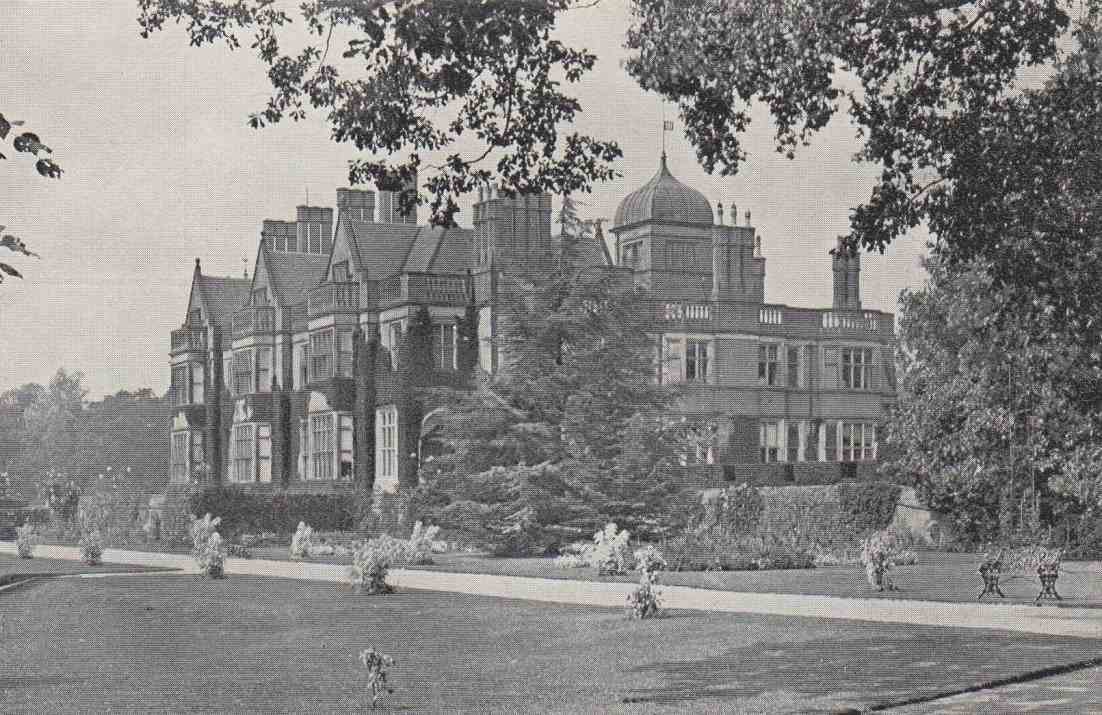
HOAR CROSS HALL - A BIT OF HISTORY: Hoar Cross was part of Needwood Forest, the 11th century lands of Henry de Ferrers. The land was passed down to Henry’s son and subsequent various people over the course of 500 years ending with the Webb family, around the 1730s, who bought the land and house known as the Manor of the Cross. This was quite a large house built on a hill near Yoxall (which is the village next to Hoar Cross). In 1740 the manor house was demolished and later the Hon. Charles Talbot bought the estate for £17,000. Eventually it was sold to Hugo Meynell, who already owned huge amounts of property all over the county.
This branch of the Meynell family originated from Leicestershire, namely Quorndon. In the 18th century Hugo Meynell had the title of ‘the father of fox-hunting’ as he had founded the Quorn Hunt in 1750 which became famous around the district. He bred his own strain of foxhounds and was the first person to study fox-hunting from a scientific point of view. He bought Quorn Hall in 1754 and built stables and kennels there, having 30 horses stabled at its height. In 1758 he became High Sheriff of Staffordshire and Member of Parliament for Lichfield. When his son, Hugo, died in 1800 he sold Quorn Hall to the Earl of Sefton and left to live in Derbyshire; although the family owned large amounts of property all over the Midlands in at least five shires.
The Meynell family claim to be descendants of the Norman baron, Hugo de Grand Mesnil, who came over with William the Conqueror. He is said to have died in Leicester in 1093 and his descendants settled in Derbyshire and Yorkshire. The sons of Hugo went off to the First Crusade and a representation of Hugo’s shield can be seen in one of the windows of Hoar Cross Church. Sir Hugo de Mesnil of Langley Mesnil represented his county under Edward III in five parliaments and thus started a long line of descent for the Mesnil family eventually changing the name to Meynell in the ...
More tea vicar? #12
Viv Wilson | 10th November 2019 |
Life at The Hall
MORE TEA VICAR? Life at Hoar Cross Hall was always busy but during the long summer holidays it was easy to get bored. As there was no public transport from Hoar Cross and no other families living nearby, we three children had to make our own entertainment and we were always having adventures and getting up to mischief – a bit like the Famous Five but without a dog! We would roam around the village or explore the basement. My dad was a hoarder and had kept all sorts of stuff over the years including his own gas mask and some field phones from World War 2. He had served in the army as a dispatch rider during the war in North Africa, mixing with Americans and Arabs alike and always had lots of interesting stories to tell.
The old Servants Hall was now my dad’s workshop and he spent a lot of time down there restoring antiques to re-sell. He had one of the field phones in his workshop and the other one was in our kitchen at the opposite end of the house. To operate them you would wind a handle on the side and a bell would ring on the phone at the other end. This was how my parents communicated especially when my mum wanted to tell my dad the dinner was ready! But we also had fun playing with them too and would often ring each other up or call my mum from the basement.
In the grounds was The Church of the Holy Angels. Mrs Meynell Ingram commissioned Bodley to commence work on the church in 1872 in memory of her husband who had died the previous year. It was generally regarded as one of the finest Victorian churches in the country and was known locally as the “Cathedral of the Midlands”. It was indeed a huge church (for a village) and always open to the public so we would sometimes go and have a look inside. On one occasion there was no-one around so Gavin and I lit all the candles in the church as we thought it looked really pretty and brightened the place up a bit. Oh dear – that was definitely not the right thing to do! A strongly worded l...
Mediaeval Mayhem!
Viv Wilson | 03rd November 2019 |
Life at The Hall

MEDIAEVAL MAYHEM! It was the end of the summer season at Hoar Cross Hall in 1973 and rehearsals had started for the new venture of Mediaeval Banquets. All the cast would come around to the house each week for rehearsals and my mum and one or two other ladies were busy making the skirts and blouses for the wenches. My mum also made about 200 bibs which the guests were going to be wearing as eating five courses with a dagger can be quite messy! We had a King, a Jester, a Fire-eater, a Halberdier, an organist and various wenches and serving ladies. To launch the banquets my parents decided to hold a Press Reception about a month before and so we all gathered at the Hall one day in early September. There were lots of nibbles and quite a lot of champagne flowing and the newspapers and radio stations turned up to take lots of photos of us all in various poses and record interviews with the cast. It was a lovely, warm Autumn day and many of the photos were taken outdoors. I remember it turning out to be quite a party, even though it started at 9.30 in the morning; as the day wore on the organist started playing a few of the songs we would be doing at the banquets, and everyone started dancing and singing along – it was 4pm by the time we finished!
And so arrived the day of the first banquet. All the furniture and costumes from the Chinese Room and Ballroom had been removed and put into storage elsewhere in the house. A local carpenter had made long tables and benches to seat about 200 guests in the Ballroom, which was now known as the Banqueting Hall. We had employed caterers to do the food and the Chinese Room was used as a food preparation area next to the kitchen/café. A bar had been built in the middle of the Long Gallery. I had to sew numbers onto the coat hangers for the cloakroom – it took all day to do 100 hangers! The afternoon was spent laying the tables with mugs, daggers and serviettes. Before 7pm we went to get changed into our med...
Eat, Drink and be Merry! #10
Viv Wilson | 27th October 2019 |
Life at The Hall
EAT, DRINK AND BE MERRY! We were now in our third year at Hoar Cross Hall and our lives were always busy keeping on top of the weeds and general upkeep of the house. My dad expected us children to help as much as possible, which we hated, and much of our time was spent trying to hide from him to get out of doing the chores. But sometimes we didn’t mind and we happily pulled an old trolley into the woods every now and then to collect wood for the fires and sometimes as a family we would spend a day clearing parts of the woods and grounds. My mum had hired a lady from the village to help with the housework and we had also taken on a retired chap called Mr Hickman to do some gardening. My brother Gavin and I had found some huge barrels which had been left behind, possibly from the wine and beer cellars, and we had great fun learning to walk on them like they did in the circus! We also built a treehouse in one of the huge cedar trees which lined the path to the church. As per usual the three of us would hide up there and watch the visitors walk by on their way to the church, as this was also open to the public, then we would make animal noises or suchlike and throw pine cones into nearby bushes to make them jump! It was also a good place to hide from our dad!
The visitors continued to come on a regular basis and my parents tried to think up different ideas to attract them. At one end of the terrace, near to the old grass tennis courts (still with two foot high grass on them!) they made a playground, which was fun for us too. My dad continued to buy and sell antiques and was often at local auctions and occasionally made trips to London for sales at Sothebys or Christies auction houses. I once went with him and we spotted the actor Rodney Bewes from The Likely Lads TV programme – he pulled up next to Sothebys in his Rolls Royce!
My dad’s antique collection continued to grow as he couldn’t resist a bargain and he would often go to a sale to get one...
Motor Racing Days #9
Viv Wilson | 20th October 2019 |
Life at The Hall
MOTOR RACING DAYS: Although my blogs are about living at Hoar Cross Hall, I would just like to give a bit of background about my dad’s racing career in the years leading up to moving to the Hall as this will set the scene for later instalments of my story.
As mentioned in my first blog my dad used to be a racing driver but he actually started off racing motor cycles in the 1930s. Because of this he became a despatch rider during the Second World War and spent a lot of time in North Africa. After the war he started racing motor bikes at nearby Donington Park and he raced there up to the beginning of the 1950s. After that he moved onto cars and drove a Cooper 500cc (which is the equivalent to Formula 3) along with the likes of Graham Hill and Sterling Moss. At the end of the 1950s he moved into Formula 2. Of course in those days it was completely different and much more ‘fun’, unlike more recent times where it has become a big money business. My dad didn’t have a rich family to support him or financial backers and probably did it all on a shoestring knowing him! He told me that he would always ‘take it easy’ and wasn’t too bothered about winning; drivers always got their ‘start’ money and he was satisfied with that. Accidents meant expensive repairs!
My dad (Bill Jones) with his first racing car
During the 1960s he raced Lotus Elites and I have never forgotten the time, aged just 5 years old, when he took me for a spin around Mallory Park. I remember it all very clearly, even now. He strapped me into the car, watched by the mechanics in the pits. My poor mother was worried to death and kept asking if I’d be alright! My dad was his usual self, flouting the rules, and continued to do a few laps around the circuit with me clinging petrified to the side of the seat - I have been terrified of speed ever since – can you imagine that happening today!
My dad would spend a lot of his time tinkering about on the car once it ...
Ghostbusters! #8
Viv Wilson | 13th October 2019 |
Life at The Hall
GHOSTBUSTERS! People were always coming to Hoar Cross Hall to either hire the place or to have a look around. In 1973, because of all the media interest in our ghosts, we had a couple of professional ghost hunters asking to stay over one night to try and find the source of the noises. They brought cases full of recording equipment and set it all up in one of the attic rooms. Rather them than me I thought! Then I had a brilliant idea and went off to tell my brother Gavin all about it. As mentioned in my first blog the attic and basement had a row of bells which the family used to summon the servants. Before the three men arrived we spent all day trying out all the bells to see which ones were which. We found that one of the bell pulls in the Chase Dressing Room made one of the bells in the attic ring. We also found that the bell pull in the Morrey Bedroom rang a bell in the basement and a bell in the attic rang a bell in the Long Gallery! Gosh, these people must have been hearing bells ring all day long!
Anyhow, the plan was that we would ring one of the bells right outside their room and when next day they told us about the noises we would tell them that the room for that bell was no longer there – it had been knocked down when the old kitchens had been demolished! Then they would think that it must have been a ghost ringing the bell and listen to their recordings quivering in fear! Gavin and I were so excited we could hardly sleep that night. Before we went to bed we rang the bell quite a few times until we were satisfied that they had heard it then went to sleep. Next day we went up to see them expecting to hear all about the ringing bells but all they said was that they’d seen a fox running across the fields but nothing else! What a disappointment – our trick had failed even though they had all that fancy equipment to record any eerie sounds - perhaps they just fell asleep and forgot to switch it on. We still thought it was a good tr...
Calendar Girls and Front Covers #7
Viv Wilson | 07th October 2019 |
Life at The Hall
CALENDAR GIRLS AND FRONT COVERS: During our time at Hoar Cross Hall people would occasionally hire the house for a day’s filming or whatever. During the summer of 1973 a photographer from London hired the place for a day and he brought two models with him, one English and one German, and they were taking photos for a glamour calendar. We were told to keep right out of the way as they were taking photos in the gardens as well as the house. Naturally we wanted to see everything that was going on and my younger brother Gavin especially was very keen to watch – so much so that he found a pair of binoculars to follow all the proceedings! We managed to find all sorts of hiding places eventually settling in our attic room to keep tabs on everything. From the attic we could access the roof which was flat in places and meant that we could view all the grounds at the front of the house and the back. We often came up here to run around and explore and in the summer it was a great place to sun-bathe in private - not sure if our parents were aware that we did this!
The girls wore wigs and hair pieces and were being photographed in military jackets with swords and other accessories from the house. They posed either topless or scantily clad in the gardens and in front of a pair of wrought iron gates (by Robert Bakewell, renowned Derbyshire ironsmith) right at the bottom of the garden. These gates linked the Ha-Ha wall. This was a wall which bordered the grounds and had a small ditch on the other side – the reason was that the ditch stopped the deer from jumping the wall; for on the other side was a deer park, although the deer had long since run off and it was just a field when we were there. The Ha-Ha wall is a French invention, the idea being that the recessed design element gives an uninterrupted view of the landscape beyond, so a small wall above ground and the rest below ground next to the ditch which also stopped animals jumping into the garden. It...
Huntin', Shootin' and Fishin' #6
Viv Wilson | 30th September 2019 |
Life at The Hall
HUNTIN’, SHOOTIN’ AND FISHIN’: Most stately homes have the obligatory hunting, shooting and fishing and Hoar Cross Hall was no exception during the Meynell family’s time there. We participated in none of these but the Meynell and South Staffs Hunt used to meet locally to do a spot of fox hunting. They would all gather at different venues around the area and enjoy a drink before setting off. One of their usual places was the Meynell Ingram Arms Public House at the bottom of the village. In February 1972 they had their ‘meet’ at the Hall. We, as the host family, got all dressed up to meet and greet them and local helpers served drinks, usually sherry. I had no interest in horses (unusual for a girl my age!) but the horses with their scarlet coated riders did look very impressive. The pack of hounds were everywhere, sniffing and panting and waiting for the off. My dad tried to make conversation with the Master of the Hounds by asking “So these are the dogs are they?” to which he received a curt “They’re hounds Mr Bickerton-Jones, not dogs!” Oh dear, mustn’t go upsetting the local gentry!
We hated the idea of a little fox being terrorised by a pack of dogs – sorry, hounds - and being ripped to pieces. Gavin and I were actually playing in the woods once when the hunt went by quite near to us – the fox literally ran right past us at such a speed it was incredible! We hoped he would get away and tried to think up all sorts of plans to divert the hunt away from the fox, finally pointing them in the wrong direction as they got near to us! Years later someone we knew rode in the hunt for the first time and came home with blood on her forehead – this was her initiation into joining up; the blood of the fox daubed all over her brow to show it was her first time! It seemed so barbaric.
The other ‘sport’ was shooting pheasants. This was something that was started by Henry VIII when guns became easier to handle back around 15...
The Grand Opening #5
Viv Wilson | 21st September 2019 |
Life at The Hall
THE GRAND OPENING: And so we move into 1971 and the preparation of Hoar Cross Hall so we could open it to the public by Easter. During the run up to buying the house my dad had been buying furniture, carpets and paintings like crazy and I remember our previous home being jam packed with chaise longues, sideboards and carved chests as well as all the suits of armour that he already had. This furniture was now set out in all the rooms. My mum’s collection of Victorian costumes were on display in the Ballroom as well as my dad’s collection of silver plated ‘display’ armour, which hung around the panelled walls; the suits of armour and the many paintings they had lined the Long Gallery and other rooms. The old Dining Room was renamed The Chinese Room as my dad had quite a collection of Chinese armour, swords and wall hangings – and even a Burmese Palace Chair. Display cabinets bought in sale rooms showed off smaller items. The biggest excitement though was seeing our house advertised on the local TV channel!
The Damask Room was turned into Lady Dorothy’s Boudoir complete with an 18th century four poster bed, an original bed complete with canopy and hanging curtains slept in by aristocrats throughout the centuries. I used to love lying on the bed with the curtains closed imagining myself in another era – once I lay down on the bed and fell asleep. When I awoke and climbed out from behind the drapes it was to a roomful of visitors staring open mouthed at me!
In another room my dad had his racing car surrounded by displays and photos of his racing career. The Entrance Hall was turned into a café area next to the kitchen, which had once been the old Butler’s Pantry, and my job was to bake scones and make sandwiches for the hungry visitors and groups that often came for a day out. Although I would make the scones earlier in the day, we would always leave a few in the oven so that there was a lovely smell of home baking floating around the pl...
Our mansion gets a facelift #4
Viv Wilson | 14th September 2019 |
Life at The Hall
OUR MANSION GETS A FACELIFT: We moved into Hoar Cross Hall during the summer holidays and my parents quickly realised that they had a lot of work on their hands to make the place habitable as well as to earn some money from it. As previously mentioned, there was an East Wing and a West Wing to the house. My dad decided to convert the first floor rooms of each wing into three separate apartments; he had done this at our previous house. This would generate income from rents until we got the main house open to the public. It wasn’t a big job to convert the rooms as the East Wing had four main rooms and two bathrooms already there, which would have been used as guest bedrooms in Victorian times. He made these into two one-bedroom apartments with a bit of stud walling here and there and made small kitchens in the spaces which connected the lounge and bedroom, probably once used as cupboard space. The spiral staircase with it’s green baize door opened onto the inner landing next to the apartments and this is how the servants would have accessed these rooms when bringing the family breakfast trays in the mornings. Where children were to be seen and not heard, servants were to be neither seen nor heard by members of the family and all the areas to the house were accessed via the spiral staircases and then inner hallways and corridors so they could go about their duties quickly and quietly.
My dad spent a lot of his time at auction houses buying and selling antiques and so he went back there again to source carpets and kitchen equipment. He also installed huge electric heaters to keep our new tenants warm. The West Wing was smaller than the East Wing so was made into a two-bedroomed apartment. The tenants entered the house through the basement entrance and used the spiral staircases to get to their homes – so they were a bit like the servants of old, neither seen nor heard by us!
The next change to make was to our own rooms so we could move downstai...
Things that go bump in the night #3
Viv Wilson | 08th September 2019 |
Life at The Hall
THINGS THAT GO BUMP IN THE NIGHT! Going to sleep in a big old house is quite scary when you’re young but going to sleep in a big old house that’s haunted is even more scary!! That first winter at Hoar Cross Hall was like that. Every time there was a windy night I could hear a window banging in the attic – all night long it kept me awake. The next day I would go upstairs to close it but there would be no windows open or even loose. They were all tightly shut as they had been for 20 years. I remember standing there in the attic rooms feeling a tingling down my spine and goose bumps all over as I felt the atmosphere closing in on me - and I quickly legged it back downstairs!
On other nights I would hear people walking along the attic corridor (the attic was the floor right above our bedroom floor) and then at other times I could hear heavy furniture being dragged about – yet there was nothing up there as the rooms were all empty! Other members of the family heard it too and also people that stayed overnight, so it wasn’t the imaginings of a frightened child. There was also nobody else in the house at that point, apart from our family and they definitely weren’t walking about the house at 3am. I loved reading about old houses, mysteries and ghosts but when you’re actually in the middle of it in real life, it’s a bit different!
My parents also heard noises from their bedroom. It sounded like a room full of people talking, like at a party. They couldn’t work out if it was birds nesting under the eaves so they slept in another room down the corridor to see if they still heard it – and sure enough, they did! What was going on? Had we disturbed some lost souls forever wandering in the attics?
One night my mum was woken up by the sight of a little girl ‘floating’ over the bed. She said the girl was wearing a long nightdress and mop cap and seemed to be stretching her arms out to my mum as if she was asking for help. She float...
Moving house to a mansion #1
Viv Wilson | 01st September 2019 |
Life at The Hall
MOVING HOUSE TO A MANSION: My parents took vacant possession of Hoar Cross Hall in 1970 and the whole process of moving house was done over the summer months. We lived about 20 miles away in an old vicarage with a large garden and lots of outbuildings. This house was about 200 years old and they say Bonnie Prince Charlie marched past it on his way to battle back in the day, for all you history buffs out there! Actually I love history and I think my interest was fuelled by living in these historic houses as a child. My dad used to be a racing driver in the 1950s and before that he did motorcycle racing, often at nearby Donington Park. During the 1960s he ran his own team, Shardlow Motor Racing, travelling all over Europe to race at all the famous circuits, so the outbuildings were always full of bits of racing cars and their engines! All this stuff had to be moved and my dad did most of it by travelling back and forth each day with vans and trailers full of the contents of our house and outbuildings – an enormous undertaking!
My parents with the student helpers on moving day
He knew some students and used to pick them up en route to help and they also stayed on to help tame the gardens which were very overgrown, the grass standing about 2 feet high. As I’m sure you can imagine, after nearly 20 years of neglect, the gardens were a sorry sight having once been very grand. Apparently, when the house was built, there were 20 gardners and the head gardner was pushed around in his wheelchair inspecting all the borders and paths; if he saw a weed it was quickly removed! I couldn’t imagine the grounds ever looking as good as they used to but we certainly had a good try and started attacking the hedges and grass as soon as we moved in. If anyone saw the Chester Zoo mini-series in 2014 about an ordinary family moving into a huge old house to start a zoo then that is exactly what it was like for us. When I saw that programme it brought back so...
Temple Newsam and the Meynells
Viv Wilson | 15th August 2019 |
Life at The Hall
TEMPLE NEWSAM AND THE MEYNELLS: On 11th August 1863, Hugo Francis Meynell Ingram married the Hon. Emily Charlotte, daughter of Sir Charles Wood, Bart, afterwards 1st Viscount Halifax. The Woods were an old gentry family, for many centuries respectable York merchants. They were to turn grand upon the discovery of coal beneath their ancestral estates. This was the great Barnsley field, with several hundred acres of Britain's deepest and finest coal. Sir Charles Wood had a distinguished political career and they owned family seats at Garrowby, Pocklington, near York and Hickleton, near Doncaster. They also owned a London house in Belgrave Square.
In 1782, Hugo's grandfather, Hugo Meynell of Quorndon, the 'father of fox hunting', married the Hon. Elizabeth Ingram Shepheard. She was the daughter of Charles Ingram, 9th Viscount Irwin and Lord Ingram. The family seat was Temple Newsam in Yorkshire and this was how the Meynell family became associated with this great house. Through this marriage of Hugo and Elizabeth, the Meynell family also inherited the Ingram estates in Lincolnshire, acquired by Sir Arthur Ingram in the first half of the 17th century. In 1793 Hugo bought the Hoar Cross estate and built a hunting lodge which was known as Old Hall.
Hugo and Elizabeth had six children, the eldest being Hugo Charles who inherited the Temple Newsam estate from his aunt; however, he had to assume the surname of Ingram in compliance with the terms of the will of the last Lord Irwin. So this was how the Meynell Ingram name came about, something which was quite common with the aristocracy in those days. Hugo Charles went on to marry Georgiana Pigou in 1819; their eldest son was Hugo Francis Meynell Ingram, the last of the descendants of Sir Arthur Ingram to inherit Temple Newsam.
Temple Newsam had been built by Thomas, Lord Darcy, early in the 16th century. He, coincidentally, had married a Meynell, and a descendant married Elizabeth Meynell, so there...
Aristocratic travels Part 2
Viv Wilson | 23rd July 2019 |
Life at The Hall

ARISTOCRATIC TRAVELS PART 2: During the latter part of the 1800s Emily Charlotte Meynell travelled around the Mediterranean on board her schooner, Ariadne, recording her travels in her many diaries and drawing books, as mentioned in my previous blog. I have now found the photo of her yacht and one of her paintings; she was a skilled water colour artist as you can see but had a particular affection for nautical subjects. One particular holiday around Nice in the South of France with her brother Charles is documented by the water-colour paintings they both made. Soon after her husband Hugo's death in 1871, she embarked on a Mediterranean tour with her yacht, Zara, recording the scenes as she went.
In later years, the tradition of travelling carried on into the new century and below are some photos of the family around the 1920s - 1930s era. Unfortunately I don't know who they are exactly but they are Meynell family members as the photos were found in the Library of the Hall. The aristocracy often went on travels abroad and it's obvious that they are in hot countries. Note the one with the soldiers marching - does anyone know where this might be?
One of Emily's paintings
The Meynell family abroad
Soldiers marching
Emily's schooner, "Ariadne"
African farmers
I hope you have enjoyed looking at these old photos - more next week!
If you would like to follow my blog from the beginning, click here and please feel free to share with your friends!...
Racing travels #40
Viv Wilson | 18th July 2019 |
Life at The Hall
RACING TRAVELS: During the 1960s my dad travelled all over Europe with his racing team. The header photo shows him with his VW van with his racing car on the back. He usually took two mechanics with him who were friends of his who just loved racing and volunteered their services for a free holiday abroad! He went to all the big racing circuits: Hockenheim, Nurburgring and Monza, travelling across Europe to get to them. He always came back with lots of funny stories to tell. Because the van he used wasn't brand new it would sometimes break down but at least he had two mechanics with him - however, getting parts wasn't easy in the 1960s, especially if they were in the middle of nowhere and they often had to fix things using anything they could get their hands on. They also had a few spare parts with them for the racing car.
The places they stayed in en route were very basic - probably an inn with a couple of rooms to let, as my dad never wanted to spend too much money! At one place they were kept up all night as the innkeeper and his customers kept the bar open long into the night. At another place the innkeeper's wife made a pass at them - I don't think they were very interested as she was well past her prime and rather large! But I think she fed them well as my dad always had some treat on him that he would give to the owners.
From each country that he went to he brought home a doll in that country's traditional costume. This amounted to quite a collection eventually and below is a photo of most of them. I wonder if you recognise your own country's costume and if you can tell me where they are from as I have forgotten some of them after all these years! The matador and his bull are obviously Spanish and other countries represented are Germany, Switzerland, Ostende, Greece, Portugal and Florence (the lady with the lace).
If you would like to follow my blog from the beginning, click here and please feel free to share with your friends.
More ...
Aristocratic travels # 39
Viv Wilson | 11th July 2019 |
Life at The Hall
ARISTOCRATIC TRAVELS: Emily Charlotte Meynell, the original owner of Hoar Cross Hall, was probably one of the wealthiest independent women of the late 19th century in Britain. Her property included country estates around the Midlands, a London house in Eaton Square and a villa in Florence. For many years she owned a yacht, the latter a fully-crewed schooner of 380 tons. The family had large financial resources in addition to their estate income, through which they were sustained until well into the 20th century.
Emily cruised the Mediterranean every springtime in her yacht and occasionally crossed the North Sea to the Netherlands and Germany in the summer. During these trips she collected items of beauty and interest with which to decorate and embellish Hoar Cross and the Church of the Holy Angels, which she had built in memory of her late husband.
In 1890 Emily went on a painting trip up the Nile, accompanied by her brother Frederick and his wife Lady Mary plus two friends. She was an accomplished water-colour artist having been a prolific painter since childhood. Much of her adult work was done during her cruises, on her schooner Ariadne, which was acquired by Emily in 1886. It was one of the largest schooners afloat - its scale can be appreciated by the number of crew on board: 20 hands on deck and six under deck. That's nearly as many staff as she had at home! Emily was also devoutly high church and even took the vicar of Hoar Cross on regular cruises with her, having had a small chapel installed aboard.
These two pictures were taken in Africa, possibly from her Nile trip, although there are other photos showing members of the family in foreign climes. Emily cruised the Mediterranean, the North Sea, the Baltic and around the British Isles between 1886 and 1897 - all her trips were recorded in ten leather bound volumes of diaries and logs, all beautifully illustrated with paintings, sketches, and photographs. If only we could see...
The War Years and Beyond #38
Viv Wilson | 08th July 2019 |
Life at The Hall
THE WAR YEARS AND BEYOND: During the Second World War, life in country houses changed dramatically. It was no different at Hoar Cross. The flower borders on the main lawns were turfed over to reduce maintenance and vegetables were grown in areas formerly restricted to flowers. Evacuees from Birmingham came to stay for the duration of the war and they lived in the basement, as it was considered to be the safest place. I imagine that they must have been in the care of the servants as they were living amongst them but it must also have been quite exciting for them to move from a bombed out city to the relative safety of the countryside, although they must have missed their parents of course. Many children in those days never left the cities and towns where they lived and often didn’t know what a cow looked like in real life! To see all the lawns and woods at the Hall must have been incredible for them although I’m not sure if they were allowed to wander around the grounds.
Two of these youngsters returned to the Hall in the mid-1980s and spoke to my mum about the kindness they received from the family. They also told her about the ‘secret airfield’ hidden away in a copse behind the ha-ha wall (the wall separating the bottom of the grounds and the deer park). Apparently aircraft were kept here in readiness for action, it being a Satellite Landing Ground (SLG) site serving Fradley aerodrome, near Lichfield. The Hall was also offered as an Auxiliary Red Cross Hospital during the war but nothing came of this, probably owing to the lack of mains water. However, during the First World War, the Meynell home in London was offered to the War Office and the Red Cross and became a Military Hospital for officers, being used by Francis Meynell himself who was wounded in action.
The deer park, where the secret airfield was hidden
One feature at the Hall was the daily barometric readings; these had been taken since 1880 up until the Second Wor...
Gardeners' World at Hoar Cross #36
Viv Wilson | 30th June 2019 |
Life at The Hall
GARDENERS’ WORLD AT HOAR CROSS: In it’s heyday Hoar Cross Hall had around 28 people employed to keep the 20 acres of grounds tidy and weed free. In Victorian England the most common of all male servants was the gardener. At Hoar Cross the head gardener had numerous under-gardeners known affectionately as ‘digging slaves’! They were responsible for producing fruit, vegetables and growing luxury items in and out of season, much of it under glass. Adjacent to the house was the carp pool and greenhouse area along with a palm house; next to these was a walled kitchen garden. This supplied the house with all its fruit, vegetables and herbs. The palm house produced palms and pot plants along with flowers for the house; these would be brought across to decorate the main rooms when an important function was on.
The ‘bothy’ house was in one corner of the kitchen garden. (A bothy is a simple dwelling on an estate, usually used for gardeners and other workmen). Here lived the ‘bothy boys’ who were young under-gardeners. Their job was simply to sweep the pathways all day and keep the leaves at bay!
There were two elderly chaps, Mr Knight and Mr Dukes, who were solely responsible for the south garden – however, their task was complicated by the fact that they couldn’t get on with one another! Grass was cut by a horse drawn mower, a task carried out by the chauffeur of all people! One of the family told us that back in the early days the head gardener was pushed around in a wheelchair when he was older, inspecting the lawns – apparently if he saw a weed amongst the grass blades he would tell one of the gardeners to pluck it out straightaway!
Emily Meynell Ingram employed a Mr Rowley especially to carry out her plans of planting the yew hedges, of which there were many. At each side of the garden was a long walk bordered by yew hedges down to the ha-ha wall at the bottom. Across the bottom of the gardens were smaller square gardens (...
What the Butler saw!
Viv Wilson | 23rd June 2019 |
Life at The Hall
WHAT THE BUTLER SAW! Anyone who’s seen Downton Abbey will remember Carter the butler. He is exactly how a butler would have been in the 19th century and, strangely enough, the butler at the Hall during the early part of the 20th century was also called Carter!
Although most big houses had a house steward who was in charge of accounts and general running of the household, a butler was more commonly engaged by the wealthy. He was usually a grand, authoritarian figure, commanding respect and awe and most of the servants would have been scared to death of upsetting him! He was dressed like a gentleman of the period and generally ran the household with an iron fist.
As I said, the butler at the Hall was called Gus Carter and he was with the family for over 40 years, joining the staff in the mid-1930s. When the family left the Hall in the 1950s and bought the smaller Hollybush House in nearby Newborough he went with them until his retirement. He and his wife celebrated their Diamond wedding anniversary in 1972.
However, when at the Hall his main duties would have been looking after the wine cellar and silverware or plate as it was known. This was kept in a room next to his bedroom so he could keep an eye on it and make sure no-one stole anything. Similarly with the wine cellar, he would have kept it all under lock and key so none of the servants could have a crafty drink when no-one was looking. There was actually a Chubb walk-in safe in the basement where, I assume, the more valuable items were kept for special occasions. Near to the butler’s room was a Chubb wall safe, which would have been used for keeping guests’ valuables in while they were staying at the Hall. Not unlike a hotel nowadays! Carter also waited on table at all the meals and at night, secured all doors and windows and checked the fires were safe before retiring to bed. If there was no valet in the house then the butler would also have been responsible for looking after his mast...
The Kitchen Maid's Story #35
Viv Wilson | 16th June 2019 |
Life at The Hall
THE KITCHEN MAID’S STORY: If you were young, free and single – oh, and very well-to-do – the 1920s was the decade to live in! The upper classes had lots of time on their hands and enjoyed post-First World War delights such as the theatre and jazz clubs.
Not so for the lower classes, in particular a young girl who was to become the kitchen maid at Hoar Cross Hall in the 1920s. The ‘depression’ after the First World War brought stark poverty to her home and many like her. Her name was Jean Rennie, and she was extremely intelligent having won a scholarship to Glasgow University to study French and music. However, the £5 bursary she got was taken by her father and used to buy whiskey in his local pub. Her hopes of a career in music were dashed and she needed to find employment.
Jean was now known as Jenny and had many jobs as a servant, including one in a castle in the Highlands! She was, in her own words, a good housemaid but never a good servant. With memories of hungry children fresh in her mind she could never get used to the wanton waste of food left on plates, in the homes she worked in. Her mistresses were always untidy with stockings, shoes and underwear “flung everywhere” and powder “spilt lavishly” – this always rankled with her and she never really got used to the ways of the aristocracy.
She gradually travelled down the country and eventually found a job in London. Although she was still a scullery maid, she worked under a skilled chef who taught her much and she hoped for a career as a cook. Her employers were good and so were the wages. When she got the job at Hoar Cross Hall she could not only read a menu (in customary French) but also write one and prepare many of the dishes herself. Lady Dorothy Meynell was very impressed with her and as her husband, Hugo Meynell was about to take a small shooting party to their Laughton estate, she asked Jenny to go with them to do the cooking. Jenny recalled how thrilled she...
The Schoolroom Maid's Story #34
Viv Wilson | 09th June 2019 |
Life at The Hall

THE SCHOOLROOM MAID'S STORY: For the first 75 years of the Hall’s history about 50 servants were employed by the Meynell family in the house and grounds. Among these was a young girl of fifteen who started work in 1920 as a Schoolroom Maid. Her name was Miss Inez Sophia Large and she had connections to Hoar Cross through her grand-parents, William and Mary Tooth, who lived in the village where William was the blacksmith; his smithy was just along from the Meynell public house. He had worked on the ironwork of the Hall during its construction in the 1860s. Inez’s aunt, Constance Madeley, was the wife of the landlord at the Buffalo Inn, in nearby Newborough, and it was through her that she secured the job at the Hall. Inez’s parents were themselves in service; her mother had been a lady’s maid and her father was a butler for the Spanish Ambassador in London – from which source Inez assumes her Christian name originated.
There was little choice but to go into service in those days (her sister, Beatrice, was also a nursery maid with the Earl and Countess of Lichfield), and she was engaged on a salary of £18 per annum. Her mother made her uniform, which comprised of a morning dress and an afternoon dress, and Lady Dorothy Meynell supplied her cap. She was the personal maid to Lady Dorothy’s eldest daughter, Dorothy, who was just four years younger than Inez. She also looked after Dorothy’s younger sister, Rachael.
The schoolroom at this time was situated just off the main Entrance Hall, and immediately below the nursery. Inez worked under the supervision of Mrs Catt, the housekeeper, Miss Rhodes, the lady’s maid, and the head housemaid, Rose.
Her day began at 6am every day and she was so afraid of oversleeping that she kept an alarm clock under her pillow! The first job of the day was always to clean the grate and get the fires lit, then sweep and dust the schoolroom, lay the table for breakfast, call the governess, Miss Chromy, with m...
Moving on - the end of an era #33
Viv Wilson | 02nd June 2019 |
Life at The Hall
MOVING ON - THE END OF AN ERA: And so I come to the end of my story. After ten years of living in a stately home, my parents’ divorce agreement meant that my dad had to be bought out by my mum and he had to leave his dream home forever. He and Gavin moved out to live in Burton-on-Trent and my mum carried on running Mediaeval Banquets for a few more years. She and the singer eventually got together much to my dad’s chagrin. The singer spent a lot more time at the Hall helping my mum run the banquets; however, Piers didn’t really get on with him. When he was about 14 years old my dad received a phone call from Piers – he had run away from home and was ringing from the phone box in the Meynell Ingram Arms car park! He told my dad that he was hiding behind a bush and could he come and get him. Of course, my dad was only too happy to fetch him and get him away from my mum and the singer and he set off to find him hiding, as he had said, behind a bush in the darkened car park. Piers continued to live with my dad and he joined in with the go karting along with Gavin and also got very involved with BMX stunts, even having a half pipe in their yard to practice on!
After a couple of years my dad moved to a much bigger house in Burton which had been an old doctors’ surgery that Kev and his family had gone to when Kev was young! He continued to buy and sell antiques and his interest in motor racing never waned; he often went to local races with his friends. Gavin eventually moved out to live near Norwich with his girlfriend Helen, and they married in 1991. He joined a motor racing team over there and went on to have a very successful career in racing, eventually running his own GP2 motor racing team, iSport International, who became world champions: see link. He also takes amazing photographs of wild animals and birds for a hobby – check out his website: see link
Piers stayed with my dad and used the large workshops at the new house to renova...
Moving Out #32
Viv Wilson | 27th May 2019 |
Life at The Hall
MOVING OUT: And so the day arrived a month or so after our wedding when my dad had to leave the Hall. Ten years after moving in he was now moving out, leaving his dream home for my mum to live in alone. Gavin moved with him and Piers was away at school most of the time. It was a mammoth task as he had so much stuff to move, especially from the basement. He had some heavy machinery too that he’d brought with him from his alabaster days, including a band saw which we used to saw up logs for the huge fireplaces in the main rooms. He had bought a house in nearby Burton-on-Trent which had some outbuildings for a workshop and there he moved to start afresh.
He carried on buying and selling antiques and often went to antiques fairs and sale rooms with his friends. He also continued with the go-karting with Gavin and this kept them busy at weekends. However, the whole experience had left him very bitter and he would constantly talk about it whenever we went round to see him, making visits fraught with tension!
However, we carried on with our lives as newly-weds and bought a house in a nearby village. It was completely empty and needed an oven and washing machine amongst other things. My dad was keen to help and offered to buy anything he saw at a sale room as he knew he could get them cheap; and that was how we ended up with a 1950s style twin tub washing machine! Well, it matched the age of the house I suppose! Many a week whilst washing, I cursed my dad for buying it as it always broke down and flooded the kitchen – eventually we threw it out!
A little while later we went to an auction at a large farmhouse that was quite local to us and because of the interesting ‘lots’ it had, quite a few of our well-to-do friends were there too. My dad was also there and told us he’d bought an oven for our new house. He couldn’t wait to tell us that it had only cost him £1. Even in those days £1 was ridiculously cheap, especially for an oven! He s...
Here comes the Bride (Part 2) #31
Viv Wilson | 19th May 2019 |
Life at The Hall
HERE COMES THE BRIDE (Part 2): And so our wedding day arrived bright and clear, all thoughts of solicitors, legals, fights and arrests behind us! Myself and my bridesmaids went to get our hair done in the morning and Kev slapped a piece of steak on his jaw to bring the swelling down after the rather unfortunate fight at his stag do. Fortunately, the bruise didn’t show up too much on the photos! Gavin drove my dad’s Mercedes Benz car all the way down the drive and back up the road to the church – this was one of the drawbacks of having a church in your grounds; you don’t get to drive all through the town with everyone looking at you! Never mind, a small crowd of locals were gathered around the gate to the church and we got out, had a few photos taken and walked down the aisle to ‘Here comes the bride’.
However, as Kev had not attended the rehearsal (remember, he was in someone’s shower!), he didn’t have a clue what was going on or where to stand or anything! When we came to say our vows, the vicar got his name wrong and so I nearly married a ‘Derek’. There was much whispering at the front as we told him the correct name. Again, when I put my ring on the Bible, the vicar thought it was two rings as I had a Russian wedding ring with three bands. He started to say ‘with these rings……’ and once again, there was much whispering at the front as we explained that it was only one ring!
And then, just as we were on our knees to receive the blessing, Chris Meek (my dad’s old racing driver) walked in with a beautiful model on his arm. She was wearing a short cheesecloth dress and with the sun behind her it was completely see through! Anyone who remembers the Lady Di photo will know what I mean! We heard a sharp intake of breath as the whole congregation turned to face the door – talk about upstaging the bride!
Finally, the ceremony was over and I was married to Kev (not Derek) and as we walked out into the sunlight I felt a...
Here comes the Bride (Part 1) # 30
Viv Wilson | 10th May 2019 |
Life at The Hall
HERE COMES THE BRIDE (Part 1): Now that my dad was having to move out of the Hall we had decided to bring our wedding forward so that we could get married in the church in the grounds and then have the reception afterwards in the Hall, which was after all our family home. The wedding preparations were going quite well and as we knew lots of musicians it wasn’t hard to find a local band and a DJ to do the disco. A friend of my dad’s offered to do the catering and the bar was set up with plenty of kegs from the local brewery in Burton on Trent. I had two bridesmaids and we all went to Birmingham one day to choose our dresses and shoes – it was all kept very simple really as I had no help or advice from my mum as most brides do. Kev’s parents had eloped after the war and got married in a register office with two witnesses dragged off the street, so they had no idea what you did to plan a wedding! I managed to find a church near to Kev’s house and sorted out the reading of the banns. Then we went to the vicarage across the road from my house and booked the date. The vicar told us in no uncertain terms that he would expect us to be there when the banns were read. However, as we never got up before lunch on a Sunday, try as we might, we never actually managed to hear our own banns being read!
It was almost as bad at the wedding rehearsal. I went to the church with my dad and the two bridesmaids but Kev never managed to get there as he was fitting a shower for someone! I don’t think the vicar was very impressed with us!
The nearer it got to our wedding date the more we worried about my mum turning up. It wasn’t that I didn’t want her there but that my dad told us we couldn’t possibly have her there as he would ‘see red’ and a row would ensue. We really didn’t want a huge argument on our wedding day but knowing my dad’s temper we weren’t sure that he would be able to control himself so he offered to see his solicitor to see if ...
The tax man cometh! #29
Viv Wilson | 06th May 2019 |
Life at The Hall
THE TAX MAN COMETH: My parents’ court case was finally over and my dad had six months to leave the house. In the meantime my mum had to find the funds to buy him out and he had to find another house to live in. He also had an awful lot of stuff to move too! He eventually found a house in nearby Burton-on-Trent but as it was obviously a lot smaller he had to get rid of a lot of his possessions and one of the first things to go was his Lotus Elite. He advertised it in the local paper but instead of getting a phone call from a likely buyer, the first call was from the local tax office. Back in those days they used to check advertisements in the newspapers and they had spotted this expensive car for sale and thought they would check it out. They actually thought it was my mum’s car and it transpired that they were keeping an eye on her. They didn’t know that my parents were getting a divorce so when they spoke to my dad he quickly informed them of that fact and told them that this was why he was selling his car. He also told them that she was making loads of money from the banquets; money which he had no access to.
This then led to a few meetings between the tax man and my dad. Of course, my dad was in his element thinking of more ways to get his revenge on my mum! What better way than to shop her to the tax people. He knew that she didn’t tell them exactly how many guests came to the banquets each week. It was usually around 200-240 but I think the tax office were told slightly less than that! My dad was happy to tell them that my mum always did the book-keeping as he was useless at that sort of thing and so he feigned ignorance!
I have always kept a diary and during the time of the banquets I used to keep accurate records of how many people came along to them. When I told this to my dad he jumped up and down in glee and quickly informed the tax office! A meeting was arranged with them and I went along with my dad (and my diaries) to pro...
See you in Court #28
Viv Wilson | 29th April 2019 |
Life at The Hall
SEE YOU IN COURT: The saga of my parents’ split continued as we grew up in our stately home, although their behaviour was anything but stately for most of the time! Seven years of arguing and fighting were about to come to an end and the solicitors had finally agreed on a date to go to court. We carried on helping my dad to run the Hall and he still went to his boat in Caernarfon at weekends to get away from the house but we were all getting weary of it now. We were young adults and wanting to get on with our own lives. After five years together we were hoping to get married at some point so we were glad that it was finally going to be sorted out one way or another.
Gavin was now involved with a band who regularly supported The Jam so he was often travelling around the country with them. Piers had been sent to a local boarding school so we saw even less of him than before. My mum continued to live in the West Wing Apartment and was now seeing the singer who sang at the banquets. My dad sat on his own most nights with only the parrot for company. When he found out about the singer it started a fresh load of outbursts from him as he now felt that the pair of them were trying to take his house and business off him! He constantly ranted on about it and often threatened to shoot the singer with his gun – I don’t think he would have done but then again, with his temper, who knows! This latest twist in the story did nothing for my dad’s sanity and my mum was still hoping to have him committed and kept making appointments for him with the psychiatrist. Once again, the Police were called every week informing them of the threats on the singer’s life and they eventually took my dad’s gun licence off him just in case anything did happen!
We tried to keep out of the way as much as possible and stayed in Burton all week, where we worked, and came home at weekends where we would meet up with our friends and party in the apartments out of sight and s...
Race Day Parties #27
Viv Wilson | 21st April 2019 |
Life at The Hall

RACE DAY PARTIES: My dad used to be a racing driver so he was often invited to parties and open days at various racing circuits. He naturally knew lots of racing people and on this particular occasion he was invited to an Open Day at Donington Park. Tom Wheatcroft, a local entrepreneur, had bought Donington Park in the 1970s as he owned the largest collection of Grand Prix cars in the world at that time. In 1973 he opened a museum there to house them all and called it the Donington Grand Prix Exhibition. Donington became the favoured home of the British round of the MotoGP motorcycling championships but he was really hoping to bring Formula 1 racing back to the track and a bid was put in in 2007. Unfortunately the 2008 global crash put a stop to this as they lost financial backing and the bid went to Silverstone who now host the Grand Prix every year.
However, in 1977 he re-opened the track for cars and this was the Open Day that we all went along to. There were lots of different races with old cars as well as new. My dad used to race his motor bike there before the war and he was invited to join in with the historic bike racing – he jumped at the chance of riding a bike again and did really well, at the age of 61!
Official Donington Park Opening Brochure
Kev and I went along with my brothers and we all got dressed up in our Sunday best, Kev wearing a jacket and me in a large floppy hat and heels – we looked as if we were going to a wedding not a racemeeting! But dad assured us that we needed to look the part as there was a big party afterwards in a marquee with all the top racing people in attendance – ‘racing royalty’ we called them. People like Bob Gerrard, who was one of the top racing drivers of the post war era – he and his wife were always very expensively dressed and hosted one of the marquee parties. There was also a VIP marquee which we managed to sneak into when no-one was looking. After ordering our drinks at the bar, ...
Whodunit in the Library? #26
Viv Wilson | 14th April 2019 |
Life at The Hall
WHODUNIT IN THE LIBRARY? When we first moved to Hoar Cross Hall, growing up in a stately home seemed an idyllic way to live – and lots of fun if you’re a child. This rambling old house full of empty rooms and secret doors, wild gardens and woods to explore, was in some ways a dream come true for our family, certainly for my dad. But as we turned from children to teenagers the isolation and lack of public transport was frustrating. Coupled with this was my parents fighting and subsequent split, living at each end of the house and battling for the house and business through their solicitors.
The effect this had on me, as the eldest child who perhaps saw more of it than my brothers, was that I started to have awful pains/cramps in my stomach. Whenever Kev and I were out I would often double up in agony and once I was in such pain in a local bar that the landlord rang for an ambulance and I was whisked off to hospital with suspected appendicitis. After a full examination I was told there was nothing wrong but that it was probably my nerves affecting me. After a visit to my GP he prescribed Valium tablets (now known as Diazepam) which was a drug to relax you when you felt under stress. Both my parents were already on this medication and we would often borrow each other’s tablets if one of us ran out! I now realise what a ridiculous situation this was – Valium was a powerful drug to be taken for 2-3 months but back in the 70s I was freely given it (aged 17) and was not monitored at all by the GP. I took it for well over a year and mixed it with alcohol totally oblivious to the effects it might have on me – one of them being that I frequently had horrendous hallucinations. My dad was already visiting a psychiatrist each week and my mum took me to see one too! Our family really was falling apart at the seams!
However, the feud went on and my dad was still selling items from the house unbeknown to my mum. He had a beautiful wooden musical box...
The Graveyard Shift! #25
Viv Wilson | 07th April 2019 |
Life at The Hall
THE GRAVEYARD SHIFT! Life carried on at the Hall as best it could in difficult circumstances. My dad continued to go to Arms and Armour Fairs to buy and sell antiques and we also went to a mediaeval banquet in Cheshire one night, although it wasn’t anywhere near as good as ours! Once or twice we took my dad out with our friends to Derby, where he originated from, and that seemed to cheer him up. But he really needed to get away from the house for longer periods of time and when he saw a boat advertised for sale at Caernarvon he jumped at the chance and bought it. It was an ex lifeboat called The Bembo so quite sturdy, although in need of a lick of paint and a bit of TLC. The town of Caernarvon is in Wales and is host to a huge castle where the Prince of Wales (Prince Charles) had his investiture in 1969. The Bembo was moored by the harbour and the town was full of quaint, narrow streets which we loved to explore. Once he had bought the boat he would go away at weekends and usually took Gavin or Piers along with him. My mum jumped at the chance of making me go as well so she could keep me away from Kev, but after a couple of times on my own Kev decided to come along too, and was able to help fix the electrics on the boat amongst other things.
When my dad went away at weekends during the summer months Kev and I would open the house to the public. As well as a bad atmosphere between my parents there was also a bad atmosphere between me and my mum and mum and Kev, so we were all trying to avoid each other! My mum had taken over the West Wing apartment when the tenants left, leaving my dad with one less rental income. She was also putting Yale locks on all the rooms that she used in the house as well as any storage rooms used for the banquets. This infuriated my dad who obviously didn’t have access to them once the locks went on. One of these rooms was the cupboard off the Entrance Hall which held the meter boxes, so we now had no access to the el...
Suits you sir! #24
Viv Wilson | 01st April 2019 |
Life at The Hall
SUITS YOU SIR! When we moved to Hoar Cross Hall in 1970 the organ in the private chapel wasn’t working as the house had been empty for 20 years. It was such a shame as it had been designed by Bodley, the famous organ maker of the 19th century. The chapel itself had been added about 25 years after the house was built at the staggering cost of just under £1000! When one of the visitors to the house said he could fix the organ, my dad readily agreed. This chap really loved organs and volunteered his services free of charge just for the love of mending this musical work of art; my dad was over the moon! Alas, after removing all the pipes and laying them out in the basement, he found that he couldn’t carry on with the renovations and we never saw him again!
When Kev saw the organ in pieces he offered to try and fix it and we spent many an hour in the chapel and basement trying to work out which pipe went where and how to make it play again. But it was quite complicated and it was an ongoing project for some time – still, it kept us busy!
The divorce was getting quite bad by now and I had to accompany my dad to the solicitors on more than one occasion, mainly for moral support but also to back up what was happening in the house between my parents as I witnessed quite a lot of arguments and fights. The solicitor explained to my dad that his antique collection would be classed as ‘chattels’ in the marriage and my mum would be entitled to half of it. My dad went berserk as usual and vowed that she wouldn’t have any of his antiques as they were his means of earning money and not part of the domestic furniture. However, as he was classed as self employed, his collection was deemed part of the family belongings. The Mediaeval Banquets business was now in my mum’s name as a limited company and she ran them herself, separate from my dad. My dad still got the rent money from the apartments and the takings from the house when it was open to the pu...
Panto Pranks! #23
Viv Wilson | 25th March 2019 |
Life at The Hall

PANTO PRANKS! During the 1970s Hoar Cross Hall was used from time to time for local community activities and one such event was the production in 1978 of a traditional pantomime, ‘Midnight and a Journey back to Happiness’. It was written by local people, Robert Leighton from Yoxall and the Hon. Alexandra Meynell, daughter-in-law of Mrs Jean Meynell whom we had purchased the Hall from. The words and music were written by local songwriter, David Matthews, who had written songs for quite a few pop artists during the 1960s, his most famous being Matt Munro’s ‘We’re gonna change the world’. So off to a good start there!
For those of you who don’t reside in the UK and have no idea what a pantomime is, it is a musical play with slapstick comedy based on a children’s nursery story or fairy tale, usually produced at Christmas. It’s mainly for children but adults tend to love them too as there is always a lot of audience participation, especially when the villain walks on and everyone boos and hisses or shouts “He’s behind you!”.
The aim was to involve as many people as possible, particularly the youngsters, and adults and children from around the area of Hoar Cross were invited to participate in the event, forming a group known as ‘The Overdraft Players’! (See header picture of some of the children who took part). About 80 people were involved altogether including three ‘retired’ semi-professionals. A huge, three-tiered, sectional wooden stage was built for the venture and sited in the Ballroom. Local people got involved with set design and costumes; another lady arranged and produced the ballet routines.
Gavin and Piers were involved of course but Gavin broke his arm a couple of weeks before the show started so ended up with the minor but important role of working the hands of the large clock that stood to one side of the stage! I felt really sorry for him as he had to stand behind the clock and no-one could see him – ho...
Midnight pool parties #22
Viv Wilson | 17th March 2019 |
Life at The Hall
MIDNIGHT POOL PARTIES: After leaving school I spent a year at Burton-on-Trent Technical College studying to be a secretary but my year at college had come to an end - now to find a job! It didn’t take too long as there was plenty of employment around in those days and I was soon offered a position with a small engineering firm in Burton. As I didn’t drive there was still the problem of me getting to work and dad managed to talk the residents of the apartments into taking me, as they were going to Burton every day as well, and it would save him coming out twice a day (no doubt he was thinking about the petrol he would save too!)
Kev and the band were getting a few gigs around the area and after singing with them for a little while I gave it up and let a more professional singer take over – I needed to work on my confidence first! We still went to the 76 Club though to see live music – it was the start of the punk era and we saw the Sex Pistols there when they were just starting out – I have to say they didn’t get a very good reception as they couldn’t even start the first song properly and were actually booed off stage which was a ‘first’ for that club. Their ‘punk’ behaviour almost started a riot in what was normally a peaceful hippy venue!
My mum still wasn’t convinced that Kev was the right person for me and was becoming quite determined to split us up. She tried to talk me into giving Kev up for six months - but we didn’t want to be parted. When he walked 7 miles from Burton to see me my mum asked him to dig a border (our borders were about 30 feet long!) as a way of proving himself. He did it too, bless him! We were very determined to stay together but my mum started to plan ways to prevent this – one of her schemes (we discovered) was to suggest to the local Police that Kev’s band were all taking drugs which led to the drug squad regularly following us. It was quite comical as we would be walking down the street an...
Like Father, Like Sons #21
Viv Wilson | 10th March 2019 |
Life at The Hall
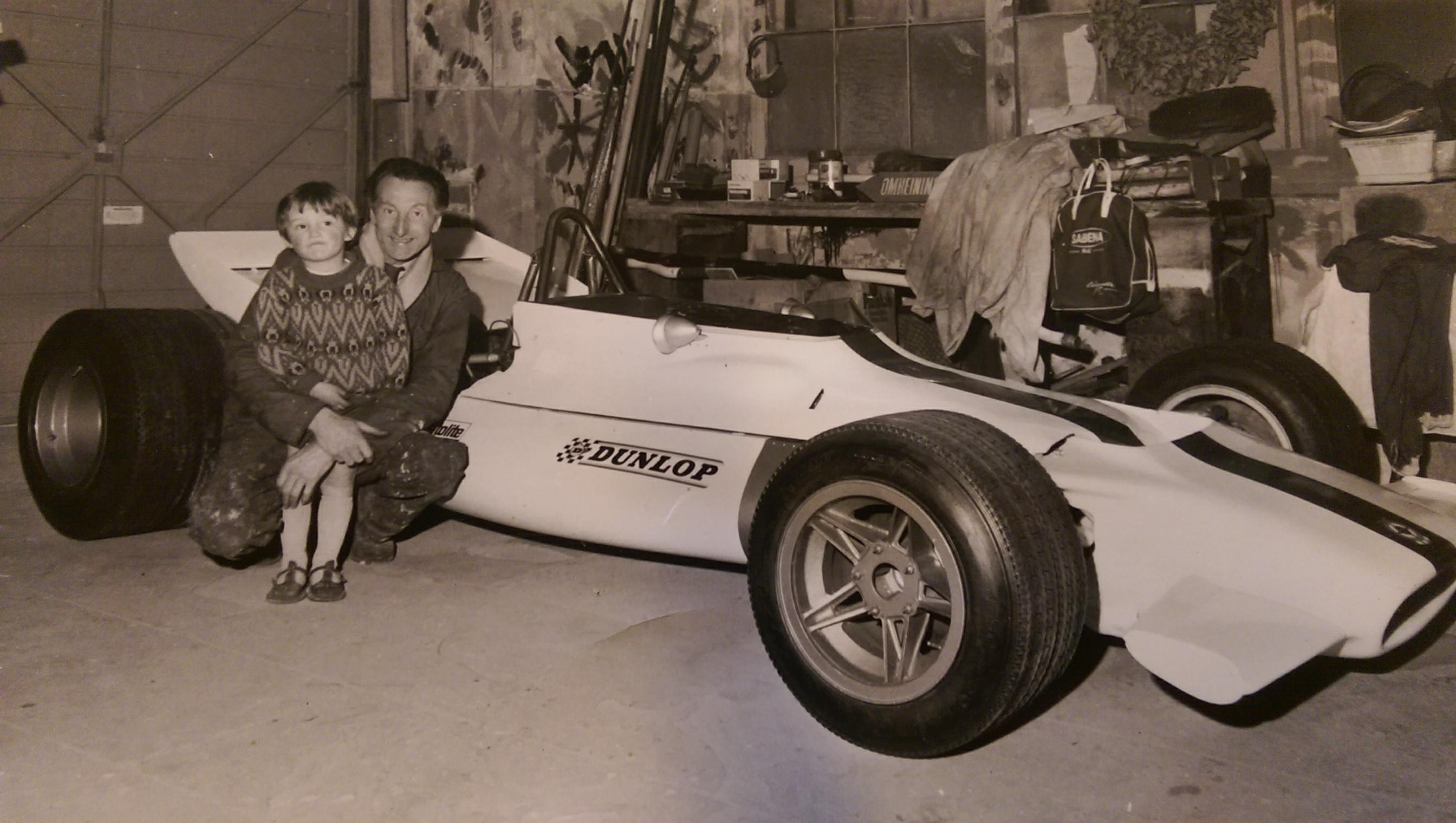
LIKE FATHER, LIKE SONS: As previously mentioned in earlier blogs my dad used to be a racing driver during the 1950s and ran his own team in the 1960s, travelling all over Europe in his trusty Volkswagon van with his two mechanics and driver. He didn’t have big sponsorship money behind him and most of it was done on a shoestring but he came back with lots of funny stories of their van breaking down or some rural ‘hotel’ that they had stayed in. From each country that he visited he always brought me back a doll dressed in the traditional costume of that country. There was quite a collection and I still have them; I used to put them on display in the Library when our house was open to the public.
Because of this background in motor racing, Gavin wanted to start kart racing when he was about 14 and kept pestering my dad to get him a kart. Dad promised that he would take him to the races but said he didn’t have time to do the preparations and so Gavin had to learn the hard way how to do it! He made lots of mistakes early on, including the engine nearly falling off in one race, but he got there in the end!
As he got better he moved into the seniors when he was 16 and started to win trophies – now he was getting serious! He raced at a place called Chasewater near Lichfield and finished second twice in the regional championships, regularly winning races against over 40 other drivers. The Welsh Championships found him coming in 5th. He also did some British championship races against 160 other drivers around the country, finishing in the top 30 but as he never had new tyres like most of the top drivers, it stopped him moving all the way up. The kart racing created a new interest for my dad and he was glad to get out of the house at weekends since splitting up with my mum. The atmosphere at home was always tense and if they accidentally bumped into each other in a corridor somewhere it would usually spark an argument. Kev and I would keep the ...
Hoar Cross Hall - Life below stairs #20
Viv Wilson | 03rd March 2019 |
Life at The Hall
HOAR CROSS HALL – LIFE BELOW STAIRS: This week I’ve done a history blog about the servants who lived at the Hall from the 1870s to the 1950s when the Hall became empty. They were an essential part of keeping a big house running but were often not appreciated by the aristocracy as they went about their day to day duties.
The life of a servant in Victorian times was a hard one. They had to rise at 5am to clean and light all the fires and dust and polish the floors, then do a day’s work, often not getting to bed much before midnight. No wonder they didn’t live to a great age in those days! By the end of the 19th century there were nearly one and a half million servants; most young girls went into domestic service when they left school. A large house with neither running water nor electricity would need a lot of help to keep things going. There was also the continuous cooking that needed to be done – for the family above stairs and the servants below. Everyone had meals at different times; the servants would obviously eat before or after they had served the family. The children and nursery staff would eat at around 5pm and then there were the afternoon teas and full English breakfasts! Everything had to be made from scratch of course so the cooks must have been cooking something or other from dawn until dusk. It must have been exhausting!
In the grounds there were around 20 gardeners and groundsmen who helped to keep the constant weeds down and tend to the rose bushes and hedges. This in itself would have been a full time job. The kitchen gardens and greenhouses would have provided a lot of the produce they ate as well as the pheasants and other game birds that were reared to be eaten. There was also a carp pool for their fish stock. In total there were about 50 servants employed by the Meynell family which included cooks, housemaids, chambermaids, lady’s maid, a governess, a nanny, a butler, footmen and a house-keeper among others. ...
Ghouls Galore! #19
Viv Wilson | 25th February 2019 |
Life at The Hall
GHOULS GALORE! One of the great things about living in a stately home is that you can have a wild party with the loudest of music – and no-one will hear it! I was now going out with Kev, whom I had met at college. Mum was a bit disappointed that my sensible boyfriend and I had parted company after 18 months of an on/off relationship but she accepted Kev into the fold and eventually met all the other members of the band. I think she wanted to put her mind at rest that they were a bunch of nice lads and not a drug crazed rock band eating bats! Which of course they were! No – I’m only kidding! After the awful split up at Christmas my parents were now living at each end of the house – what a carry on – some nights were spent with my mum and other nights with my dad as we tried to spread our affections and loyalties between them. But sometimes it was hard and I was glad to leave the oppressive atmosphere at home and stayed out after college as much as possible, spending time with Kev and the band.
Of course we all still liked to party like most young people and we often held parties in the west wing apartment at the Hall where we had got to know the latest residents there. A large crowd of people would meet up at the Meynell, the local pub in the village, and then we would all troop up to the Hall at closing time and sneak into the west wing via the basement door, which was the way in for the people who lived in the apartments. Up the spiral staircase we would all go and eventually we got to our destination, trying to beat the time switches which kept the lights on until we got there. We were always terrified that the lights would ‘time out’ before we got to the next one along the basement passageway and everyone would be making ghostly sounds and chasing each other into dark rooms off the main route. Good job no-one could hear us!
As everyone had heard about the ghost stories at the Hall, occasionally at these parties we would make an oui...
Becoming a rock chick #18
Viv Wilson | 18th February 2019 |
Life at The Hall
BECOMING A ROCK CHICK: My schooldays were coming to an end now and I absolutely couldn’t wait to leave. The school itself was an old Victorian grammar school in Uttoxeter which still had wooden desks with inkwells in them! Even the teachers wore their mortar boards and gowns just like the ones at Eton and Harrow – or the Beano! However, in the last two years there I had made a few good friends and we would go into town every lunch time to meet up with a group of guys that worked at the local J. C. Bamford firm. They were all into motor bikes and one of the first films I watched was ‘Easy Rider’. They also went to a lot of concerts to see live music, something which was totally new to me – I’d only seen dance bands at the New Year’s Eve Balls (yawn), even though I loved music. They opened my eyes (and ears) to a new type of music and always bought me a ticket for the next concert they went to but my mum would always say ‘No’, much to my disgust!
Eventually I started dating one of the lads who was actually 21 so a bit older than my 16 years but as he was quite sensible my mother approved of him and eventually let me go to concerts with him. Over the space of a few months we saw Jack the Lad, Dr Feelgood and The Who. The Who were incredible and Keith Moon even smashed his drum kit up as their grand finale! We also went to this really cool place called The Highwayman. Up to this point my only socialising was at the banquets with my parents watching my every move – now I could get out and away from them as my boyfriend had a car! I loved the dark, smoky atmosphere of this place with its loud rock music – we would go there in a convoy of minis and motor bikes, driving fast through the lanes. With places like this to go to, life could only get better – couldn’t it?
In September I started college in Burton-on-Trent – another big change for me. It was nice to be in an environment where I was treated a bit more like an adul...
Hysterical Productions #17
Viv Wilson | 10th February 2019 |
Life at The Hall
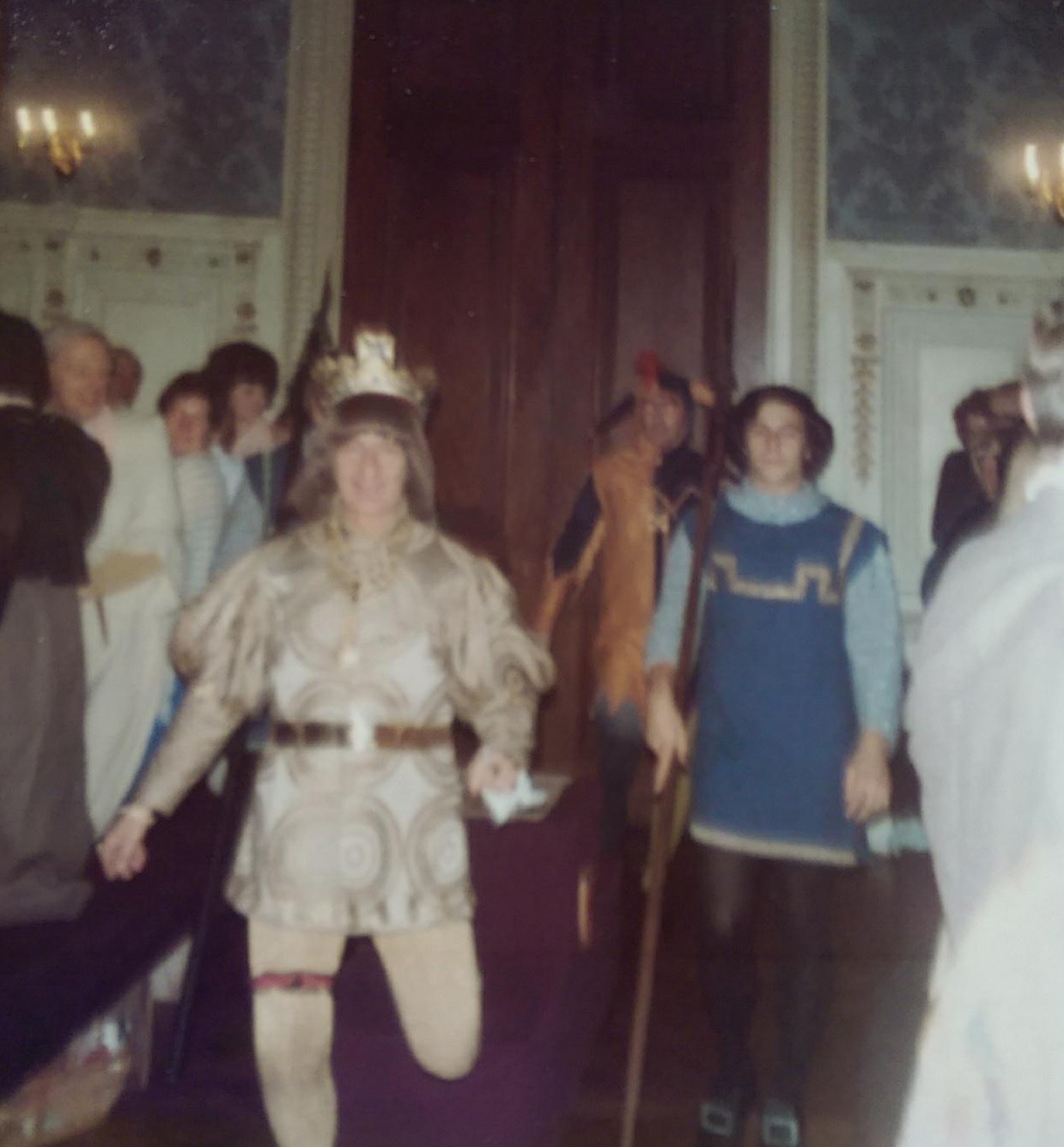
HYSTERICAL PRODUCTIONS: By the end of 1974 we had done about 40 banquets at the Hall and they were still going strong. Most of the original cast were still with us but we were on our second King now and also doing our own catering and bar, whereas when we first started, we had a catering firm in to do it all. Every weekend over 200 people came to sample our Noble Brose, Roast Lambe and Saracen’s Delight and sing along to ‘I’m Henry VIII’ whilst drinking beer, wine and mead. But it was a very adult environment for 15 year old girls to work in; a few of my school friends also worked at the banquets as wenches and we were constantly being chatted up by men who bought us drinks all evening. The cast were all married men but that didn’t seem to bother them and one or two of my friends were always sneaking off with one or other of them. But despite the seventies shenanigans the nights were always a good laugh and there were lots of funny things that happened. Myra (the fire-eater’s wife) and I always did the cloakroom and one time this lady took her coat off and as she did so her halter neck top came undone and she stood there in her bra and skirt for all to see!
Menu from a typical banquet
Once the banquets started we would join in with the singing, even standing behind the main act and pretending to be the backing group. Another member of the cast would wear a sombrero and shake maracas to a Latin song while we threw petals all over him – don’t ask me why! My dad didn’t seem to mind me doing all this but when my mum started singing along and dancing about with some of the guests, he wasn’t too happy and one time started shouting at her in front of everyone, which was a bit embarrassing! The next day, when cleaning up, we would find all sorts of things which people had left behind: scarves, perfume, money, cigarettes and even a set of false teeth left on the mantelpiece! I had found a little hidey hole in the wooden p...
Rags to Riches #16
Viv Wilson | 03rd February 2019 |
Life at The Hall
RAGS TO RICHES: My family originated from Derby and my parents were married there in July 1952. Mum was 19 and dad was 36 so quite a bit older. They both lived in Derby and were very arty; my dad went to the Derby Sketching Club in his free time and my mum attended art college. I’m not sure where they met but it was either at something art related or at a dance, as was usual in those days. My dad was a sculptor by trade; I think his interest was sparked by seeing all the beautiful alabaster in Italian churches during the war. After the war he set up his own business making alabaster lamps, bowls and candlesticks among other things (see header picture). He would go to the alabaster mines at Chellaston near Derby and bring back huge slabs which were then cut down to smaller sizes at his works in Crosby Street. He also owned a car as well as his own business so was quite the catch for my mum! After they married he built a little bungalow next to the works for them to live in, which is still there after all these years although the works have now been demolished.
For someone from his background, owning your own business was something of an achievement, being born the illegitimate son of a servant girl during the First World War. Even his birth is a story in itself as his mother worked at a nearby stately home as a servant and fell for the son of the house. My mum told me all about it years later – how they had fallen in love and were ‘walking out’ together even though it was forbidden in those days for the aristocracy to mix with the servants. However, the son caught tuberculosis and sadly died so my grandmother had to bring my dad up alone with help from her own parents, and without getting married (this is where my dad gets his double-barrel surname from). When my dad was about 4 years old my grandmother married a sailor (also called Bill) and they had a little girl, my Aunty Dorothy. He told me how his grandparents brought him up but how ...
Hoar Cross Hall - a bit of history #15
Viv Wilson | 26th January 2019 |
Life at The Hall
HOAR CROSS HALL - A BIT OF HISTORY : Hoar Cross was part of Needwood Forest, the 11th century lands of Henry de Ferrers. The land was passed down to Henry’s son and subsequent various people over the course of 500 years ending with the Webb family, around the 1730s, who bought the land and house known as the Manor of the Cross. This was quite a large house built on a hill near Yoxall (which is the village next to Hoar Cross). In 1740 the manor house was demolished and later the Hon. Charles Talbot bought the estate for £17,000. Eventually it was sold to Hugo Meynell, who already owned huge amounts of property all over the county.
This branch of the Meynell family originated from Leicestershire, namely Quorndon. In the 18th century Hugo Meynell had the title of ‘the father of fox-hunting’ as he had founded the Quorn Hunt in 1750 which became famous around the district. He bred his own strain of foxhounds and was the first person to study fox-hunting from a scientific point of view. He bought Quorn Hall in 1754 and built stables and kennels there, having 30 horses stabled at its height. In 1758 he became High Sheriff of Staffordshire and Member of Parliament for Lichfield. When his son, Hugo, died in 1800 he sold Quorn Hall to the Earl of Sefton and left to live in Derbyshire; although the family owned large amounts of property all over the Midlands in at least five shires.
The Meynell family claim to be descendants of the Norman baron, Hugo de Grand Mesnil, who came over with William the Conqueror. He is said to have died in Leicester in 1093 and his descendants settled in Derbyshire and Yorkshire. The sons of Hugo went off to the First Crusade and a representation of Hugo’s shield can be seen in one of the windows of Hoar Cross Church. Sir Hugo de Mesnil of Langley Mesnil represented his county under Edward III in five parliaments and thus started a long line of descent for the Mesnil family eventually changing the name to Meynell in ...
Skools out for summer! #14
Viv Wilson | 20th January 2019 |
Life at The Hall
SKOOLS OUT FOR SUMMER! When Hugo and Emily Meynell built Hoar Cross Hall it included a whole estate with it, namely kitchen gardens, greenhouses, stables, a farm and cottages. Old Hall (their original home) was also on the estate and was accessed via a private road, which ran from the main road. By the time the seventies came along the stable block and Old Hall were private houses and another part of Old Hall had been made into a children’s home. Emily Meynell had started this home in the Victorian days, calling it ‘The Home of the Good Shepherd’ but it was for boys only at that time. When we were there it was a mixed home and run by a husband and wife couple. They used to have fetes there in the summer and we would sometimes play there as they had lots of climbing frames and slides. At one of the fetes I was standing next to a crockery smashing stall and a piece of crockery cut my head open causing a huge gash. I ran all the way home screaming and crying with blood pouring down my face – no-one could stop me – and was taken to the nearby hospital to have it stitched up. I still have a huge scar from that cut but luckily no-one can see it!
The private road also joined up to our woods near the driveway and this is the road I walked along every day, up to the main road, to catch the bus to school. It was about half a mile but I hated walking through the woods, especially in the winter when the mornings were darker. I was growing up now and keeping different secrets from my parents than the previous escapades with my brothers, Gavin and Piers; I had started smoking! Going into Uttoxeter every day meant I could buy cigarettes for 30p a pack and smoke them on the way home. I often went up to our attic room to do my homework and write stories but also to have a crafty cigarette. I had also started to help myself to the odd bottle of mead from the banquet stock and kept it hidden in the attic – all typical teenage stuff!
One day, whilst wa...
More Tea Vicar? #13
Viv Wilson | 13th January 2019 |
Life at The Hall
MORE TEA VICAR? Life at Hoar Cross Hall was always busy but during the long summer holidays it was easy to get bored. As there was no public transport from Hoar Cross and no other families living nearby, we three children had to make our own entertainment and we were always having adventures and getting up to mischief – a bit like the Famous Five but without a dog! We would roam around the village or explore the basement. My dad was a hoarder and had kept all sorts of stuff over the years including gas masks and field phones from World War 2. The old Servants Hall was now my dad’s workshop and he spent a lot of time down there restoring antiques to sell. He had one of the field phones in his workshop and the other one was in our kitchen at the opposite end of the house. To operate them you would wind a handle on the side and a bell would ring on the phone at the other end. This was how my parents communicated especially when my mum wanted to tell my dad the dinner was ready! But we also had fun playing with them too and would often ring each other up or call my mum from the basement.
In the grounds was The Church of the Holy Angels. Mrs Meynell Ingram commissioned Bodley to commence work on the church in 1872 in memory of her husband who had died the previous year. It was generally regarded as one of the finest Victorian churches in the country and was known locally as the “Cathedral of the Midlands”. It was indeed a huge church (for a village) and always open to the public so we would sometimes go and have a look inside. On one occasion there was no-one around so Gavin and I lit all the candles in the church as we thought it looked really pretty and brightened the place up a bit. Oh dear – that was definitely not the right thing to do! A strongly worded letter was sent to my dad from the vicar telling him in no uncertain terms that he should be disciplining his children a lot better than he was. My dad hit the roof about this as ...
Mediaeval Mayhem! #12
Viv Wilson | 06th January 2019 |
Life at The Hall
MEDIAEVAL MAYHEM! It was the end of the summer season at the Hall in 1973 and rehearsals had started for the new venture of Mediaeval Banquets. All the cast would come round to the house each week for rehearsals and my mum and one or two other ladies were busy making the skirts and blouses for the wenches. My mum also made about 200 bibs which the guests were going to be wearing as eating five courses with a dagger can be quite messy! We had a King, a Jester, a Fire-eater, a Halberdier, an organist and various wenches and serving ladies. To launch the banquets my parents decided to hold a Press Reception about a month before and so we all gathered at the Hall one day in early September. There were lots of nibbles and quite a lot of champagne flowing and the newspapers and radio stations turned up to take lots of photos of us all in various poses and record interviews with the cast. It was a lovely, warm Autumn day and many of the photos were taken outdoors. I remember it turning out to be quite a party, even though it started at 9.30 in the morning; as the day wore on the organist started playing a few of the songs we would be doing at the banquets, and everyone started dancing and singing along – it was 4pm by the time we finished!
And so arrived the day of the first banquet. All the furniture and costumes from the Chinese Room and Ballroom had been removed and put into storage elsewhere in the house. A local carpenter had made long tables and benches to seat about 200 guests in the Ballroom, which was now known as the Banqueting Hall. We had employed caterers to do the food and the Chinese Room was used as a food preparation area next to the kitchen/café. A bar had been built in the middle of the Long Gallery. I had to sew numbers onto the coat hangers for the cloakroom – it took all day to do 100 hangers! The afternoon was spent laying the tables with mugs, daggers and serviettes. Before 7pm we went to get changed into our mediaev...
New Year jinks! #11
Viv Wilson | 30th December 2018 |
Life at The Hall
NEW YEAR JINKS! The New Year’s Eve Balls at the Hall were usually the highlight of the year. After twelve months of hard work, especially running the Mediaeval Banquets twice a week throughout the winter, we were always ready to see out the year in style with a big new year party. In those days it was always black tie for the men and long dresses for the ladies – usually around 500 people bought tickets for an evening of entertainment with a dance band, disco and a meal. At midnight a man dressed in traditional Scottish regalia, including a kilt and sporran, would pipe in the new year with his bagpipes. Down the Long Gallery he would slowly walk and into the Ballroom with his pipes droning on. When midnight arrived a net full of balloons was dropped onto all the guests from the ceiling, out came the party poppers and hats and everyone joined hands to sing ‘Auld Lang Syne’. Once all the traditional stuff was done the band started up again and we all did the Hokey Cokey, the Conga and other silly dances that only happen on New Year’s Eve! It was always great fun and I loved to dress up in my long dress.
My parents were having a trial separation around this time so my dad had to run the New Year’s Eve Ball on his own. I helped, as I had before, with the administration; posting out tickets and doing a bit of book-keeping. . The week prior to the Ball was spent moving furniture about and cleaning the house up after all the banquet tables and benches were removed. We usually used some of the banquet tables for people to sit at but this particular year my mum had stored them all away in the basement and put a lock on the door – these were her property now! This left my dad in a bit of a quandary about what to do for tables and after a lot of ranting he decided that he would have to hire some. As my dad was well known for being ‘careful’ with his money, he didn’t want to spend too much and hired the cheapest tables and chairs he cou...
Eat, drink and be merry! #10
Viv Wilson | 18th December 2018 |
Life at The Hall
EAT, DRINK AND BE MERRY! We were now in our third year at the Hall and our lives were always busy keeping on top of the weeds and general upkeep of the house. My dad expected us children to help as much as possible, which we hated, and much of our time was spent trying to hide from him to get out of doing the chores. But sometimes we didn’t mind and we happily pulled an old trolley into the woods every now and then to collect wood for the fires and sometimes as a family we would spend a day clearing parts of the woods and grounds. My mum had hired a lady from the village to help with the housework and we had also taken on a retired chap called Mr Hickman to do some gardening. My brother Gavin and I had found some huge barrels which had been left behind, possibly from the wine and beer cellars, and we had great fun learning to walk on them like they did in the circus! We also built a treehouse in one of the huge cedar trees which lined the path to the church. As per usual the three of us would hide up there and watch the visitors walk by on their way to the church, as this was also open to the public, then we would make animal noises or suchlike and throw pine cones into nearby bushes to make them jump! It was also a good place to hide from our dad!
The visitors continued to come on a regular basis and my parents tried to think up different ideas to attract them. At one end of the terrace, near to the old grass tennis courts (still with two foot high grass on them!) they made a playground, which was fun for us too. My dad continued to buy and sell antiques and was often at local auctions and occasionally made trips to London for sales at Sothebys or Christies auction houses. I once went with him and we spotted the actor Rodney Bewes from The Likely Lads TV programme – he pulled up next to Sothebys in his Rolls Royce!
My dad’s antique collection continued to grow as he couldn’t resist a bargain and he would often go to a sale to get one thin...
Motor Racing Days #9
Viv Wilson | 11th December 2018 |
Life at The Hall

MOTOR RACING DAYS: Although my blogs are about living at Hoar Cross Hall, I would just like to give a bit of background about my dad’s racing career in the years leading up to moving to the Hall as this will set the scene for later instalments of my story.
As mentioned in my first blog my dad used to be a racing driver but he actually started off racing motor cycles in the 1930s. Because of this he became a despatch rider during the Second World War and spent a lot of time in North Africa. After the war he started racing at nearby Donington Park and he raced there up to the beginning of the 1950s. After that he moved onto cars and drove a Cooper 500cc (which is the equivalent to Formula 3) along with the likes of Graham Hill and Sterling Moss. At the end of the 1950s he moved into Formula 2. Of course in those days it was completely different and much more ‘fun’, unlike more recent times where it has become a big money business. My dad didn’t have a rich family to support him or financial backers and probably did it all on a shoestring knowing him! He told me that he would always ‘take it easy’ and wasn’t too bothered about winning; drivers always got their ‘start’ money and he was satisfied with that. Accidents meant expensive repairs!
During the 1960s he raced Lotus Elites and I have never forgotten the time, aged just 5 years old, when he took me for a spin around Mallory Park. I remember it all very clearly, even now. He strapped me into the car, watched by the mechanics in the pits. My poor mother was worried to death and kept asking if I’d be alright! My dad was his usual self, flouting the rules, and continued to do a few laps around the circuit with me clinging petrified to the side of the seat - I have been terrified of speed ever since – can you imagine that happening today!
My dad would spend all his time tinkering about on the car once it was back home and then take it for a test drive around the village ...
Ghostbusters! #8
Viv Wilson | 03rd December 2018 |
Life at The Hall
GHOSTBUSTERS! People were always coming to the Hall to either hire the place or to have a look around. In 1973 a couple of professional ghost hunters asked to stay over one night to try and source the noises we heard in the attic. They brought cases full of recording equipment and set it all up in one of the attic rooms. Rather them than me I thought! Then I had a brilliant idea and went off to tell my brother Gavin all about it. As mentioned in my first blog the attic and basement had a row of bells which the family used to summon the servants. Before the two men arrived we spent all day trying out all the bells to see which ones were which. We found that one of the bell pulls in the Chase Dressing Room made one of the bells in the attic ring. We also found that the bell pull in the Morrey Bedroom rang a bell in the basement and a bell in the attic rang a bell in the Long Gallery! Gosh, these people must have been hearing bells ring all day long!
Anyhow, the plan was that we would ring one of the bells right outside their room and when next day they told us about the noises we would tell them that the room for that bell was no longer there – it had been knocked down when the old kitchens had been demolished! Then they would realise that it must have been a ghost ringing the bell and listen to their recordings quivering in fear! Gavin and I were so excited we could hardly sleep that night. Before we went to bed we rang the bell quite a few times until we were satisfied that they had heard it then went to sleep. Next day we went up to see them expecting to hear all about the ringing bells but all they said was that they’d seen a fox running across the fields but nothing else! What a disappointment – our trick had failed even though they had all that fancy equipment to record any eerie sounds - perhaps they just fell asleep and forgot to switch it on. We still thought it was a good trick to play though and had fun doing it!
Every now and ...
Calendar Girls and Front Covers #7
Viv Wilson | 25th November 2018 |
Life at The Hall
CALENDAR GIRLS AND FRONT COVERS: During our time at the Hall people would occasionally hire the house for a day’s filming or whatever. During the summer of 1973 a photographer from London hired the place for a day and he brought two models with him, one English and one German, and they were taking photos for a glamour calendar. We were told to keep right out of the way as they were taking photos in the gardens as well as the house. Naturally we wanted to see everything that was going on and my younger brother Gavin especially was very keen to watch – so much so that he found a pair of binoculars to follow all the proceedings! We managed to find all sorts of hiding places eventually settling in our attic room to keep tabs on everything. From the attic we could access the roof which was flat in places and meant that we could view all the grounds at the front of the house and the back. We often came up here to run around and explore and in the summer it was a great place to sun-bathe in private - not sure if our parents were aware that we did this!
The girls wore wigs and hair pieces and were being photographed in military jackets with swords and other accessories from the house. They posed either topless or scantily clad in the gardens and in front of a pair of wrought iron gates (by Robert Bakewell, renowned Derbyshire ironsmith) right at the bottom of the garden. These gates linked the Ha-Ha wall. This was a wall which bordered the grounds and had a small ditch on the other side – the reason was that the ditch stopped the deer from jumping the wall; for on the other side was a deer park, although the deer had long since run off and it was just a field when we were there. The Ha-Ha wall is a French invention, the idea being that the recessed design element gives an uninterrupted view of the landscape beyond, so a small wall above ground and the rest below ground next to the ditch which also stopped animals jumping into the garden. It was so...
Huntin', Shootin' and Fishin' #6
Viv Wilson | 20th November 2018 |
Life at The Hall
HUNTIN’, SHOOTIN’ AND FISHIN’ : Most stately homes have the obligatory hunting, shooting and fishing and ours was no exception during the Meynell family’s time there. We participated in none of these but the Meynell and South Staffs Hunt used to meet locally to do a spot of fox hunting. They would all gather at different venues around the area and enjoy a drink before setting off. One of their usual places was the Meynell Ingram Arms Public House at the bottom of the village. In February 1972 they had their ‘meet’ at the Hall. We, as the host family, got all dressed up to meet and greet them and local helpers served drinks, usually sherry. I had no interest in horses (unusual for a girl my age!) but the horses with their scarlet coated riders did look very impressive. The pack of hounds were everywhere, sniffing and panting and waiting for the off. My dad tried to make conversation with the Master of the Hounds by asking “So these are the dogs are they?” to which he received a curt “They’re hounds Mr Bickerton-Jones, not dogs!” Oh dear, mustn’t go upsetting the local gentry!
We hated the idea of a little fox being terrorised by a pack of dogs – sorry, hounds - and being ripped to pieces. Gavin and I were actually playing in the woods once when the hunt went by quite near to us – the fox literally ran right past us at such a speed it was incredible! We hoped he would get away and tried to think up all sorts of plans to divert the hunt away from the fox, finally pointing them in the wrong direction as they got near to us! Years later someone we knew rode in the hunt for the first time and came home with blood on her forehead – this was her initiation into joining up; the blood of the fox daubed all over her to show it was her first time! It seemed so barbaric.
The other ‘sport’ was shooting pheasants. This was something that was started by Henry VIII when guns became easier to handle back around 1500 and co...
Moving into the Manor #2
Viv Wilson | 21st October 2018 |
Life at The Hall
MOVING INTO THE MANOR: My parents took vacant possession of Hoar Cross Hall in 1970 and the whole process of moving house was done over the summer months. We lived about 20 miles away in an old vicarage with a large garden and lots of outbuildings. This house was about 200 years old and they say Bonnie Prince Charlie marched past it on his way to battle back in the day, for all you history buffs out there! Actually I love history and I think my interest was fuelled by living in these historic houses as a child. My dad used to be a racing driver in the 1950s and before that he did motorcycle racing, often at nearby Donington Park. During the 1960s he ran his own team, Shardlow Motor Racing, travelling all over Europe to race at all the famous circuits, so the outbuildings were always full of bits of racing cars and their engines! All this stuff had to be moved and my dad did most of it by travelling back and forth each day with vans and trailers full of the contents of our house and outbuildings – an enormous undertaking!
He knew some students and used to pick them up en route to help and they also stayed on to help tame the gardens which were very overgrown, the grass standing about 2 feet high. As I’m sure you can imagine, after nearly 20 years of neglect, the gardens were a sorry sight having once been very grand. Apparently, when the house was built, there were 20 gardners and the head gardner was pushed around in his wheelchair inspecting all the borders and paths; if he saw a weed it was quickly removed! I couldn’t imagine the grounds ever looking as good as they used to but we certainly had a good try and started attacking the hedges and grass as soon as we moved in. If anyone saw the Chester Zoo mini-series in 2014 about an ordinary family moving into a huge old house to start a zoo then that is exactly what it was like for us. When I saw that programme it brought back so many memories of those early months at the Hall when we were ...
Moving Into a Mansion #67
Viv Wilson | 15th July 1970 |
Life at The Hall
As summer turns to autumn my thoughts have gone back in time to 1970 when my family moved house at this time of the year - not to any old house, but to a 70-roomed stately home in Staffordshire! The whole process of moving was done over the summer months as we lived about 20 miles away in an old vicarage with a large garden and lots of outbuildings. This house was about 200 years old and they say Bonnie Prince Charlie marched past it on his way to battle back in the day, for all you history buffs out there! Actually I love history and I think my interest was fuelled by living in these historic houses as a child. My dad used to be a racing driver in the 1950s and before that he did motorcycle racing, often at nearby Donnington Park. During the 1960s he ran his own team, Shardlow Motor Racing, travelling all over Europe to race at all the famous circuits, so the outbuildings were always full of bits of racing cars and engines!
All this stuff had to be moved and my dad did most of it by travelling back and forth each day with vans and trailers full of the contents of our house and outbuildings – an enormous undertaking! He knew some students and used to pick them up en route to help and they also stayed on to help tame the gardens which were very overgrown, the grass standing about 2 feet high. As I’m sure you can imagine, after 20 years of neglect, the gardens were a sorry sight having once been very grand.
The neglected gardens
Apparently, when the house was built, there were 20 gardeners and the head gardener was pushed around in his wheelchair inspecting all the borders and paths; if he saw a weed it was quickly removed! I couldn’t imagine the grounds ever looking as good as they used to but we certainly had a good try and started attacking the hedges and grass as soon as we moved in. If anyone saw the Chester Zoo mini-series in 2014 about an ordinary family moving into a huge old house to start a zoo then that is exactly what it was like...